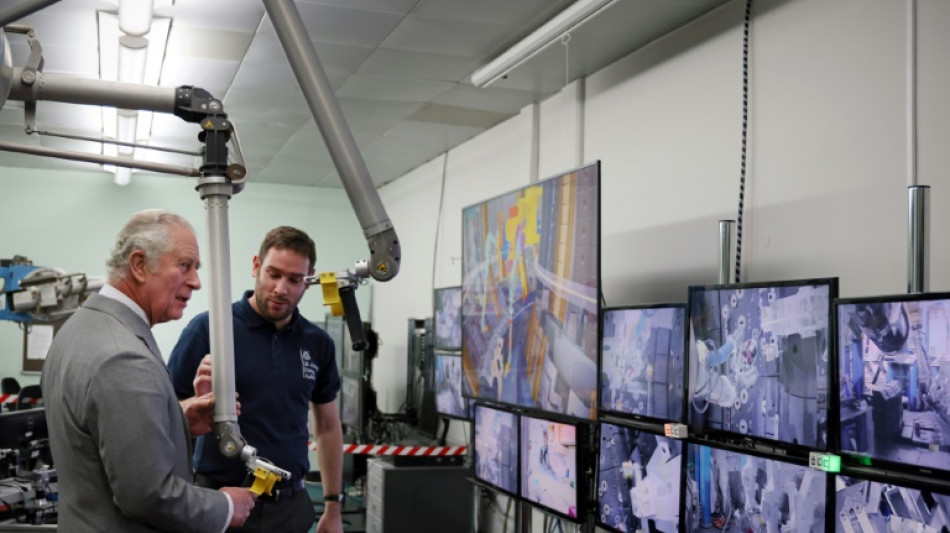
Climate hope as scientists in UK set fusion record / Photo: ©

 Germany's Merz vows to stay course despite new vote losses

 Man City outgun Sunderland despite Brobbey hat-trick, Man Utd rescue Fulham draw

 Mourinho blames ref committee for Real Madrid derby defeat

 Maresca craves a 1-0 win after eight-goal Man City thriller
 Atletico Madrid beat Real Madrid in tense derby clash

 Reusser retains world time-trial title

 Man City outgun Sunderland despite Brobbey hat-trick, Liverpool win at Bournemouth

 Top US, Chinese economic officials meet ahead of Trump-Xi summit

 Erdogan's LGBTQ crackdown 'first step of election campaign': activist

 Mass drone barrage on Moscow kills two

 82-year-old dies after beach fight in Greece over sun lounger

 US warns of rapid escalation in Mideast war

 Iran 'put hearts on the court' to win Asian Games basketball bronze
 School girl Yu helps China dominate in Asian Games swimming openers

 Myanmar win first Asian Games teqball gold as Spain great Puyol watches

 China's 13-year-old Yu scorches to first major gold at Asian Games

 Russians vote on last day of parliamentary elections

 Hong Kong pays final respects to former city leader Tung

 Typhoon put people off Asian Games opening ceremony, official says
 China's 13-year-old Yu cruises as Asian Games swimming begins

 AI 'warning shots' focus Beijing on national security risks

 Philippine tribe in limbo over US-led tech hub

 Leo XIV, first US pope transcends his restrained style

 Singer Ed Sheeran says Gaza situation 'unjustifiable' following controversy

 In 'Tenzing', a Sherpa mountaineer gets his due

Scientists in Britain announced Wednesday they had smashed a previous record for generating fusion energy, hailing it as a "milestone" on the path towards cheap, clean power and a cooler planet.
Nuclear fusion is the same process that the sun uses to generate heat. Proponents believe it could one day help address climate change by providing an abundant, safe and green source of energy.
A team at the Joint European Torus (JET) facility near Oxford in central England generated 59 megajoules of energy for five seconds during an experiment in December, more than doubling a 1997 record, the UK Atomic Energy Authority said.
That is about the power needed to power 35,000 homes for the same period of time, five seconds, said JET's head of operations Joe Milnes.
The results "are the clearest demonstration worldwide of the potential for fusion energy to deliver safe and sustainable low-carbon energy", the UKAEA said.
The donut-shaped machine used for the experiments is called a tokamak, and the JET site is the largest operational one in the world.
Inside, just 0.1 milligrammes each of deuterium and tritium -- both are isotopes of hydrogen, with deuterium also called heavy hydrogen -- is heated to temperatures 10 times hotter than the centre of the sun to create plasma.
This is held in place using magnets as it spins around, fuses and releases tremendous energy as heat.
Fusion is inherently safe in that it cannot start a run-away process.
Deuterium is freely available in seawater, while tritium can be harvested as a byproduct of nuclear fission.
Pound for pound (gram for gram) it releases nearly four million times more energy than burning coal, oil or gas, and the only waste product is helium.
- Reagan-Gorbachev fusion -
The results announced Wednesday demonstrated the ability to create fusion for five seconds, as longer than that would cause JET's copper wire magnets to overheat.
A larger and more advanced version of JET is currently being built in southern France, called ITER, where the Oxford data will prove vital when the site comes online, possibly as soon as 2025.
ITER will be equipped with superconductor electromagnets which will allow the process to continue for longer, hopefully longer than 300 seconds.
About 350 scientists from EU countries plus Britain, Switzerland and Ukraine -- and more from around the globe -- participate in JET experiments each year.
JET will soon pass the fusion baton to ITER, which is around 80 percent completed, said Milnes.
"If that's successful, as we now think it will be given the results we've had on JET, we can develop power plant designs in parallel... we're probably halfway there" to viable fusion, he said.
If all goes well at ITER, a prototype fusion power plant could be ready by 2050.
International cooperation on fusion energy has historically been close because, unlike the nuclear fission used in atomic power plants, the technology cannot be weaponised.
The France-based megaproject also involves China, the EU, India, Japan, South Korea, Russia and the US.
Tim Luce, head of science and operation at ITER, said the project emerged in the 1980s from talks on nuclear disarmament between US president Ronald Reagan and Soviet leader Mikhail Gorbachev.
"And the one thing they did agree on was using fusion as a cooperation," he told AFP.
"Somehow fusion has had the scientific panache to bring together disparate governmental entities and actually choose to work together on it."
Despite dozens of tokamaks being built since they were first invented in Soviet Russia in the 1950s, none has yet managed to produce more energy than is put in.
Ian Fells, emeritus professor of energy conversion at the University of Newcastle, said Wednesday's result was a "landmark in fusion research".
"Now it is up to the engineers to translate this into carbon-free electricity and mitigate the problem of climate change," added Fells, who is not involved in the project.
F.Müller--BTB