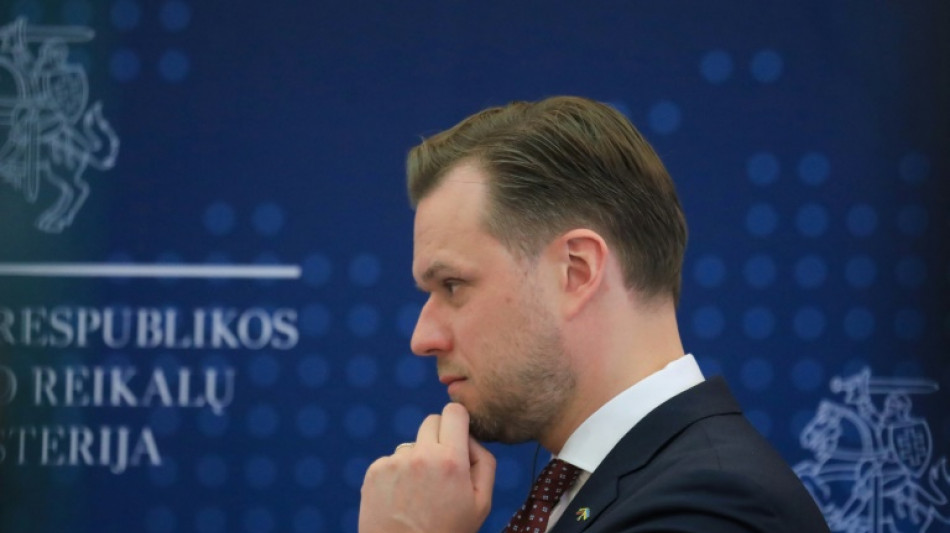
Lithuanians slam 'one-sided' reax to Gorbachev death / Photo: © AFP

 US Mortgage Rate Falls for Fourth Week but Remains Above 7%

 13 Native American-Owned Restaurants in Arizona to Experience Indigenous Culinary Traditions
 Best Digital Photo Frames 2026: Aura, Skylight, and Amazon Compared

 UK Economy Grows 0.7% in Third Quarter as Services Lead Expansion

 India's Retail Inflation Reaches 6.09% as Food Prices Accelerate

 China's October Activity Data Reveal a Weak Start to the Fourth Quarter
 South Korea Launches Probe into NewJeans Contract Controversy

 Helen Rees Reflects on Four Decades of South Africa's HIV Journey
 Foreign Investors Return to Indian Equities with ₹84,290 Crore Inflow
 Interactive Map Reveals 1,000 Unsolved Murders Across UK
For many in the West, Mikhail Gorbachev, the last leader of the Soviet Union who has died at the age of 91, is worth applauding for his role in ending the Cold War.
But in some countries that spent years under Soviet rule, he is nothing more than another Russian imperialist who used force to deter nations seeking independence in the early 1990s.
Lithuanian psychologist Robertas Povilaitis, who lost his father during Moscow's crackdown on the Baltic state's independence drive, said Gorbachev's glorification "grates on my ears".
"To me, this seems one-sided and inadequate," the 45-year-old told AFP on Wednesday, a day after Gorbachev's death.
Povilaitis considers Gorbachev personally responsible for the 1991 deadly Soviet assault that killed his father and 13 other civilians and wounded more than 700 others.
In 2019, a Lithuanian court convicted dozens of Soviet-era officials of war crimes but the country's prosecutors have refused to investigate Gorbachev, who was in power at the time.
The refusal has angered those seeking justice for the crackdown and this year Povilaitis and a few others initiated a civil case against Gorbachev.
The civil lawsuit states that Gorbachev had control of the Soviet military, but failed to stop the "international crime" against Lithuanians seeking freedom after 50 years of Soviet occupation.
"He participated in very serious crimes, carried them out, organised them, gave orders," Povilaitis said.
- 'He was a criminal' -
He expressed disappointment in the response of some politicians to his death, including European Commission chief Ursula von der Leyen's praise of Gorbachev as a "trusted and respected leader".
"Even though Lithuania, Latvia and Estonia are full-fledged members of the EU, she doesn't have enough empathy or understanding that this person participated in organising the slaughter of current EU citizens," Povilaitis said.
Lithuanian Defence Minister Arvydas Anusauskas for his part condemned Gorbachev.
"He was a criminal who ordered a ruthless crackdown on peaceful protests in Vilnius, Tbilisi, Almaty, Baku and other cities. There was no remorse," Arvydas Anusauskas wrote on Facebook.
"Such is the memory we are left with, even though we should never speak ill of the dead -- but not this time," he added.
Foreign Minister Gabrielius Landsbergis said "Lithuanians will not glorify Gorbachev".
"We will never forget the simple fact that his army murdered civilians to prolong his regime's occupation of our country," he said on Twitter.
"His soldiers fired on our unarmed protestors and crushed them under his tanks. That is how we will remember him."
E.Schubert--BTB