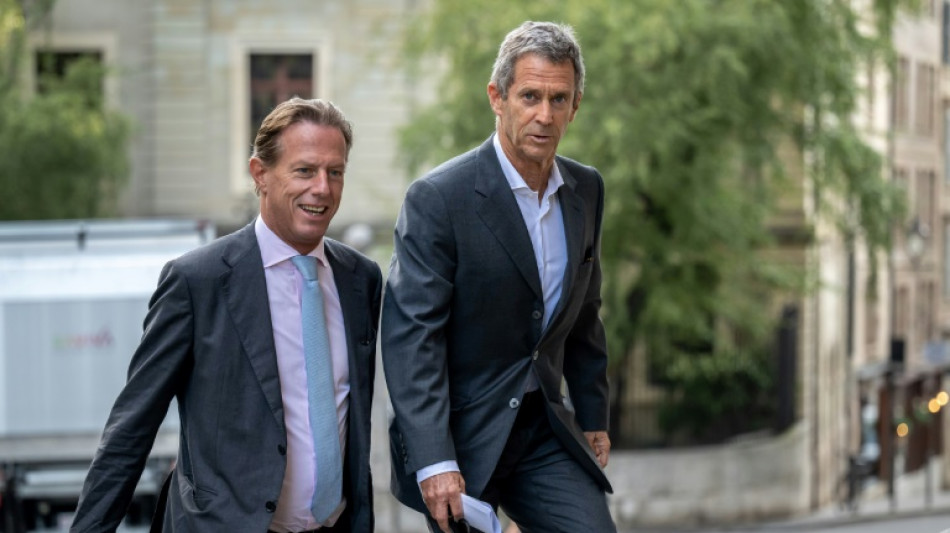
'I never corrupted anyone,' diamond magnate tells Swiss court / Photo: © AFP

 US Mortgage Rate Falls for Fourth Week but Remains Above 7%

 13 Native American-Owned Restaurants in Arizona to Experience Indigenous Culinary Traditions

 Best Digital Photo Frames 2026: Aura, Skylight, and Amazon Compared

 UK Economy Grows 0.7% in Third Quarter as Services Lead Expansion

 India's Retail Inflation Reaches 6.09% as Food Prices Accelerate

 China's October Activity Data Reveal a Weak Start to the Fourth Quarter

 South Korea Launches Probe into NewJeans Contract Controversy

 Helen Rees Reflects on Four Decades of South Africa's HIV Journey

 Foreign Investors Return to Indian Equities with ₹84,290 Crore Inflow

 Interactive Map Reveals 1,000 Unsolved Murders Across UK
A French-Israeli businessman and diamond magnate insisted Wednesday he had never bribed anyone, as he sought to overturn his conviction in a vast corruption case involving mining rights in West Africa.
Beny Steinmetz, 66, told the Geneva appeals court he was innocent and "had done nothing wrong".
"I never corrupted anyone."
Steinmetz was found guilty in January 2021 of setting up a complex financial web to pay bribes to ensure his company could obtain permits in Guinea's southeastern Simandou region, which is estimated to contain the world's biggest untapped iron ore deposits.
He was sentenced by a Geneva court in 2021 to five years in prison and ordered to pay 50 million Swiss francs ($52 million) in compensation.
Wearing a grey suit and white shirt with his collar unbuttoned, Steinmetz told court president Catherine Gavin he was proud of the massive mining project Beny Steinmetz Group Resources, BSGR, had set up in Guinea, claiming it would have been hugely beneficial for the country.
"I am fully convinced that BSGR never crossed the red line," and the company had become victim to a local power struggle and corruption, he said.
Steinmetz, who maintained his innocence throughout the original trial, changed his lawyers and beefed up his communications team for the appeal.
- 'Pact of corruption' -
During the first trial, prosecutors convinced the court Steinmetz and two associates had bribed a wife of then Guinean president Lansana Conte and others in order to win lucrative mining rights in Simandou.
The prosecutors said Steinmetz obtained the rights shortly before Conte died in 2008 after about $10 million was paid in bribes over a number of years.
Conte's military dictatorship ordered global mining giant Rio Tinto to relinquish two concessions that were subsequently obtained by BSGR against an investment of $160 million.
Just 18 months later, BSGR sold 51 percent of its stake in the concession to Brazilian mining giant Vale for $2.5 billion.
But in 2013, Guinea's first democratically-elected president Alpha Conde launched a review of permits allotted under Conte and stripped the VBG consortium formed by BSGR and Vale of its permit.
To secure the initial deal, prosecutors claimed Steinmetz and representatives in Guinea entered a "pact of corruption" with Conte and his fourth wife Mamadie Toure.
- 'Local tragedy' -
Toure, who has admitted to having received payments, has protected status in the United States as a state witness.
A request from Steinmetz's lawyer Daniel Kinzer for her written testimony to be deemed inadmissible due to lacking insight into the "opaque" US deal, was rejected by the court.
The defence meanwhile maintains there was nothing inappropriate about how BSGR obtained the permits, and that Rio Tinto lost half the concessions for failing to develop them.
Steinmetz rejected suggestions his company was seeking to cash in and make "a quick exit", saying the BSGR and Vale consortium had planned to stay for the long term.
"This was not a 20-year deal, but a 50-year deal," he told the court, calling it "Africa's largest mining project" that would have included building a railway system.
It would have tripled Guinea's gross domestic product, he said.
The abandonment of the project was "a local tragedy, created by local corruption," according to Steinmetz, indicating Conde's decision to strip VBG of the rights was linked to promises made to secure his election.
I.Meyer--BTB