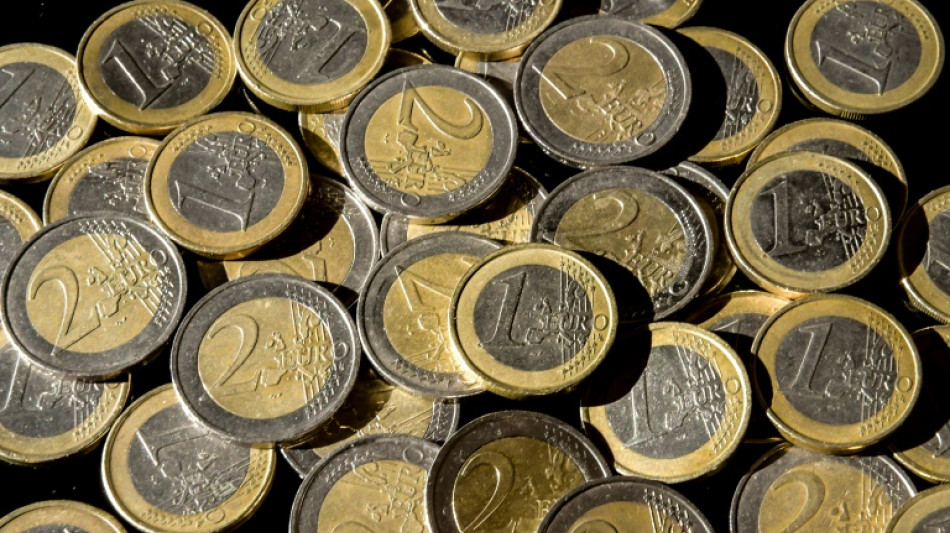
Eurozone inflation jumps to new record 9.1% / Photo: © AFP/File

 Brazil Faces Debt and Inflation Test as Lula Prepares Fourth Term

 Canada Signals Openness to Chinese Automakers if US Trade Talks Fail

 US Mortgage Rate Falls for Fourth Week but Remains Above 7%

 13 Native American-Owned Restaurants in Arizona to Experience Indigenous Culinary Traditions

 Best Digital Photo Frames 2026: Aura, Skylight, and Amazon Compared

 UK Economy Grows 0.7% in Third Quarter as Services Lead Expansion

 India's Retail Inflation Reaches 6.09% as Food Prices Accelerate

 China's October Activity Data Reveal a Weak Start to the Fourth Quarter

 South Korea Launches Probe into NewJeans Contract Controversy

 Helen Rees Reflects on Four Decades of South Africa's HIV Journey

 Foreign Investors Return to Indian Equities with ₹84,290 Crore Inflow

 Interactive Map Reveals 1,000 Unsolved Murders Across UK
The eurozone inflation rate hit a new record in August, official data showed on Wednesday, increasing pressure on the European Central Bank to hike rates to tame Ukraine war-fuelled prices.
Driven by soaring energy prices caused by Russia's invasion in Ukraine, the yearly inflation rate in the 19-country single currency area reached 9.1 percent, its highest since records began, according to Eurostat.
Consumer prices had accelerated to 8.9 percent in July.
The president of Germany's powerful federal central bank, Joachim Nagel, immediately declared that the ECB should plan for a "strong rise in interest rates for September".
"Otherwise, inflation expectations could become permanently entrenched above our target of two percent," he warned.
The headline rate has been rising since November 2021, amid global supply chain stresses. War erupted in Ukraine in February and the European summer was marked by a drought that helped force up food prices.
The ECB is expected to raise interest rates at its next meeting on September 8, after first increasing them in July for the first time in a decade. Rates had been kept low as Europe emerged from its coronavirus slump.
France, which has moved to cap energy prices saw the lowest rate within the eurozone, with 6.5 percent in August, according to Eurostat.
But powerhouse Germany was high on 8.8 percent, Italy saw nine percent and Spain 10.3.
Russia's neighbours on the Baltic, Estonia, Lithuania and Latvia suffered the most, at 25.2 percent, 21.1 and 20.8 respectively.
Economist Jack Allen-Reynolds of Capital Economics warned that the eurozone inflation rate could hit 10 percent by the end of the year, even if the bank hikes rates.
"The balance of probabilities is shifting towards a 75 basis points hike next week," he said. The ECB raised rates by 50 basis points in July, from a zero interest rate to 0.5 percent.
- Slam on the brakes? -
For Bert Colijn, a senior economist at the bank ING, the increase in the price of goods contained within the broader inflation rate should worry observers as much as the hikes in energy.
"The increase from 4.5 percent to 5 percent was much larger than expected and fuels worries about second-round effects from the input cost shock lasting longer," he said.
But he noted that wage growth data for the second quarter of the year -- salaries rose only 2.1 percent -- suggested that Europe was tightening its belt already.
"As the economy is slowing rapidly –- and perhaps already contracting at this point -- the question is how much the ECB needs to slam the brakes," he said.
"Another hike of at least 50 basis points in September seems to be a done deal, with the hawks pushing for 75 basis points,2 he said.
"The big question is how the ECB will respond after this, if indeed signs of economic distress become more apparent, and inflation remains highly driven by supply-side factors."
Among the items in the eurozone inflation basket, energy prices once again experienced the highest annual increase in August, although they slowed slightly to 38.3 percent compared to 39.6 in July.
Food prices including alcohol and tobacco increased by 10.6 percent, from 9.8 in July. Industrial goods and services increased by five percent and 3.8 respectively, also accelerating compared to the previous months.
C.Kovalenko--BTB