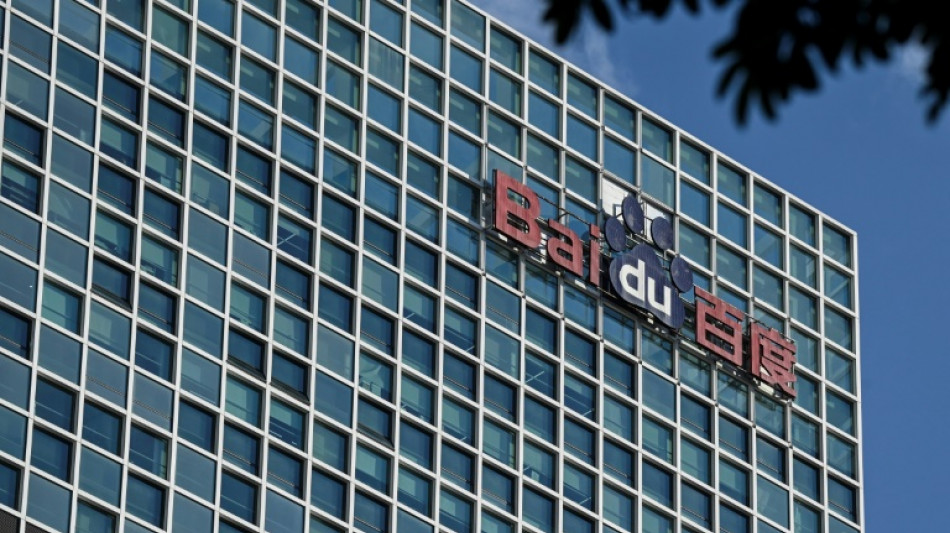
Baidu reports 5% year-on-year decrease in Q2 revenue / Photo: © AFP

 Brazil Faces Debt and Inflation Test as Lula Prepares Fourth Term

 Canada Signals Openness to Chinese Automakers if US Trade Talks Fail

 US Mortgage Rate Falls for Fourth Week but Remains Above 7%

 13 Native American-Owned Restaurants in Arizona to Experience Indigenous Culinary Traditions

 Best Digital Photo Frames 2026: Aura, Skylight, and Amazon Compared

 UK Economy Grows 0.7% in Third Quarter as Services Lead Expansion

 India's Retail Inflation Reaches 6.09% as Food Prices Accelerate

 China's October Activity Data Reveal a Weak Start to the Fourth Quarter

 South Korea Launches Probe into NewJeans Contract Controversy

 Helen Rees Reflects on Four Decades of South Africa's HIV Journey

 Foreign Investors Return to Indian Equities with ₹84,290 Crore Inflow

 Interactive Map Reveals 1,000 Unsolved Murders Across UK
Chinese internet giant Baidu Inc. on Tuesday announced second-quarter revenues of 29.6 billion yuan ($4.3 billion), down five percent from last year after the company faced a challenging economic climate and tight controls on China's once-thriving tech sector.
Other Chinese tech giants, including Tencent and e-commerce behemoth JD.com, had also reported disappointing results in recent weeks.
China's major tech companies have been grappling with economic uncertainty, Covid-19 restrictions that have kept consumers jittery, and heightened scrutiny from regulators in recent months.
Baidu, which operates China's most widely used search engine, saw revenues decrease but posted a net profit of 3.6 billion yuan ($522 million), buoyed by a 31 percent year-on-year growth in its cloud computing business.
"Despite a challenging macro environment caused by Covid-19, Baidu Core generated RMB23.2 billion in revenues in the second quarter," CEO Robin Li was quoted as saying in an official press release.
"Going forward, we remain committed to quality revenue growth and sustainable business models."
Last year, the Beijing-based group reported second-quarter revenue of 31.4 billion yuan ($4.5 billion), up 20 percent year-on-year at the time.
Baidu has heavily diversified into artificial intelligence, cloud computing and autonomous driving technologies in recent years, as advertising revenue remains sluggish.
Li claimed Apollo Go, its autonomous driving arm, further consolidated its position as a leading intelligent ride-hailing provider, with fully driverless taxi services launched in the cities of Chongqing and Wuhan.
Beijing regulators' widespread crackdown on the tech sector, beginning in late 2020, saw record fines, cancelled IPOs and lengthy investigations targeting top players, which decimated revenues and put further pressure on the stalling economy.
The campaign is intended to reduce monopolistic practices and promote competition between internet platforms.
Last week, Alibaba rival JD.com reported its slowest revenue growth to date in the second quarter, after tech giant Tencent reported its first drop in quarterly revenue since going public.
Didi Chuxing, China's answer to Uber, was also fined the equivalent of $1.2 billion last month after a year-long cybersecurity investigation.
Many parts of China have faced lockdowns and other Covid restrictions in recent months, disrupting business activity and adding to consumer worries as Beijing tries to stamp out the Omicron variant's spread under its strict zero-Covid policy.
L.Janezki--BTB