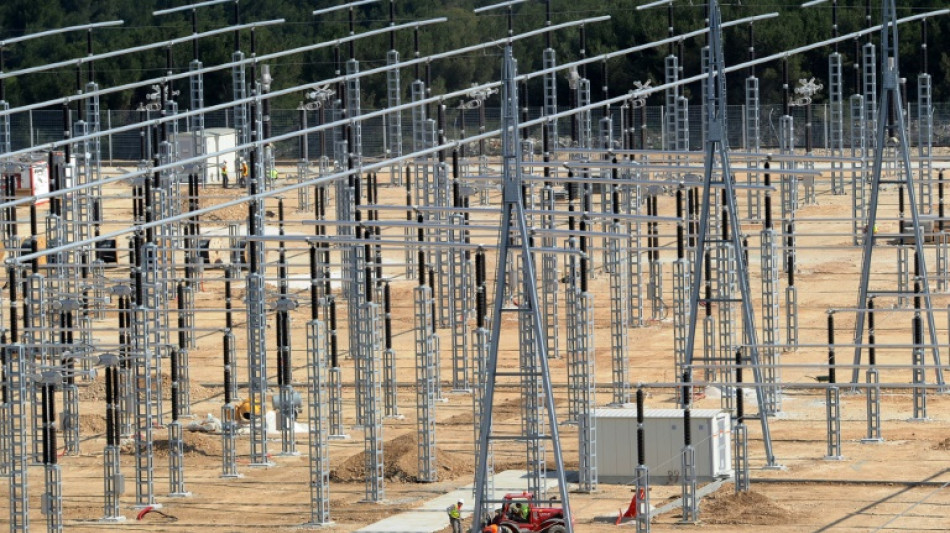
EU plans emergency action to halt energy price rise / Photo: © AFP/File

 Brazil Faces Debt and Inflation Test as Lula Prepares Fourth Term

 Canada Signals Openness to Chinese Automakers if US Trade Talks Fail

 US Mortgage Rate Falls for Fourth Week but Remains Above 7%

 13 Native American-Owned Restaurants in Arizona to Experience Indigenous Culinary Traditions
 Best Digital Photo Frames 2026: Aura, Skylight, and Amazon Compared
 UK Economy Grows 0.7% in Third Quarter as Services Lead Expansion

 India's Retail Inflation Reaches 6.09% as Food Prices Accelerate
 China's October Activity Data Reveal a Weak Start to the Fourth Quarter
 South Korea Launches Probe into NewJeans Contract Controversy

 Helen Rees Reflects on Four Decades of South Africa's HIV Journey

 Foreign Investors Return to Indian Equities with ₹84,290 Crore Inflow

 Interactive Map Reveals 1,000 Unsolved Murders Across UK
The European Union is preparing to take emergency action to reform the electricity market and get a grip on energy prices that have soared since Russia invaded Ukraine, senior officials said Monday.
Energy ministers from EU member states will hold urgent talks in Brussels on September 9.
High gas prices have been followed by disruptions in the nuclear and hydroelectric sectors amid a heatwave blamed on climate change -- threatening businesses and households with massive bills.
"The skyrocketing electricity prices are now exposing the limitations of our current electricity market design," EU Commission president Ursula von der Leyen told a forum in Bled, Slovenia.
"It was developed for different circumstances. That's why we are now working on an emergency intervention and a structural reform of the electricity market."
Separately, Germany's Chancellor Olaf Scholz also called for action.
Speaking at a press conference after talks with Czech Prime Minister Petr Fiala, Scholz said that "we are in complete agreement that rapid action has to be taken" to reform the market.
"My impression is, I think our common impression is, that this will now succeed more quickly across Europe than under other framework conditions," he said.
The Czech Republic holds the rotating presidency of the European Union, and it was Czech Industry and Trade Minister Jozef Sikela who announced next week's emergency talks.
"We must fix the energy market. Solution on the EU level is by far the best we have," he said on Twitter.
The European Commission has yet to publish a detailed plan for market reform, but some member states have been pushing for a temporary cap on wholesale gas prices.
EU officials are also considering measures to split electricity price setting from the gas price and take into account other energy sources.
Some member states have launched price reduction measures of their own, but Brussels believes EU capitals working together will be more effective.
The move comes as the 27-nation bloc is trying to shed dependence on supplies of Russian oil and gas following Moscow's assault on Ukraine.
Reduced supplies and anxiety over the future have sparked rocket growth in energy prices across Europe.
- Private pools -
On Friday, Germany and France reported record electricity prices, with the German year-ahead contract jumping to 995 euros ($995) per megawatt hours while the French equivalent soared past 1,100 euros -- compared to 85 euros in both countries last year.
Nicolas Berghmans, an expert at the Institute for Sustainable Development and International Relations in Paris, told AFP that Brussels had already been working on a plan to reform the electricity market before the crisis hit.
"A year ago there were only a few countries in favour of these measures -- and some that were very sceptical of a change in the architecture of the electricity market. That's changing. Today we have proposals that are beginning to be on the table," he said.
Germany, heavily dependent on Russian gas, has notably put aside its scepticism.
The European Commission is planning to cut EU dependency on Russian gas by two-thirds this year and end its reliance on Russian supplies of the fuel before 2030.
The EU has targeted the Russian energy sector in its sanctions, banning coal imports from Russia.
Its plan to cut gas consumption across the bloc by 15 percent to cope with the energy price crisis came into effect earlier this month.
The aim is for the EU to be able to bolster its reserves of gas in time for what is likely to be a very tough winter.
Some EU nations are launching power saving drives, including measures to cut back on air conditioning, switch off illuminated advertising screens at night and banning the heating of private swimming pools.
Germany said on Sunday is was replenishing its gas stocks more quickly than expected and should meet an October target early.
Some member countries, however, have had carve-outs from strictly following the rules as they are too dependent on Russian supplies.
Y.Bouchard--BTB