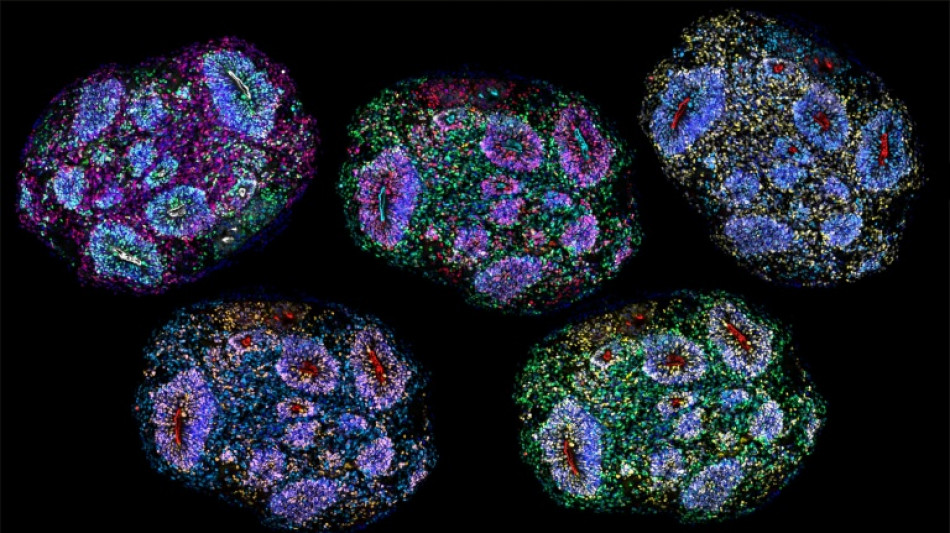
Oldest human brain cells grown in lab 'recorded passage of time' / Photo: © Springer Nature/AFP

 Top-ranked Rybakina to face Fernandez for Ningbo title

 Late India charge seals thrilling second T20 win over New Zealand

 Seen and heard at France protests

 White says Fiji can have 'massive' World Cup after beating Japan

 England thrash France 82-0 to keep Rugby League World Cup hopes alive

 Security high as France braces for new protests

 White makes winning start as Fiji edge Eddie Jones's Japan

 Lula, Bolsonaro strike calmer tone in final Brazil election debate

 'How is it possible?': Students protest Indonesian haze

 Israel launches major West Bank operation after soldiers killed

 Typhoon Champi knocks out power to thousands in Taiwan

 As Israeli election nears, campaign turns ugly

 Oscar hopeful 'La Bola Negra' offers lessons about communicating, directors say

 Trapped: Soaring fuel costs hurt Maine lobster industry before midterms

 Marc Marquez beats brother Alex to Australian MotoGP pole

 Ebola vaccine trial begins in DR Congo

 Travelling man Wade equals Prem try record

 Rescuers search for seven people in Nairobi building collapse

 Sacha Baron Cohen revives the 'problematic dinosaur' Ali G in new film

 New race in Barcelona tops 17-event '27 IndyCar season

 Neymar backs Flavio Bolsonaro in Brazil election

 Melania Trump says she brokered truce in war-torn Ukrainian city

 Leclerc tops times for Ferrari in opening practice for US Grand Prix

 Bayern Munich coach Kompany in hospital after collapsing

 Signs point to renewed major US military ops against Iran

Peppercorn-sized clumps of human brain cells grown in a lab for a record seven years aged similarly to those inside our heads, suggesting they "recorded the passage of time," scientists said Wednesday.
These tiny clumps called organoids are grown from stem cells by scientists around the world in the hopes of uncovering the mysteries of our brain -- and to test new medicine without having to use animals such as mice.
Normally these organoids live for a few months, meaning they can only offer a window into the earliest stages of human brains, which take nearly 20 years to fully develop.
So a US-led team of researchers grew some for around seven years, making them the "oldest ever", Paola Arlotta, the senior author of a new study describing the experiment, told AFP.
They discovered that the brain organoids continued to change and mature over the years, despite never having been inside an embryo, let alone a body.
"The brain can continue to develop outside the context of a person for this unprecedented amount of time," explained Arlotta, a Harvard University professor.
The scientists hope this will help shed light on how a range of disorders such as autism and schizophrenia first emerge and then progress later in life.
The study, published in the journal Nature, said the organoids "recorded the passage of time and retain a memory of the developmental steps already performed".
This does not mean organoids have memories like we tend to think of them -- such as recalling something from childhood -- but simply that their past is "engraved" on a cellular level, Arlotta emphasised.
Organoids are "biological models" or "avatars" for human brain cells that are far less complex and do not receive sensory input, she added.
Scientists widely agree that organoids are not capable of consciousness or other higher-order brain functions.
- Experiment 'warped time' -
The researchers analysed their ageing organoids with three different kinds of recently developed genetic "clocks" that can roughly determine the biological age of cells.
They all showed that the organoids changed over time in similar ways to normal brain cells.
To further confirm their theory, the scientists carried out what Arlotta described as a "crazy experiment".
They mixed cells that had been developing for a year together with others that were only two weeks old, creating a "chimera".
The young cells behaved as normal.
But the older cells "jumped ahead a whole chunk of development" and started making neurons that normally take around four months, Arlotta said.
This effectively "warped time" for brain development, which was "super cool", she added.
In the future, it could be possible to use this technique to rapidly speed up the development of certain brain cells, Arlotta speculated.
The previous record for the oldest grown brain organoids was a little under two years, according to the study.
Unlike the brains inside our heads, these organoids do not have a body that can get sick and die.
So could brain organoids grown and maintained in a lab hypothetically outlive humans?
"Nobody really knows," Arlotta said, adding she suspected organoids could hypothetically last a little longer.
That will not be the case for the brain organoids used for the new research, which were recently destroyed.
L.Meier--VB