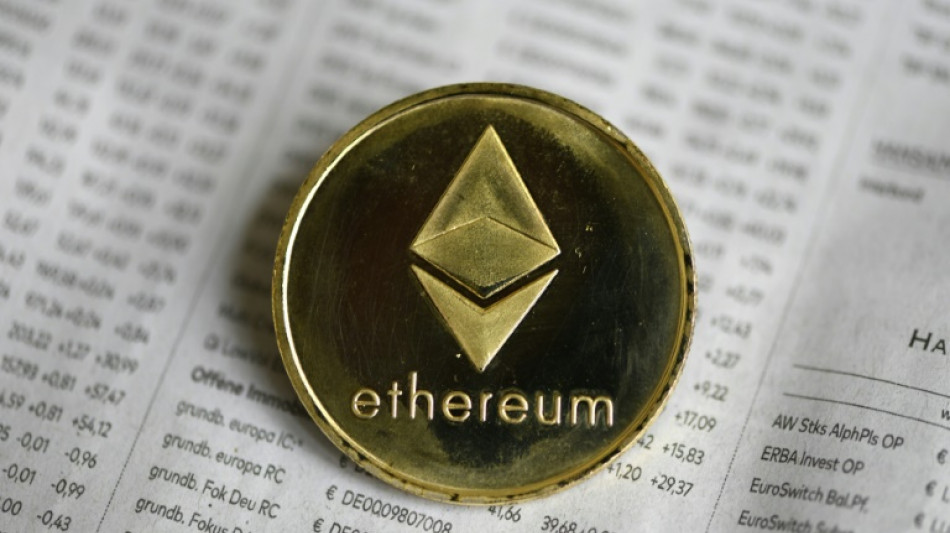
Ethereum crypto overhaul targets environmental impact / Photo: © AFP/File

 UN approves resolution on dealing with rising sea levels

 Yalcouye makes dream debut as Ivory Coast beat Ghana in AFCON qualifier

 Chicago's White Sox and Cubs book MLB playoff berths

 Last-gasp Gakpo strike snatches Dutch draw to sour Klopp debut

 Global stocks mostly fall as oil prices and bond yields rise

 Israel's Netanyahu denounces enemies, allies in fiery UN speech

 Hollywood stars among arrests in NY anti-Netanyahu protest

 Losing start in AFCON qualifying for 78-year-old coach Le Roy

 Italy bans burqas in schools, caps numbers of foreign students per class

 Israel policies threaten 'life and existence' of Palestinians, Abbas says

 Paolini steers Italy past China in BJK

 Zidane admits emotion on eve of first game as France coach

 Breetzke and Maharaj sink Australia in first one-day international

 Zelensky broke confidentiality with North Korea POWs disclosure: South's president

 Former Liverpool star Carroll reveals he was sexually assaulted

 Dominican Republic calls for Haiti force to be strengthened

 Dolly Parton's nephew ordered to stay away from estate staff, properties

 Early exit for Philippine darling Eala at Singapore Open

 Hurricane Polo triggers huge waves in coastal Mexican city

 What happens if the US bans diesel exports

 Macklemore hits back with 'Free Palestine Tour' after Sheeran split

 Met Opera to give New Yorkers free tickets in affordability push

 Top ECB official to resign to take up IMF role

 Xi and Trump call for peace in lavish White House state visit

 Five up-and-coming players looking to make mark in Nations League

The world's second biggest cryptocurrency after bitcoin, ethereum, will soon overhaul its blockchain technology to curb the network's much-criticised environmental impact.
Ethereum, whose digital unit ether tumbled in a crypto crash earlier this year, will in September undergo a major technical revolution.
So what is the backdrop for the looming reset -- known as the Merge -- and how will it calm prices and cut electricity usage?
- Why does crypto use so much energy? -
Bitcoin, ethereum and other such currencies are "mined" by solving complex puzzles using powerful computers that consume enormous amounts of energy in vast warehouses, often near cheap electricity sources.
A blockchain is the decentralised and secure ledger for recording those transactions, which occur when encrypted codes are passed across a computer network.
Users validate their success via a so-called "proof of work" mechanism that rewards them with cyber currency -- but only after they have proved their participation in such energy-intensive mining.
The lucrative crypto industry is worth about $1.0 trillion, despite crashing in the first half of 2022.
However, ethereum is still down by a hefty 55 percent in value so far this year.
- Why is ethereum popular? -
Ethereum is nevertheless regarded as vital because it is where most virtual assets, including headline-grabbing non-fungible tokens (NFTs), are bought and sold.
That is partly because users can create "smart contracts" or algorithmic computer code, which carry out customised transactions for different functions.
"The ethereum blockchain is the base layer infrastructure of the majority of the whole crypto ecosystem," summarised Lennart Ante, CEO and co-founder of the Blockchain Research Lab.
"Everything relies on ethereum," he told AFP.
"In the last few years, there have been other similar platforms such as Solana or Cadano, but none of these have this huge network and this huge amount of developers and projects, and historical success."
- Why is it changing? -
Ethereum's broad adoption makes it even more important to address environmental concerns and change tack, as those worries had sparked a partial boycott.
"Proof-of-work mining is environmentally destructive, expensive, and inefficient," summarised digital currency specialist Eswar Prasad, a professor at Cornell University.
Yet the carbon footprint of a decentralised blockchain system is difficult to assess because electricity sources are not always identified.
- What is the switch? -
Ethereum creator Vitalik Buterin has planned for a switch to a so-called "proof of stake" mechanism from the middle of September.
This means that participation no longer requires proof of electricity usage, and instead relies on staking blocks of ether.
Users will then validate, or effectively bet their currency, in order to try and win more ether.
Ethereum currently consumes about 45 terawatt hours of power per year.
Bitcoin in contrast is estimated to use 95 terawatt hours of power per year, equivalent to Pakistan's annual consumption.
- What are pros and cons? -
Experts estimates the upgrade will use 99 percent less energy than the current set-up.
It would therefore allow users to execute quicker and more efficient transactions.
"The energy consumption would be close to zero," Ante told AFP.
"You do not need any of the hardware anymore, only the software."
At the same time, the new approach is not without risks.
Some users might decide to switch to rival networks where they can still able to use enormous amounts of energy to mine currency.
Prasad also cautioned that the proof-of-stake method was "not perfect" owing to liquidity and governance concerns.
J.Horn--BTB