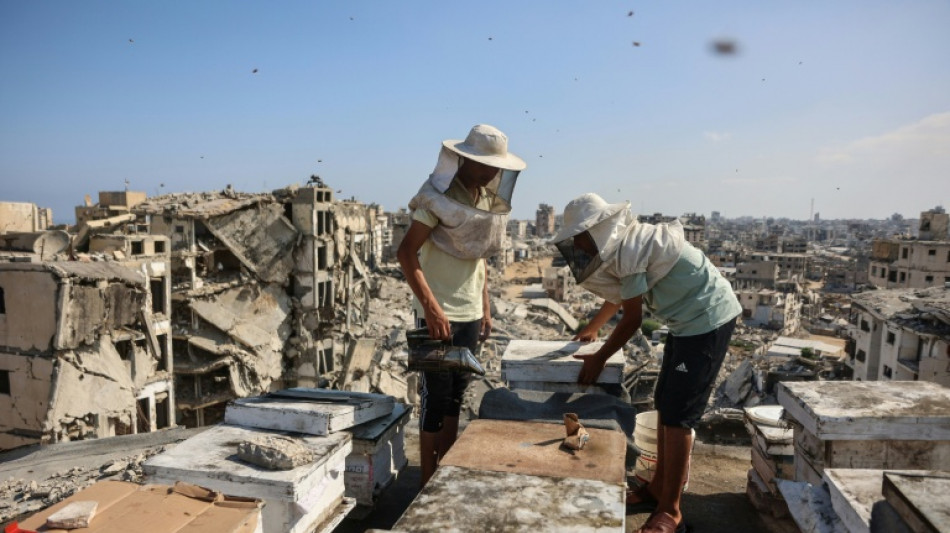
Gaza beekeeper starts again on rooftop amid ruins of war / Photo: © AFP

 Marchand 'stressed' about racing Japanese rivals at LA Olympics

 Mobile boat clinics bring healthcare to India's remote islands

 Former India paceman Zaheer Khan named Chennai coach in IPL

 Six-year-old Chinese girl sets world record with Rubik's Cube
 Swimming prodigy Yu, 13, says 'interviews way harder than racing'
 Star coaches make their bows as Nations League returns
 Rams bounce back as Giants reel from Dart injury

 In Bangladesh, Pakistan's Jinnah photo stirs anger

 Two New Zealand naval ships transit Taiwan Strait

 Zidane gets down to work as France start new era

 Inside the Venezuelan prison meant to 'drive you insane'

 UK king braces as memoir by Diana's brother goes on sale

 No green light to lift EU sanctions on Russian oligarchs, talks to resume

 UK agrees support for Saudi in struggle with Houthis: reports

 EU foreign policy chief calls for continued sanctions on Russia

 Flights scrapped, evacuations urged as Typhoon Dujuan wallops Japan

 Fonseca to take break from tennis

 A Cuban zoo, and its animals, in epic battle for survival

 Infantino proposes consulting federations to reform FIFA

 El Nino weather pattern enters record territory: scientist
 OpenAI calls for US to lead global effort on AI standards

 South African ostriches plucked alive for luxury fashion: report

 US networks halt Trump coverage in revolt over White House ban

 Paramount settles with US states to clear Warner Bros. mega-merger

 Climate crisis a job for world leaders, not just activists: UK FM

Perched on the edge of a rooftop high above Gaza City's bombed-out landscape, Ibrahim al-Dabba lovingly tends his community of bees, cultivating a rare source of hope among the ruins of the Israel-Hamas war.
Al-Dabba and his sons, donning protective netted hats and wielding metal bee smokers, gently inspect the neat rows of teeming hives.
As each frame of honeycomb is lifted out, hundreds of bees buzz lazily above the shattered urban neighbourhood -- an incongruous setting for an apiary, but one the veteran beekeeper had little option but to choose.
Al-Dabba, who heads the Beekeepers Cooperative in the Gaza Strip, said the war which erupted in October 2023 obliterated the Palestinian territory's beekeeping culture.
"We had more than 40,000 beehives and more than 450 beekeepers" before the war, he told AFP from the rooftop in Gaza City's Tel al-Hawa neighbourhood.
"The situation was good, with more than 1,000 families making a living through the beekeeping sector," he added.
"The war came and destroyed the beekeeping sector by more than 95 percent because most beekeepers were near the border areas," he explained.
Al-Dabba himself lost some 400 hives, which he had kept in agricultural lands east of Gaza City.
He had no choice but to relocate his remaining 35 or so hives to the roof of a residential building, but admitted the situation was far from ideal.
"Bees are supposed to be in a safe, suitable agricultural area, but today the bees are suffering just as we are," he said.
Al-Dabba explained that he could not move his bees back to their previous home because it had been destroyed and the land was now under the control of the Israeli military.
"We cannot approach or enter," he said.
"Just as we are displaced in the streets, the bees are also displaced on the rooftops."
- Hope despite suffering -
The devastating war in Gaza was triggered by Hamas's October 7, 2023 attack on Israel, which resulted in the deaths of 1,221 people, according to an AFP tally based on official Israeli figures.
Israel's retaliatory military campaign in Gaza has killed more than 73,300 people, according to the territory's health ministry, which operates under Hamas authority and whose figures are considered reliable by the United Nations.
Despite the ceasefire in effect since October, bloodshed has continued in the tiny territory, with the Israeli military continuing to target Palestinians they say are militants.
Israel says it now controls more than 60 percent of the Gaza Strip, up from about half when the ceasefire took effect.
The humanitarian situation also remains dire, with hundreds of thousands of people living in tents and Israel tightly controlling the entry of all goods into the territory.
"We lack essential supplies because importing beekeeping equipment from the other side is not permitted," Al-Dabba told AFP, saying he had approached external organisations and ministries in Gaza and the occupied West Bank for help.
Despite the suffering and challenges of relocating his hives to an unfamiliar landscape, Al-Dabba said he found "hope after seeing the bees coexist and adapt".
"The bees now come and go and feel settled," he said.
"So we hope that hope, goodness and living in peace and security will come, like in other countries."
T.Ziegler--VB