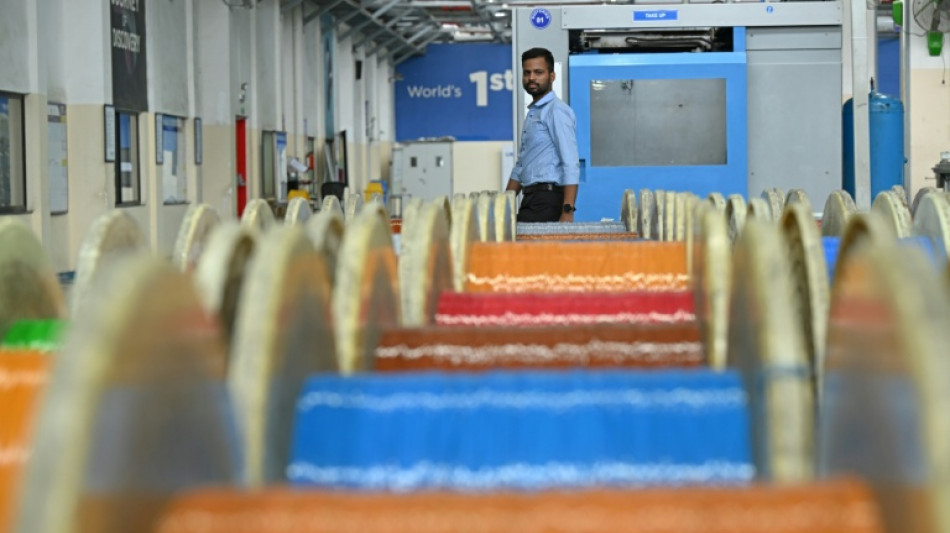
Cables and cooling bring AI windfall to Indian suppliers / Photo: © AFP

 Stocks rise on AI buzz, oil prices cool

 India narrowly survive huge scare against minnows Japan

 Missing F-35 fighter parts 'not sensitive', says Australia minister

 Cambodia showcases scams crackdown with global conference
 Afghan cyclist who disguised herself as man wins Asian Games silver

 Typhoon Dujuan leaves four dead in Japan, 45,000 houses without power

 G7 leaders condemn Houthi strikes on Saudi Arabia

 Google data centre sparks protests in Austria
 Shin Ohashi: Junk food-loving teen and Japan's next big swimming hope

 Stocks rise on AI buzz, drop in oil prices

 China's robot dancers limber up for America's Got Talent final

 Despite military might, Saudi struggles to crush the Houthis
 Trump to tout deals, defend Iran war in UN speech

 Sri Lanka to issue verdict in landmark Easter attack trial

 Macron says talks with Trump on Red Sea, Ukraine 'constructive'

 Green policies just good politics, says UK minister

 Bardot auction in Paris fetches nearly one million euros
 No timeline on Daniels injury return, says Commanders coach

 British Columbia sues OpenAI in US court over Canada school shooting

 French star Batum retires after 18-year NBA career

 Zidane leads first France training session
 Man shot by ICE agent in Texas detained with bullet inside him: lawyer

 California declares state of emergency ahead of El Nino

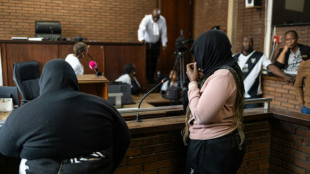 South Africa arrests three more suspects, after nine women murdered

 Carse needs time away from England, says captain Brook

At a bustling factory in western India, technicians work around the clock to turn glass into hair-thin fibre-optic strands destined for data centres powering the global artificial intelligence boom.
Indian manufacturers are cashing in on the AI infrastructure buildout by supplying cables, power systems and cooling equipment -- even as investors worry the country is falling behind in the race to develop the technology.
Analysts at Nomura describe it as a classic "picks and shovels" trade, a riff on how selling tools during a gold rush can earn people more than searching for the precious metal.
For Ankit Agarwal, managing director of Sterlite Technologies, serving the world's biggest tech companies is a dramatic shift for his firm, once known mainly as a supplier to telecoms networks.
"This is a once in a lifetime opportunity," Agarwal told AFP in Mumbai. "This is a kind of entire new network."
India has enthusiastically adopted AI but has yet to produce globally competitive models and remains dependent on imported advanced semiconductors.
Investors also fear that generative AI could disrupt the country's $315-billion IT services industry by automating tasks long outsourced to India, such as customer service and app maintenance.
These worries have weighed on markets, with the benchmark Nifty 50 down around seven percent this year and foreign investors pulling over $27 billion from Indian equities.
- 'Tsunami' -
The data centre boom is generating windfall gains for companies largely overlooked by investors, offering a bright spot in a market rattled by concerns over AI's impact on India's export-oriented tech sector.
"India doesn't need to make the chip or train the model to benefit," Prateek Nigudkar, a fund manager at Shriram AMC, told AFP.
"Every data centre needs switchgear, transformers, cables, cooling systems and grid connectivity, and Indian manufacturers are already in that supply chain."
Fibre-optic cable producers have been among the biggest beneficiaries.
Strong demand for networks linking data centres has helped manufacturers secure contracts once considered out of reach.
Sterlite earlier this year announced a $1.1-billion multi-year order from a US hyperscaler -- a term meaning a large-scale cloud service provider -- helping drive its shares up 400 percent this year.
Telecom equipment maker HFCL reported its strongest-ever April-June quarter, with revenue more than doubling on AI demand.
Founder Mahendra Nahata said he was going all out to scale up production.
"We used to increase capacity probably once in three years, once in five years. Nowadays, it's become a daily routine," he told AFP, comparing the buildout to a "tsunami".
The gains extend beyond fibre cables.
Shares in TD Power Systems have jumped 68 percent on expectations of rising demand from AI facilities, while MTAR Technologies has benefited from demand for power units used in fuel-cell systems serving big-tech operators.
- 'Big investments' -
Analysts, however, warn valuations have become stretched, while growing opposition to energy-guzzling data-centre projects also poses a risk.
Data Center Watch, a tracker run by AI intelligence firm 10a Labs, says at least 75 US projects worth some $130 billion were delayed or blocked in the first quarter of 2026.
Indian executives acknowledge the risks could hurt near-term sentiment but argue domestic demand would eventually offset any slowdown abroad.
India hosts nearly a fifth of the world's data, but accounts for less than five percent of global data-centre capacity -- leaving much room for growth.
An AFP review of funding announcements shows US hyperscalers have committed some $57 billion in new Indian capacity over the past year, while conglomerates Adani and Reliance have pledged $100 billion towards digital and infrastructure projects.
Unlike in parts of the United States and Europe, data centre development in India has faced limited resistance so far.
"Opposition is probably in a very nascent stage," said Sharad Agarwal, chief executive of data centre operator Sify Infinit Spaces.
He said operators had adopted technologies such as closed-loop water cooling systems to reduce pressure on local resources.
Sify, which operates 16 data centres and has nearly a dozen more under development, is considering an IPO that would make it India's first listed data-centre operator.
"We are talking about big investments. If I need to be a one-gigawatt company, I need $5 billion," Agarwal said. A computing power capacity of one gigawatt is often referred to as "hyperscale".
"Then only we can go and grow."
M.Betschart--VB