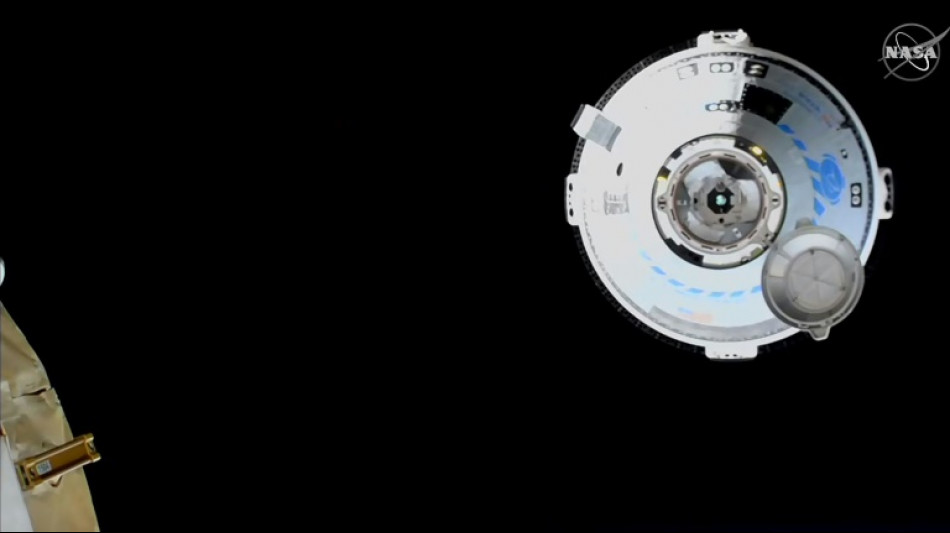
Boeing eyes February for space capsule's first crewed flight / Photo: © NASA TV/AFP/File

 US Retail Sales and Fed Minutes Set Up a Critical Test for Consumers

 Oil Heads for Second Weekly Loss as Supply Surplus Emerges

 Brazil Faces Debt and Inflation Test as Lula Prepares Fourth Term

 Canada Signals Openness to Chinese Automakers if US Trade Talks Fail
 US Mortgage Rate Falls for Fourth Week but Remains Above 7%
 13 Native American-Owned Restaurants in Arizona to Experience Indigenous Culinary Traditions

 Best Digital Photo Frames 2026: Aura, Skylight, and Amazon Compared

 UK Economy Grows 0.7% in Third Quarter as Services Lead Expansion

 India's Retail Inflation Reaches 6.09% as Food Prices Accelerate

 China's October Activity Data Reveal a Weak Start to the Fourth Quarter

 South Korea Launches Probe into NewJeans Contract Controversy

 Helen Rees Reflects on Four Decades of South Africa's HIV Journey

 Foreign Investors Return to Indian Equities with ₹84,290 Crore Inflow

 Interactive Map Reveals 1,000 Unsolved Murders Across UK
The first crewed flight of Boeing's space capsule Starliner is scheduled for February 2023, the company and NASA announced Thursday, as the United States seeks to secure a second way for its astronauts to reach the International Space Station.
Since 2020, American astronauts have traveled to the ISS aboard SpaceX's vessels but the US space agency wants to widen its options.
After a series of hiccups in its space program that led to serious delays, including a 2019 flight that did not reach the ISS, Boeing finally managed to send the gumdrop-shaped capsule to the station in May -- without a crew.
This time, the aerospace giant will send the Starliner up with humans aboard, to earn NASA's green light to begin regular missions -- at an expected pace of one per year.
"Currently, we're targeting a launch date as early as February of 2023," Steve Stich, the manager of NASA's Commercial Crew Program, told reporters.
"We're in good shape to execute these plans to be ready for that flight in February," added Mark Nappi, the Starliner program manager at Boeing.
The test flight -- aptly named CFT, or Crew flight test -- will carry US astronauts Barry Wilmore and Sunita Williams.
They are expected to be docked for eight days at the ISS, where they will conduct a series of experiments, said ISS program manager Joel Montalbano.
"Our agency goal is to get two US commercial providers up and running as soon as we can."
Boeing had hoped to conduct this test flight before the end of the year, but a few glitches experienced in the uncrewed May flight led to necessary adjustments to the vessel.
An issue was detected in the propulsion system: two thrusters responsible for placing Starliner in a stable orbit failed, though officials insisted there was plenty of redundancy built into the system to overcome the problem.
Boeing's teams later determined that "debris-related conditions" were to blame, Nappi said, adding that the origin of said debris was still unknown.
Some filters were removed to fix a pressure problem, and flight software was updated to avoid a data overload.
Boeing and SpaceX were awarded contracts in 2014, shortly after the end of the space shuttle program, during a time when the United States was left reliant on Russian Soyuz rockets for rides to the ISS.
Elon Musk's SpaceX filled the void first, providing space "taxi" service since a successful test mission for its Dragon capsule in 2020.
G.Schulte--BTB