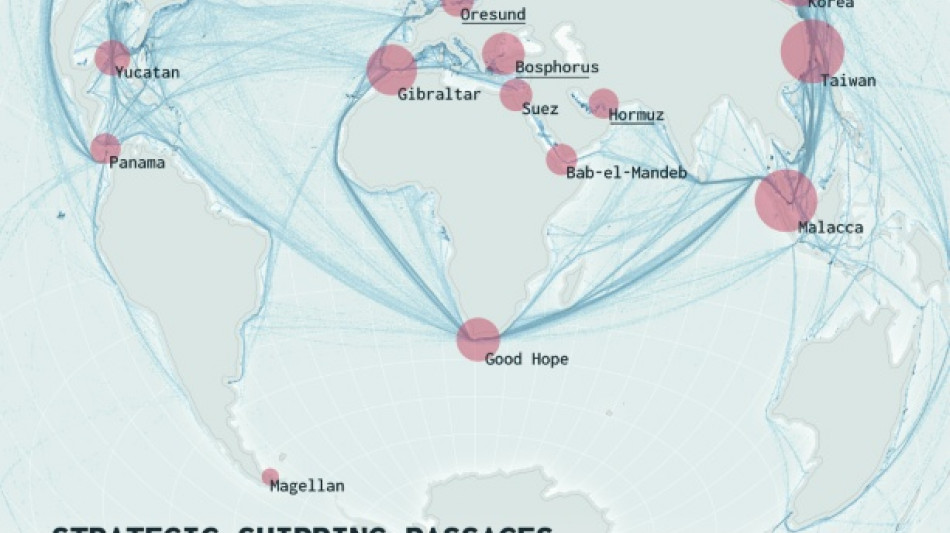
Hormuz, Malacca and other key straits spawn tensions throughout history / Photo: © AFP

 Klopp calls on Germany to 'rise above ourselves' as new era begins

 Russian strikes kill seven in Ukraine as Russia vows no 'pause' to war

 ArcPoint Expands Globally with Institutional Intelligence Platform for Modern Investors

 Ronaldo focussing on 'present' ahead of Wales test

 Outgoing UN chief makes final climate push at New York summit
 Grief and pain flow at hearing for Canadian suicide poison vendor

 Ireland boss Hallgrimsson says timing of Israel remarks 'not clever'
 Weinstein resentenced to 15 years in prison for 2006 sex assault
 Fendi brings disco bling, Italian style, to Milan Fashion Week
 French court confirms rape trial for PSG and Morocco star Hakimi
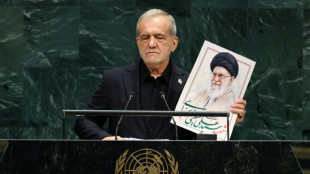 President tells Trump that Iran will never 'bend at the knee'

 أليكس بودي والبروفيسور الدكتور شتيفان هاوبت يتفقان على التعاون من أجل مجموعة فنية أسطورية في رومانيا

 U2 at 50: Irish rockers reveal anniversary album

 Алекс Боді та проф. д-р Стефан Гаупт домовилися про співпрацю щодо легендарної колекції мистецтва в Румунії

 Alex Bodi și prof. dr. Stefan Haupt încheie un acord de cooperare pentru o colecție de artă legendară în România

 Alex Bodi and Prof. Dr Stefan Haupt agree to collaborate on a legendary art collection in Romania
 Stocks dip, oil rises as traders eye chances of Iran deal

 Israel squeezing UN Palestinian refugee agency ahead of polls: chief

 Dutch to resume Eurovision with new broadcaster
 Man Utd losses jump despite record revenues

 Ethiopia's Tigray rebels seize airports, clash with govt forces

 China prodigy wins third Games gold as North Korea weightlifters roar

 China's Yu, 13, wins third Asian Games gold but has 'some regrets'

 Oil falls, stocks steady as Trump hails 'good' Iran talks

 UK sets up unit to combat disinformation from Russia, AI

Hormuz and a handful of maritime straits around the world have served as the linchpin of global trade since the 16th century and have fuelled geopolitical rivalries throughout history.
As Iran tightens its grip on the Strait of Hormuz, its Yemeni allies, the Houthi rebels, want to disrupt shipping in the Red Sea to and from Saudi ports and could possibly disturb traffic in another strait, Bab el-Mandeb, which ships must cross to reach the Suez Canal, experts say.
These two passages, which lock access to the Gulf and to the Red Sea, are among the dozen or so straits considered vital to international trade.
Oil and gas tankers, bulk carriers and container ships loaded with raw materials and goods pass through these narrow natural corridors.
The United Nations Convention on the Law of the Sea signed in Montego Bay on December 10, 1982 -- a kind of constitution for the oceans -- "formalises the fact that a strait is a natural feature that must not be subject to tolls" and where "the principle of free navigation" is guaranteed, Sylvain Domergue, a lecturer at Sciences Po Bordeaux and author of Geopolitics of Maritime Spaces told AFP.
By contrast, canals such as Panama or Suez, which are man‑made waterways, may be subject to tolls levied by the states that control them.
In Hormuz, Iran, which "has not ratified the Montego Bay Convention, had until now respected it under customary law," Domergue said.
Portugal, whose navigators were the first to open the sea route to the Indies, tried as early as 1507 to establish control over Hormuz to secure a monopoly on access to spices and the riches of the Orient, he said.
- 'The sea belongs to none' -
But after a famous controversy, the Mare Liberum thesis of Dutch jurist and philosopher Hugo Grotius prevailed in the early 17th century: straits were then seen as essential to long‑distance international trade because "the sea belongs to no one".
"To guarantee freedom of navigation, one had to start by guaranteeing freedom of passage through the straits," Domergue said.
The Netherlands adopted this doctrine and defended freedom of the seas, followed by Britain and later by the United States which to this day respects "almost all of the Montego Bay Convention," despite not having ratified it either, he said.
Yet the principle of free navigation "did not prevent the British from guiding their colonisation in part according to the geography of straits", Domergue said.
Britain's key military footholds were established along strategic waterways. Its great colonial naval base in Asia would be in Singapore, allowing control of Malacca, through which the largest share of global maritime traffic from China now passes.
London would also establish bases on the island of Socotra, near Bab el‑Mandeb and the entrance to the Red Sea.
In Europe, the Danish straits (the Oresund, the Kattegat), which close off the Baltic, "were of great importance in the 19th century because they enabled the Danes, for a very long time, to collect a toll," and are strategic because they "block access to the Atlantic for the Baltic powers, particularly the Russians," the geographer said.
- Turkish exceptions -
The only major straits where a toll is still collected are the "Turkish Straits" of the Bosphorus and the Dardanelles, which are governed by earlier agreements, signed in Montreux in 1936.
"In the long run, other issues concerning straits will arise," Domergue said, citing the Taiwan Strait, given China's declared territorial ambitions in Southeast Asia, or the Strait of Malacca, shared by Singapore, Malaysia, and Indonesia.
"There is already a 'war of sand' going on in the Taiwan Strait: Chinese vessels come to collect marine sand for the construction sector in China, in waters claimed by Taiwan—provocative actions," he said.
On the evening Iran announced plans to introduce a toll in Hormuz, "the Malaysian prime minister spoke out to say it was a very good idea that he might emulate for Malacca, before backtracking," Domergue noted.
"If there were a toll in Malacca, Singapore would lose some of its splendour and its status as a hub of East Asia," he added.
E.Burkhard--VB