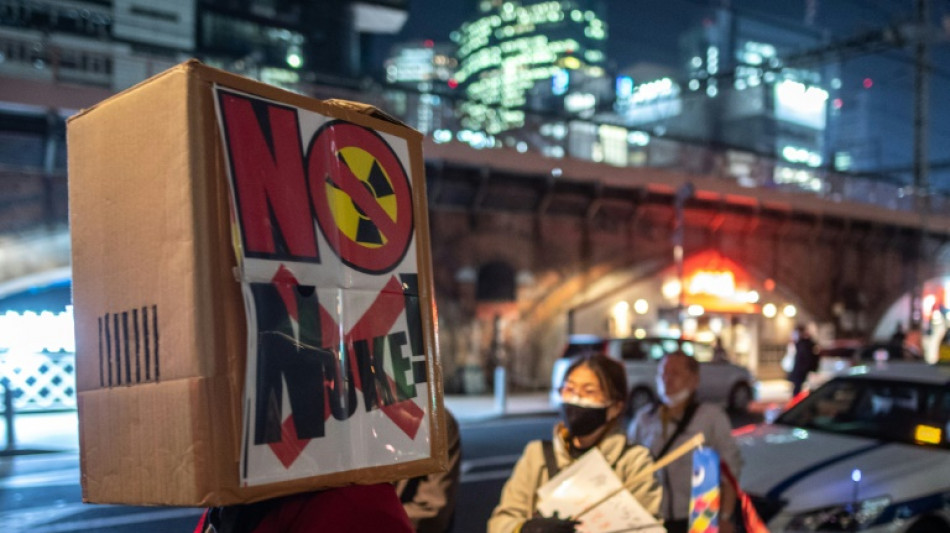
Japan eyes nuclear power push to combat energy crunch / Photo: © AFP

 UN approves resolution on dealing with rising sea levels

 Yalcouye makes dream debut as Ivory Coast beat Ghana in AFCON qualifier

 Chicago's White Sox and Cubs book MLB playoff berths

 Last-gasp Gakpo strike snatches Dutch draw to sour Klopp debut

 Global stocks mostly fall as oil prices and bond yields rise

 Israel's Netanyahu denounces enemies, allies in fiery UN speech
 Hollywood stars among arrests in NY anti-Netanyahu protest

 Losing start in AFCON qualifying for 78-year-old coach Le Roy
 Italy bans burqas in schools, caps numbers of foreign students per class

 Israel policies threaten 'life and existence' of Palestinians, Abbas says

 Paolini steers Italy past China in BJK

 Zidane admits emotion on eve of first game as France coach

 Breetzke and Maharaj sink Australia in first one-day international

 Zelensky broke confidentiality with North Korea POWs disclosure: South's president

 Former Liverpool star Carroll reveals he was sexually assaulted
 Dominican Republic calls for Haiti force to be strengthened

 Dolly Parton's nephew ordered to stay away from estate staff, properties

 Early exit for Philippine darling Eala at Singapore Open

 Hurricane Polo triggers huge waves in coastal Mexican city
 What happens if the US bans diesel exports

 Macklemore hits back with 'Free Palestine Tour' after Sheeran split
 Met Opera to give New Yorkers free tickets in affordability push

 Top ECB official to resign to take up IMF role

 Xi and Trump call for peace in lavish White House state visit

 Five up-and-coming players looking to make mark in Nations League

Japan's prime minister on Wednesday called for a push to revive the country's nuclear power industry in a bid to tackle soaring imported energy costs linked to the war in Ukraine.
Such a move could prove controversial, after the 2011 Fukushima disaster led to the suspension of many nuclear reactors over safety fears.
Like many countries, Japan -- which is aiming to become carbon neutral by 2050 -- has faced a squeeze on its energy supplies since Russian forces entered Ukraine six months ago.
The nation has also sweltered through record-breaking temperatures this summer, with residents asked to conserve power wherever possible.
"Russia's invasion of Ukraine has vastly transformed the world's energy landscape" and so "Japan needs to bear in mind potential crisis scenarios", Prime Minister Fumio Kishida said at an energy policy meeting.
Japan should consider building next-generation nuclear reactors, he said, while the government will discuss bringing more nuclear plants online and extending the service life of reactors if safety can be guaranteed.
Kishida called for "concrete conclusions by the end of the year" on the topic, which remains a sensitive one after a deadly tsunami in March 2011 caused a meltdown at the Fukushima plant, the worst nuclear disaster since Chernobyl.
Eleven years on, 10 of Japan's 33 nuclear reactors are back in action, although not all are operational year-round, and the country is heavily dependent on imported fossil fuels.
The national nuclear safety watchdog has approved in principle the restart of seven more reactors, but those moves often face opposition from local communities.
- 'All it takes' -
"In addition to securing the operations of the 10 reactors that are already back online, the government will spearhead an effort to do all it takes to realise the restart" of the others whose safety has been approved, Kishida said.
The prime minister, who joined the meeting remotely after testing positive for Covid-19, also urged policymakers to consider "constructing next-generation nuclear reactors equipped with new safety mechanisms".
Before the Fukushima disaster, around a third of Japan's power generation came from nuclear sources, but in 2020 the figure was less than five percent.
Japan's government has overhauled and strengthened nuclear safety standards, and wants nuclear power to account for 20 to 22 percent of electricity production by 2030, as part of efforts to reach carbon neutrality.
Tom O'Sullivan, a Tokyo-based energy consultant at Mathyos Advisory, said building next-generation reactors in Japan would be a "major step", because "all the current reactors are conventional ones".
Bringing more existing nuclear plants online will need to be approved by local governors, which could prove "politically challenging", O'Sullivan told AFP.
"But again, there's a different environment now after the Ukraine war," he said. Polls in recent months also show that public opinion may be softening towards the use of nuclear power.
"I don't think it's just the electricity costs. It's the reliance on Russia, for natural gas, oil and coal... the Japanese public have really woken up to that," O'Sullivan said.
Japan has imposed sanctions on Russia over the war in Ukraine along with other G7 countries, and the government has pledged to try and reduce its energy dependence on Moscow.
The price of Japanese shares related to nuclear power surged in afternoon trade as local media reported the possible plans, with Tokyo Electric Power ending up 9.96 percent and Mitsubishi Heavy Industries jumping 6.85 percent.
A.Gasser--BTB