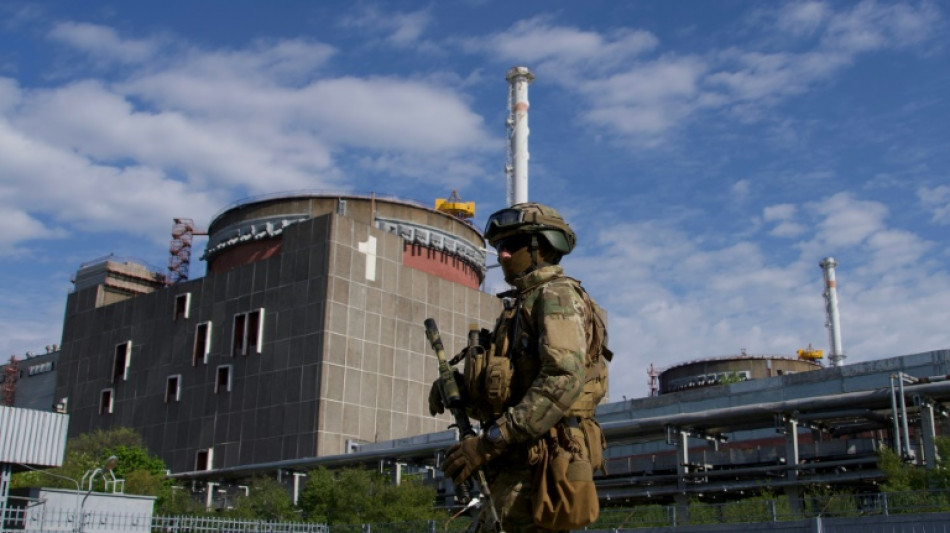
Zaporizhzhia: Nuclear power plant caught in Ukraine war / Photo: © AFP/File

 COP31 Presidency Publishes First Draft Cover Decision on Climate Action

 EU Club Group Files Antitrust Complaint Against UEFA Over Prize Money

 Heat and El Niño Drive Surge in Preterm Births Across Southern Africa

 China's Factory Activity Contracts as Export Orders Weaken

 US Retail Sales and Fed Minutes Set Up a Critical Test for Consumers

 Oil Heads for Second Weekly Loss as Supply Surplus Emerges

 Brazil Faces Debt and Inflation Test as Lula Prepares Fourth Term

 Canada Signals Openness to Chinese Automakers if US Trade Talks Fail

 US Mortgage Rate Falls for Fourth Week but Remains Above 7%

 13 Native American-Owned Restaurants in Arizona to Experience Indigenous Culinary Traditions

 Best Digital Photo Frames 2026: Aura, Skylight, and Amazon Compared
 UK Economy Grows 0.7% in Third Quarter as Services Lead Expansion

 India's Retail Inflation Reaches 6.09% as Food Prices Accelerate
 China's October Activity Data Reveal a Weak Start to the Fourth Quarter
 South Korea Launches Probe into NewJeans Contract Controversy

 Helen Rees Reflects on Four Decades of South Africa's HIV Journey

 Foreign Investors Return to Indian Equities with ₹84,290 Crore Inflow
The Russian-held Zaporizhzhia power plant in Ukraine, which is at the centre of international concern amid mutual accusations of shelling by Moscow and Kyiv, is Europe's biggest nuclear plant.
Recent fighting around the plant has prompted the International Atomic Energy Agency (IAEA) to warn of the "very real risk of a nuclear disaster", while Kyiv has accused Moscow of "nuclear terrorism".
Fears of a possible incident have brought back haunting memories of the 1986 Chernobyl nuclear disaster in then Soviet Ukraine, which left hundreds dead and spread radioactive contamination across Europe.
Here are some key facts about the facility:
- History -
Located near the city of Energodar on the Dnipro River, the plant has six of Ukraine's 15 reactors -- enough to power four million homes.
The reactors were all switched on between 1984 and 1995, according to the Ukrainian state agency Energoatom, which runs the plant.
Before the war, the plant was generating around a fifth of Ukraine's electricity.
The country, which has significant uranium reserves, is the seventh-largest producer of nuclear power in the world, according to the IAEA.
It began developing nuclear energy in the 1970s with the construction of Chernobyl, near the capital Kyiv, and has made major improvements in nuclear safety over the years since that cataclysmic event.
The Zaporizhzhia plant is "relatively modern", Mark Wenman of Imperial College London told the Science Media Centre earlier, noting that its reactor components are housed inside a heavily reinforced containment building that can "withstand extreme external events, both natural and man-made, such as an aircraft crash or explosions".
- Capture -
The power plant -- located close to the Crimean peninsula which was annexed by Moscow in 2014 -- was captured by Russian forces on March 4 following a battle in the early days of Moscow's invasion.
The fighting caused a fire at a training facility. Firefighters said they were prevented from reaching the blaze for hours.
Energoatom initially shut off two of the reactors -- and more recently a third -- but the plant has continued to be operated by Ukrainian technicians under Russian control.
The IAEA has repeatedly said it wants to organise an inspection of the plant.
This was initially opposed by Ukrainian authorities but officials have sounded less adamant about the prospect recently.
- Renewed fighting -
Ukraine on July 21 accused Moscow of storing heavy weapons at the plant after Russia said Ukraine's troops had fired on the facility.
Energoatom said Russia had moved over two dozen pieces of military equipment and ammunition into the engine room of the first reactor.
US Secretary of State Antony Blinken said Moscow was using it as a "military base to fire at Ukrainians, knowing that they can't and won't shoot back".
On August 5, Ukraine accused Russian forces of carrying out strikes near a reactor. Russia said Ukraine was behind them.
Following the attacks, Energoatom said it would have to shut down another reactor because of damage to a power cable.
Another reactor is being repaired, meaning only two reactors are now functioning.
Ukraine says there are around 500 Russian troops at the plant and has called for the establishment of a demilitarised zone.
Despite the tensions, Energoatom has said it is still in contact with the plant and receives data on radiation monitoring.
It said on Monday that there had been no change to radiation levels.
M.Ouellet--BTB