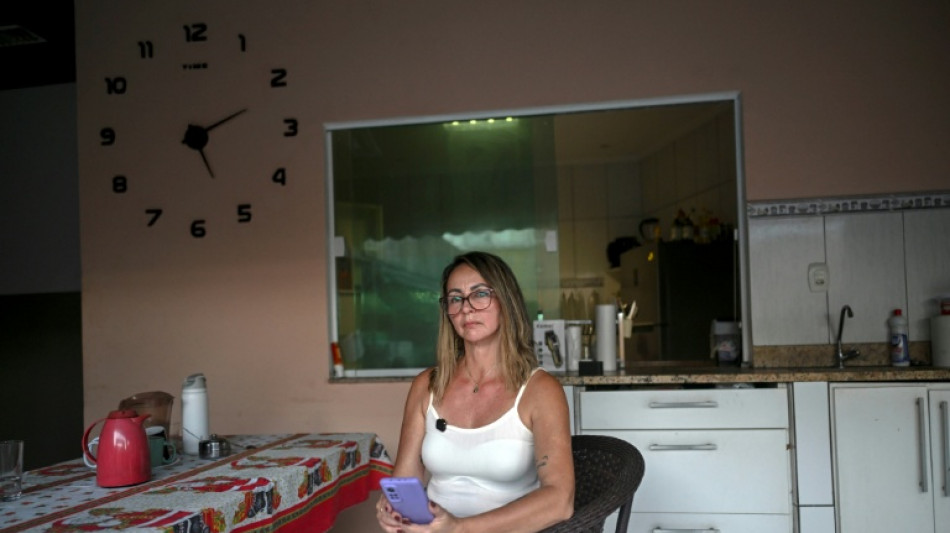
Stabbed for saying no: Is online misogyny fueling violence in Brazil? / Photo: © AFP

 India's 'Tree Father' plants for a greener future

 Hopping mad: New health warning stirs up Belgian brewers

 Canadian capital to rename 'Trump Ave'

 Pope heads to France on first state visit in 18 years

 Bacteria suspected in deaths of hundreds of baby whales off Argentina

 US 'must choose' whether to end war: Iran president to Fox News

 UN approves resolution on dealing with rising sea levels

 Yalcouye makes dream debut as Ivory Coast beat Ghana in AFCON qualifier

 Chicago's White Sox and Cubs book MLB playoff berths

 Last-gasp Gakpo strike snatches Dutch draw to sour Klopp debut

 Global stocks mostly fall as oil prices and bond yields rise

 Israel's Netanyahu denounces enemies, allies in fiery UN speech

 Hollywood stars among arrests in NY anti-Netanyahu protest

 Losing start in AFCON qualifying for 78-year-old coach Le Roy

 Italy bans burqas in schools, caps numbers of foreign students per class

 Israel policies threaten 'life and existence' of Palestinians, Abbas says

 Paolini steers Italy past China in BJK

 Zidane admits emotion on eve of first game as France coach

 Breetzke and Maharaj sink Australia in first one-day international

 Zelensky broke confidentiality with North Korea POWs disclosure: South's president

 Former Liverpool star Carroll reveals he was sexually assaulted

 Dominican Republic calls for Haiti force to be strengthened

 Dolly Parton's nephew ordered to stay away from estate staff, properties

 Early exit for Philippine darling Eala at Singapore Open

 Hurricane Polo triggers huge waves in coastal Mexican city

Alana Anisio Rosa, 20, politely turned down the man from her gym who kept sending her flowers and chocolates. A month later, he burst into her home and stabbed her around 50 times with a pocket knife.
Her mother, Jaderluce Anisio de Oliveira, 53, was confronted by the scene in February after returning early to their home in Sao Goncalo, a city across the bay from Rio de Janeiro.
"He just kept stabbing her, over and over again," Oliveira told AFP. "I pulled him off her. My entire living room was covered in blood."
As Alana emerged from an induced coma and recovered from multiple surgeries in the following weeks, videos on TikTok went viral in Brazil of men beating and stabbing mannequins with the slogan: "Training in case she says 'no.'"
Oliveira said that her daughter's attacker "followed this specific type of content," on social media.
In Brazil, alarm is rising about a surge in misogynistic "Red Pill" content online, which experts warn may be contributing to crimes against women in a country already struggling with high rates of gender-based violence.
In January, after a 17-year-old girl was allegedly gang-raped by five teenagers in Rio, one of the suspects turned himself in to police wearing a T-shirt that read "Regret Nothing" -- a phrase linked to prominent "Red Pill" influencers.
Two months later, a military policeman was arrested for allegedly shooting his wife, who wanted a divorce. In text messages published by local media, he describes himself as an "alpha male," saying she should be an "obedient, submissive, beta female."
Daniel Cara, a professor at the University of Sao Paulo (USP) who has researched "Red Pill" culture -- an international phenomenon -- said it both "legitimizes and encourages," violence against women.
- 'Radicalization of men' -
Brazil recorded 1,568 murders of women in 2025, the highest number since femicide -- a specific, aggravated form of homicide -- became a crime a decade ago.
President Luiz Inacio Lula da Silva said recently that "men are becoming increasingly inhuman and violent."
Estela Bezerra, the head of Brazil's office on violence against women, told AFP she believes online misogyny plays a big role.
"This 'Red Pill' content is, fundamentally, hate speech. It propagates a set of values that threatens to drag our society... back into an era of barbarism."
The term comes from the 1999 hit film "The Matrix", in which taking a red pill reveals a hidden and often uncomfortable truth.
A study by the Federal University of Rio de Janeiro showed that 123 YouTube channels containing hate speech and promoting control over women had 23 million subscribers in March 2026.
This number grew 18 percent in two years.
Flavio Rolim, head of the police's cyber hate crime unit, told AFP that while not everyone consuming this kind of content turns to violence, there was a "process of radicalization," of men.
This starts with exposure to an ideology of "veiled violence" in which men aggrieved by feminism promote a return to traditional gender roles and male dominance in relationships.
Some men then migrate to online communities that share "videos of women being physically assaulted. All day long, content depicting women being raped circulates there."
-'Dehumanization of an entire gender'-
Once hidden in the dark recesses of the web, this content is now easy to find.
A quick scroll by AFP through one Telegram group showed memes about rape or videos of women being beaten. On some platforms, it has become commonplace to describe women as "rapeable," or not.
"This gives rise to a phenomenon that goes beyond mere desensitization: it is the dehumanization of an entire gender," said Rolim.
In February, a police operation targeted Brazilian men involved in an international network who would drug and rape women and share videos of the abuse.
Some conservative commentators argue the "Red Pill" movement is primarily about male self‑improvement and has no link to femicide.
"They've just made the Red Pill movement a scapegoat, blaming them for this and that, even though this sort of thing has been going on for years," Raiam Santos, a Brazilian influencer frequently associated with the community, said on YouTube.
Experts are particularly concerned about how this content has seeped into the algorithms of young people.
Rolim said the police had found groups of 15 or 16-year-olds in chat groups saying: "Why would I date a girl when I can just rape her?"
At a school in Rio de Janeiro, Ana Elizabeth Barcelos Barbosa, 13, told AFP that influencers pushing the idea that "a women's sole purpose is to serve men" is eroding girls' self-esteem.
"We start wondering: Are they actually telling the truth?" she said.
Growing concern over the phenomenon has led to a flurry of recent legislative proposals.
Lawmaker Reimont Luiz Otoni Santa Barbara has introduced the "Red Pill Bill," aimed at criminalizing content that he says promotes violence against women.
Another bill approved by the Senate last month aims to classify misogyny as a crime similar to racism.
S.Leonhard--VB