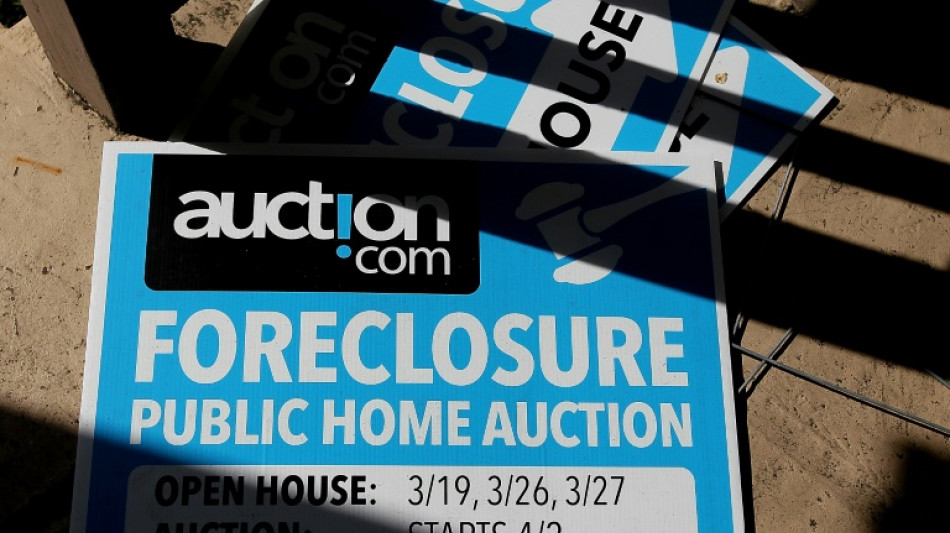
US loan delinquencies creep up amid high debt loads: report / Photo: © GETTY/AFP/File

 Redmi Note 18 5G Battery Specs Leaked: Larger Capacity in Chinese Variant

 COP31 Presidency Publishes First Draft Cover Decision on Climate Action

 EU Club Group Files Antitrust Complaint Against UEFA Over Prize Money

 Heat and El Niño Drive Surge in Preterm Births Across Southern Africa

 China's Factory Activity Contracts as Export Orders Weaken

 US Retail Sales and Fed Minutes Set Up a Critical Test for Consumers

 Oil Heads for Second Weekly Loss as Supply Surplus Emerges

 Brazil Faces Debt and Inflation Test as Lula Prepares Fourth Term

 Canada Signals Openness to Chinese Automakers if US Trade Talks Fail

 US Mortgage Rate Falls for Fourth Week but Remains Above 7%
 13 Native American-Owned Restaurants in Arizona to Experience Indigenous Culinary Traditions

 Best Digital Photo Frames 2026: Aura, Skylight, and Amazon Compared

 UK Economy Grows 0.7% in Third Quarter as Services Lead Expansion

 India's Retail Inflation Reaches 6.09% as Food Prices Accelerate

 China's October Activity Data Reveal a Weak Start to the Fourth Quarter

 South Korea Launches Probe into NewJeans Contract Controversy

 Helen Rees Reflects on Four Decades of South Africa's HIV Journey

US households have continued to take on more debt, in part to deal with soaring prices, a report showed Tuesday, while cases of borrowers unable to pay loans are creeping up in a troubling sign of things to come.
Facing the biggest surge in inflation in more than four decades, which is squeezing families trying to make ends meet, the New York Federal Reserve Bank's latest report shows credit card balances in the April-June quarter surged by the most in 20 years.
Total household debt posted a two percent increase in the latest three months, and is now $2 trillion more than the pre-pandemic level, the report showed.
While family finances remain in good shape for now -- helped by government aid and the ban on foreclosures -- researchers caution that the era of historically low delinquencies is coming to an end, especially among those with lower credit scores known as "subprime borrowers."
"The second quarter of 2022 showed robust increases in mortgage, auto loan, and credit card balances, driven in part by rising prices," said Joelle Scally, of the New York Fed's Center for Microeconomic Data.
"While household balance sheets overall appear to be in a strong position, we are seeing rising delinquencies among subprime and low-income borrowers with rates approaching pre-pandemic levels."
Delinquency rates remain low and an increase is to be expected as the moratoria on foreclosures end, but the report warns that data point to potential trouble ahead for communities that "are experiencing the economy differently."
"We are seeing a hint of the return of the delinquency and hardship patterns we saw prior to the pandemic," New York Fed researchers said in a blog post.
Total household debt rose $312 billion in the quarter to $16.15 trillion, and the biggest component -- mortgages -- jumped $207 billion to just under $11.4 trillion, the report said. However, the amount of new home loans fell, amid rising lending rates.
Credit card balances (up $46 billion) and auto loans (up $33 billion to $1.5 trillion) were impacted by rising prices, the report said.
Meanwhile, student loans, which still benefit from pandemic forbearance programs, were essentially flat at $1.6 trillion.
L.Dubois--BTB
