
Koerner seeking to put Credit Suisse on a straight path / Photo: © AFP

 Redmi Note 18 5G Battery Specs Leaked: Larger Capacity in Chinese Variant

 COP31 Presidency Publishes First Draft Cover Decision on Climate Action

 EU Club Group Files Antitrust Complaint Against UEFA Over Prize Money

 Heat and El Niño Drive Surge in Preterm Births Across Southern Africa

 China's Factory Activity Contracts as Export Orders Weaken

 US Retail Sales and Fed Minutes Set Up a Critical Test for Consumers

 Oil Heads for Second Weekly Loss as Supply Surplus Emerges

 Brazil Faces Debt and Inflation Test as Lula Prepares Fourth Term

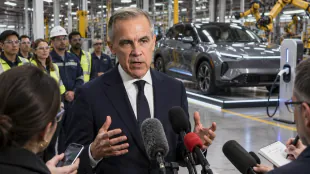 Canada Signals Openness to Chinese Automakers if US Trade Talks Fail

 US Mortgage Rate Falls for Fourth Week but Remains Above 7%

 13 Native American-Owned Restaurants in Arizona to Experience Indigenous Culinary Traditions

 Best Digital Photo Frames 2026: Aura, Skylight, and Amazon Compared

 UK Economy Grows 0.7% in Third Quarter as Services Lead Expansion

 India's Retail Inflation Reaches 6.09% as Food Prices Accelerate

 China's October Activity Data Reveal a Weak Start to the Fourth Quarter

 South Korea Launches Probe into NewJeans Contract Controversy

 Helen Rees Reflects on Four Decades of South Africa's HIV Journey

Ulrich Koerner took over as Credit Suisse's chief executive on Monday with the mammoth task of revitalising Switzerland's second-biggest bank following a series of scandals.
Reputed to be more of a technocrat than a captain of the ship, his first mission as CEO will be to carry out a strategic review to try to put the bank back in good working order.
His predecessor Thomas Gottstein, who resigned on Wednesday, led Credit Suisse through two and a half years of turmoil but failed to see the group emerge from the storm.
New chairman Axel Lehmann, who rose through the ranks of the bank's chief domestic rival UBS, highlighted Koerner's in-depth knowledge of the sector at a pivotal moment when Credit Suisse must speed up its changes.
Koerner "is an experienced, transformational leader with an excellent judgement and has demonstrated to the board of directors that he understands the urgency of the task and the need to rebuild trust", Lehmann told a press conference.
- Catalogue of woes -
In March 2021, the bank was rocked by the collapse of the British financial firm Greensill, in which some $10 billion had been committed through four funds, and then by the implosion of the US fund Archegos, which cost it more than $5 billion.
In October, it was also fined $475 million by the US and British authorities for its loans to state-owned companies in Mozambique.
In January, Antonio Horta-Osorio resigned as chairman after revelations that he broke Switzerland's Covid-19 quarantine rules.
And in June, the bank was hit with a $2 million fine in a money laundering case linked to a Bulgarian cocaine network.
Given the scale of the task, the Swiss newspaper Tages-Anzeiger wondered if Koerner was the right man for the job.
Andreas Venditti, an analyst at Swiss investment managers Vontobel, told AFP: "He is probably not a CEO in the traditional sense. But in the current situation at Credit Suisse, what's needed is probably not a visionary but someone hands-on who can restructure.
"Also he is almost 60, so it's probably his last high-profile executive job. So he can execute without having to worry for what comes after."
- 'Like a machine' -
A doctor in economics, Koerner began his career with the consulting firm McKinsey.
Koerner worked at Credit Suisse in various roles between 1998 and 2009, notably directing activities for the Swiss market, after which he switched to UBS until 2020.
The German and Swiss national returned to Credit Suisse in 2021 to turn around asset management after the Greensill affair.
He distinguished himself by his ability to carry out restructuring programmes. As head of operations at UBS, he notably transformed core functions at the headquarters "like a machine", noted the Tages-Anzeiger.
But doubts remain over his people skills, the newspaper said.
"Koerner is a technocrat, not someone who motivates people," one inside source told the daily.
And the Neue Zuercher Zeitung (NZZ) newspaper reported that he was "considered as someone of great intelligence", who can come across as brusque or arrogant on first impressions, according to his colleagues.
However, this can "quickly dissipate" in favour of a more "engaging" personality, the NZZ added.
The Ethos foundation, which represents pension funds, said it hoped that Koerner, alongside Lehmann, "will finally manage to put the bank back on the right track" and "restore the confidence" of employees and investors.
P.Anderson--BTB
