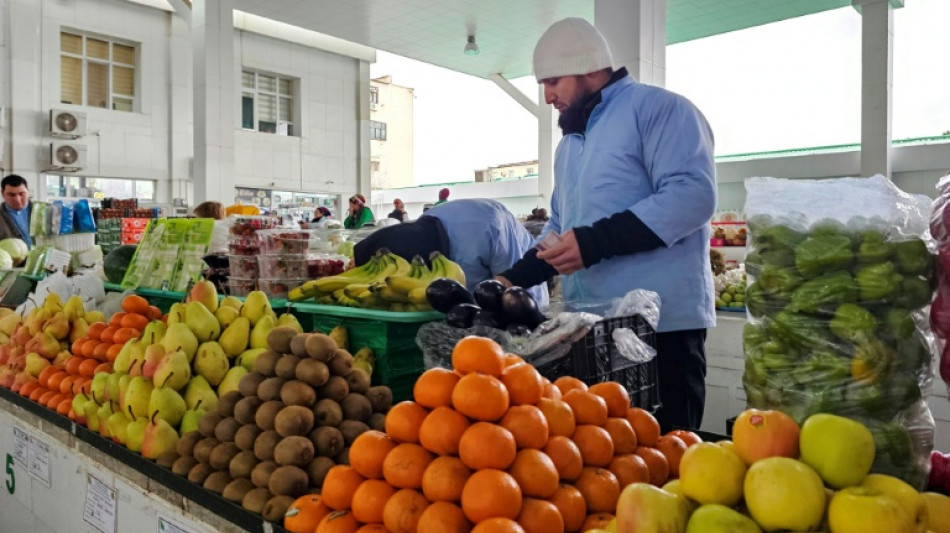
Iran war sends prices in next door Turkmenistan soaring / Photo: © AFP

 Williams boss hails Chadwick as F1 inspiration for women

 World No.1 Sinner delays return with China Open withdrawal

 South Lebanon children return to school destroyed by Israel strike

 Jewish group urges Berlin far-left vote winners to tackle antisemitism

 European stock markets climb as oil prices drop

 Trump accuser E. Jean Carroll finally has her damages

 Germany's Havertz, Musiala ruled out of Greece match with injury
 Ireland's Gaza stance spills from Eurovision into football
 Welcome aboard the Costa Serena, the Asian Games floating hotel

 Asian markets mixed after recent oil surge
 Cash for nature protection: hotelier's offer to Principe islanders
 US miner KoBold bets on AI to gain edge in DR Congo mineral hunt

 Internet disrupted in Ethiopia as conflict rages

 Asian markets mixed after oil gains

 'Genius' Ohashi bids for third Asian Games gold after world record

 India's 'Tree Father' plants for a greener future
 Hopping mad: New health warning stirs up Belgian brewers
 Canadian capital to rename 'Trump Ave'

 Pope heads to France on first state visit in 18 years
 Bacteria suspected in deaths of hundreds of baby whales off Argentina

 US 'must choose' whether to end war: Iran president to Fox News

 UN approves resolution on dealing with rising sea levels

 Yalcouye makes dream debut as Ivory Coast beat Ghana in AFCON qualifier

 Chicago's White Sox and Cubs book MLB playoff berths

 Last-gasp Gakpo strike snatches Dutch draw to sour Klopp debut

At a market in Turkmenistan's capital Ashgabat, pensioner Shemshat Kurbanova always used to pick the "juiciest" Iranian fruit -- but 10 days of war across the border have sent prices soaring and she is now worried how to get by.
The Middle East war has tumbled global markets, with the effects being felt almost immediately in some of Tehran's closest neighbours.
Iran last week banned all goods and agricultural exports, triggering economic pressure on secretive Turkmenistan and the wider Central Asian region, where Tehran had a growing economic footprint in recent years.
With the Iran border only 20 kilometres (12 miles) away, Kurbanova, 62, said she preferred Iranian fruit and juice for their freshness and affordability.
But "everything has doubled in price," she told AFP.
According to an AFP journalist, mandarins in Ashgabat cost $1.90, apples more than $2 and a pack of cigarettes has risen to $3 -- pretty much double what they were.
Kurbanova was worried how far her small pension would stretch.
"I understand the situation is difficult but I hope the conflict will soon end and the prices will come back to the previous levels," she said.
Civil servant Kerim Ballyev -- a heavy smoker who mostly bought "cheap Iranian cigarettes" -- has been forced to cut down.
"The price has almost doubled," he told AFP.
"For me, it is expensive. I won't be buying a whole pack, I'll buy them individually."
Turkmenistan is one of the most secretive countries in the world.
Little information filters through to the public in the tightly-controlled state, with the war next door virtually non-existent in censored state media.
Although trade statistics are kept secret by authorities, Tehran is a significant trading partner for Turkmenistan -- a trend seen throughout Central Asia -- despite Chinese and Russian dominance.
- Few alternatives -
A landlocked region the size of the EU, Central Asia is dependent on transit corridors via its neighbours -- China, Russia, Iran and Afghanistan.
"Iran has for a long time played the role of a window to the south for Central Asia: key transport corridors go through its territory, which give access to the Persian Gulf and then to the markets of India, the Middle East and Europe," Kyrgyz economist Iskender Sharsheyev told AFP.
The war, he said, has "essentially paralysed these southern corridors."
"The consequences for Central Asia are already felt: delays in deliveries and the rising prices of fuel, fertiliser, medicine and electronics," he added.
Byashim Ovezov, a 34-year-old businessman trading Iranian food products in Turkmenistan, said "the flow of goods has decreased".
"If the war continues, then not only will the prices double, or more, but people like me will lose their jobs," he said.
Economist Sharsheyev said Iran is a principal food supplier in the region, traditionally bringing in fruit, vegetables and dairy products.
"It is extremely difficult to replace them rapidly," he said.
"The alternatives from China or Turkey are more expensive and more complex logistically."
Alternative routes -- reaching Europe via the Caspian Sea to bypass Russia and Iran -- do not have the capacity to absorb a sudden surge in cargo.
"At the moment, the region does not have a quick replacement for Iranian transit," Sharsheyev said.
- 'Almost nothing left' -
The impact of the war is also felt sharply further from Iran in Tajikistan, which has the strongest cultural and linguistic links with Iran in the region.
Bilateral trade reached nearly $500 million in 2025 -- a substantial amount for the poorest country in Central Asia.
Madina, who runs a shop in the capital Dushanbe with Iranian products, said she had "almost nothing left in stock, except spices".
A truck full of goods meant to refill her shelves has not been able to leave Iran since the war started on February 28, she said.
"The borders were shut immediately, exports stopped, so our products got stuck," she said.
"If the war continues and we will not be able to get goods, we will have to rent out the shop or get a smaller one," she said.
D.Bachmann--VB