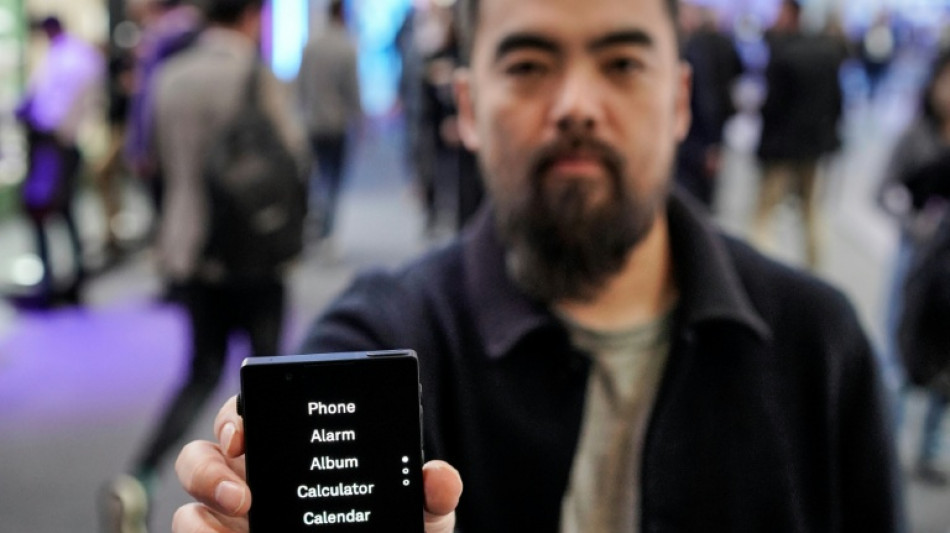
Privacy and attention promises from alternative phones at MWC / Photo: © AFP

 Assefa seeks 'better than my best' at Berlin marathon
 US court refuses to overturn Pentagon ban on Anthropic

 Verstappen and Norris blame slow cars as Mercedes tops qualifying
 Crowds cheer pope in Paris after AI 'paradise of machines' warning

 Teen swimmer makes Games history as Thai, Chinese sprinters win gold
 Man City found guilty of 114 Premier League charges - reports

 Concerns over 'missing' UK explorer Ranulph Fiennes

 Suspected Paris killer of Argentine rugby star begs forgiveness

 Oil prices fall on cautious hopes for US-Iran progress

 Noskova, Muchova take Czech Republic into BJK Cup final
 Thai sprinter Puripol breaks own Asian Games record to win 100m gold

 Russell takes pole for Azerbaijan GP, Antonelli crashes out
 Williams boss hails Chadwick as F1 inspiration for women

 World No.1 Sinner delays return with China Open withdrawal
 South Lebanon children return to school destroyed by Israel strike

 Jewish group urges Berlin far-left vote winners to tackle antisemitism
 European stock markets climb as oil prices drop

 Trump accuser E. Jean Carroll finally has her damages

 Germany's Havertz, Musiala ruled out of Greece match with injury
 Ireland's Gaza stance spills from Eurovision into football

 Welcome aboard the Costa Serena, the Asian Games floating hotel

 Asian markets mixed after recent oil surge

 Cash for nature protection: hotelier's offer to Principe islanders

 US miner KoBold bets on AI to gain edge in DR Congo mineral hunt

 Internet disrupted in Ethiopia as conflict rages

Alternative phones on offer at the Mobile World Congress (MWC) telecoms trade show in Barcelona this week aim to answer demand for devices that protect users' data and attention.
In the vein of Netherlands-based Fairphone, whose smartphones are marketed as ethical and environmentally friendly, other small companies have saddled up against the sector's giants like Apple and Samsung.
- Light Phone, designed not to be used -
With a black screen showing a few lines of text and no application logos, American company Light Phone's third model appears to have little in common with colourful mainstream devices.
With a $699 price tag, its creators intend it to be "used as little as possible", chief executive Kaiwei Tang told AFP.
Only basic functions are on offer: phone calls, messaging and 5G data, but no social networking.
Tang called the phone a response to the "attention economy" in which device and app developers attempt to keep their users online and engaged for as long as possible.
Given the attention-sucking power of mainstream devices and software, "this is not about self-control anymore," Tang added.
People aged 20-30 are especially drawn to the Light Phone, he said, as a tool to control their relationship to the tech in their lives.
With its limited functionality, Light Phone is also designed for a long life.
"Why would I need to upgrade it every two years?" Tang asked.
- Jolla, Finnish simplicity
Finland-based Jolla has just released its latest model, 13 years after the first.
Touting the device as thoroughly European, its price is similar to Light Phone's at 649 euros ($753).
Around 10,000 people had pre-ordered the device since its launch in December, with deliveries expected starting in June, the company said.
Those are small figures compared to the hundreds of millions shipped by sector giants, but enough to keep the company profitable, according to chief executive Sami Pienimaki.
"There is high demand for, in general, European technology," he said.
Built around former Nokia workers, the team behind the Jolla phone at first tackled software, building their own operating system for their devices -- a rarity on a market dominated by Apple's iOS and Google's Android.
"You can have your WhatsApp, your Signal, your Spotify, whatever, all the Android applications run without Google services," Pienimaki said.
Although the Jolla phone is assembled in Finland, the company remains dependent on parts manufactured elsewhere.
"Of course we get components from Asia," the chief executive said.
- 'Strongbox' Punkt -
Swiss sister companies Punkt and Apostrophy were in Barcelona to show a phone whose homescreen is divided in two.
By swiping from left to right, users can switch to a "strongbox" environment offering secure applications, many developed by fellow Swiss firm Proton.
The devices aim to be "tools that respect your attention", according to the company website.
Their Android-based operating system offers users centralised settings designed to control access to their data, with a selectable security level on a scale of one to five.
"Applications that you don't use for three days go automatically back to (security level) five," the highest, to avoid unnecessary data collection, sales chief Yanapi Senaud told AFP.
On top of the 699-euro phone, Punkt requires a 10-euro monthly subscription after one year of use, which the company says covers the costs of the operating system.
"If you aren't paying for the product, you are the product," it insists.
M.Schneider--VB