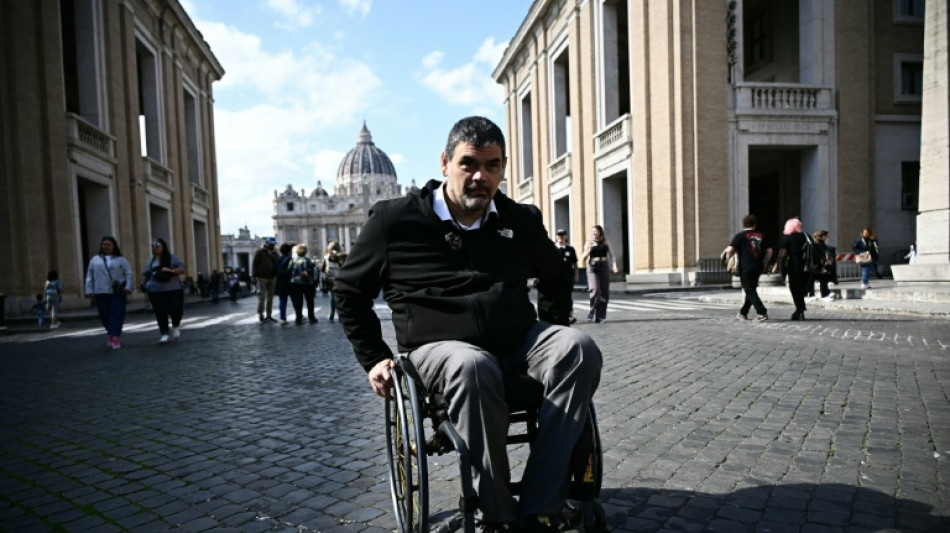
Patchy Italy disability access 'an insult' ahead of Games / Photo: © AFP

 Assefa seeks 'better than my best' at Berlin marathon
 US court refuses to overturn Pentagon ban on Anthropic

 Verstappen and Norris blame slow cars as Mercedes tops qualifying

 Crowds cheer pope in Paris after AI 'paradise of machines' warning

 Teen swimmer makes Games history as Thai, Chinese sprinters win gold

 Man City found guilty of 114 Premier League charges - reports
 Concerns over 'missing' UK explorer Ranulph Fiennes
 Suspected Paris killer of Argentine rugby star begs forgiveness

 Oil prices fall on cautious hopes for US-Iran progress

 Noskova, Muchova take Czech Republic into BJK Cup final
 Thai sprinter Puripol breaks own Asian Games record to win 100m gold
 Russell takes pole for Azerbaijan GP, Antonelli crashes out
 Williams boss hails Chadwick as F1 inspiration for women

 World No.1 Sinner delays return with China Open withdrawal
 South Lebanon children return to school destroyed by Israel strike

 Jewish group urges Berlin far-left vote winners to tackle antisemitism
 European stock markets climb as oil prices drop

 Trump accuser E. Jean Carroll finally has her damages
 Germany's Havertz, Musiala ruled out of Greece match with injury
 Ireland's Gaza stance spills from Eurovision into football
 Welcome aboard the Costa Serena, the Asian Games floating hotel
 Asian markets mixed after recent oil surge
 Cash for nature protection: hotelier's offer to Principe islanders
 US miner KoBold bets on AI to gain edge in DR Congo mineral hunt

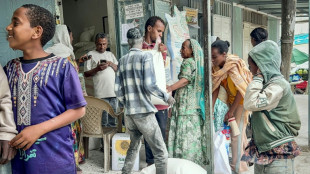 Internet disrupted in Ethiopia as conflict rages

Italy hosts the world's top paralympic athletes this month, but just getting across the street in Rome can feel like an Olympian task for wheelchair users.
"Sometimes, it's just easier to ride on the road," said Alessandro Bardini, a 48-year-old lawyer, as he navigated the high kerb and cobbles of the Eternal City.
Paralympic organisers and Italy's government have invested tens of millions of euros in making the venues and areas around the Milan-Cortina Games more accessible for people with disabilities.
More than 80 percent of Milan metro stations were already fully accessible, as were all buses, but the city has invested 55 million euros ($64 million) in upgrading the rest, according to the International Paralympic Committee (IPC).
But the story is not the same across Italy, particularly in the capital Rome, known as much for its uneven roads and anarchic parking as for its ancient ruins.
Bardini was left paraplegic after a motorcycle accident in 1998, and is now an activist for disability rights.
On a recent morning in Prati, a wealthy district near the Vatican, he took AFP with him as he weaved his way between scooters and cars and onto streets of cobbles.
The famed "Sanpietrini" cobbles are pretty but "don't provide any stability -- you risk getting stuck and falling", Bardini said.
At a pedestrian crossing, a small ramp has been cut into the kerb, but only on one side of the road, meaning he can go up one side, but not down the other.
Even in newly renovated areas, little thought appears to have been given to wheelchair users.
In Piazza Pia, an intersection in front of St Peter's Basilica redeveloped for the Vatican's 2025 Jubilee Holy Year, features "a staircase that could have been a ramp", Bardini said.
"It's an insult to people with motor disabilities," he said.
"I am so angry to see that in 2026, they are still building like this, with barriers."
- Paralympic mirror -
Taking public transport is another adventure. While 61 of Rome's 77 metro stations have lifts, 13 have only stairlifts, which require an attendant to operate, according to the ATAC public transport body.
Often this requires a wait. Double that if there is a stairlift at both ends, add time waiting for space on a busy train and it can take 40 minutes to travel just one stop.
Some stations remain completely inaccessible, ATAC acknowledged, including the one near the Spanish Steps -- one of Rome's most iconic landmarks.
The city council told AFP it has brought 80 percent of its road network up to standard as part of a major works programme.
But it noted that 15 boroughs share responsibility for local roads, leading to major disparities in maintenance.
The council has also significantly boosted its fleet of specially adapted taxis, from 40 five years ago to 250 today.
They are reserved for those who need them, and in February this year, they provided 24,400 trips.
Bardini said he believed there was "a lack of willpower" to change the situation -- and he had little faith the Paralympics would change that.
"The Paralympics are an excellent mirror to show what people with disabilities can do, but then they remain in the Olympic year," he said.
"Once the Olympics are over, the spotlight is turned off... everything goes back to how it was before."
P.Keller--VB