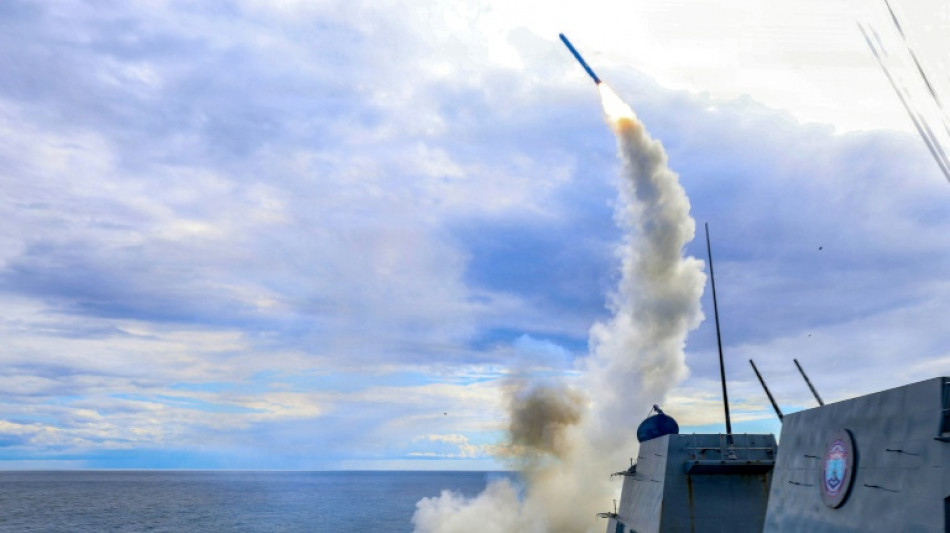
Mideast war risks sending global economy into stagflation / Photo: © US NAVY/AFP

 Assefa seeks 'better than my best' at Berlin marathon

 US court refuses to overturn Pentagon ban on Anthropic

 Verstappen and Norris blame slow cars as Mercedes tops qualifying

 Crowds cheer pope in Paris after AI 'paradise of machines' warning

 Teen swimmer makes Games history as Thai, Chinese sprinters win gold
 Man City found guilty of 114 Premier League charges - reports
 Concerns over 'missing' UK explorer Ranulph Fiennes

 Suspected Paris killer of Argentine rugby star begs forgiveness
 Oil prices fall on cautious hopes for US-Iran progress

 Noskova, Muchova take Czech Republic into BJK Cup final

 Thai sprinter Puripol breaks own Asian Games record to win 100m gold
 Russell takes pole for Azerbaijan GP, Antonelli crashes out
 Williams boss hails Chadwick as F1 inspiration for women
 World No.1 Sinner delays return with China Open withdrawal

 South Lebanon children return to school destroyed by Israel strike

 Jewish group urges Berlin far-left vote winners to tackle antisemitism

 European stock markets climb as oil prices drop

 Trump accuser E. Jean Carroll finally has her damages
 Germany's Havertz, Musiala ruled out of Greece match with injury
 Ireland's Gaza stance spills from Eurovision into football
 Welcome aboard the Costa Serena, the Asian Games floating hotel

 Asian markets mixed after recent oil surge

 Cash for nature protection: hotelier's offer to Principe islanders

 US miner KoBold bets on AI to gain edge in DR Congo mineral hunt

 Internet disrupted in Ethiopia as conflict rages
An extended conflict in the Middle East after the US and Israel launched strikes on Iran could trigger global stagflation -- a troublesome blend of high inflation and anaemic growth -- due to spiking oil and gas prices, economists warned.
- Will there be an oil shock ? -
The conflict has nearly halted traffic through the Strait of Hormuz, through which around 20 percent of global seaborne oil passes, with several ships attacked.
Global oil prices shot higher on Monday, with the Brent crude international reference oil contract up nearly nine percent at $79.30 per barrel at 1410 GMT.
It briefly surpassed $80 per barrel earlier in the day, and was up considerably from the $61 per barrel at the start of the year.
Economist Sylvain Bersinger said the war risks "creating a third oil shock after those in 1973 and 1979 and the 2022 gas shock".
Europe's benchmark gas price shot more than 50 percent higher on Monday.
He said the price of oil could rise to $110 per barrel, but added that was no longer exceptional as oil prices had risen over $140 in 2008 and were above $100 in the 2010s.
Adam Hetts at asset manager Janus Henderson said that while oil prices would certainly rise, the increase should remain "at reasonable levels".
- What impact on global trade? -
The conflict could act as a shock to trade "at the worst possible moment", said economists at ING bank.
The global trading system is already under stress from US President Donald Trump's tariff offensive as well as the fragmentation of supply chains since Covid and the war in Ukraine.
Moreover the closure of the Gulf airspace is disrupting aviation between European and Asia, they noted.
For Ruben Nizard, head of political risk research at Coface, a trade credit insurance company, this crisis could also "throw another wrench into the works by driving up maritime freight costs" and pushing up inflation.
"At the global level, this would open the door to an economic scenario of stagflation," he added, referring to a situation with high inflation and weak or non-existent growth.
- What impact on the global economy? -
According to economists at Natixis bank, a prolonged disruption of traffic in the Strait of Hormuz "would have major implications for markets, but also for inflation dynamics and overall economic stability".
They added that "China would be particularly affected by this war."
Cyrille Poirier-Coutansais, director of the research department at the French Navy's Centre for Strategic Studies, agreed that China is particularly dependent upon oil shipped through the Strait of Hormuz.
"The question is whether there will be enough fuel to keep the world's factory running," he told AFP.
For the economist Sylvain Bersinger the impact on Europe will likely be less than the 2022 gas shock, which would help France in particular to avoid a recession.
In a sign of declining investor confidence, the interest rate on European sovereign bonds climbed on Monday.
The yield on 10-year German government bonds, the benchmark in the eurozone, stood at 2.70 percent in afternoon trading, compared with 2.64 percent on Friday.
- What risks in a long war? -
The intensity and duration of the conflict will be key in determining its impact.
"In a prolonged conflict, the combination of higher energy costs, disrupted logistics, and a generalised confidence shock would constitute a meaningful drag on global trade volumes at precisely the moment the world economy was still digesting the inflationary and growth consequences of the tariff shock," said economists at ING bank.
Coface's Nizard said they estimated that "an increase of roughly 15 dollars in the price of Brent over a prolonged period could shave about 0.2 percentage points off global growth and add almost half a point to inflation."
These are "not insignificant" effects in a context of "fairly fragile global economic growth", he added.
K.Sutter--VB