Vietnam AI law takes effect, first in Southeast Asia / Photo: © AFP

 Assefa seeks 'better than my best' at Berlin marathon

 US court refuses to overturn Pentagon ban on Anthropic

 Verstappen and Norris blame slow cars as Mercedes tops qualifying

 Crowds cheer pope in Paris after AI 'paradise of machines' warning

 Teen swimmer makes Games history as Thai, Chinese sprinters win gold

 Man City found guilty of 114 Premier League charges - reports

 Concerns over 'missing' UK explorer Ranulph Fiennes

 Suspected Paris killer of Argentine rugby star begs forgiveness

 Oil prices fall on cautious hopes for US-Iran progress

 Noskova, Muchova take Czech Republic into BJK Cup final

 Thai sprinter Puripol breaks own Asian Games record to win 100m gold

 Russell takes pole for Azerbaijan GP, Antonelli crashes out

 Williams boss hails Chadwick as F1 inspiration for women

 World No.1 Sinner delays return with China Open withdrawal

 South Lebanon children return to school destroyed by Israel strike

 Jewish group urges Berlin far-left vote winners to tackle antisemitism

 European stock markets climb as oil prices drop

 Trump accuser E. Jean Carroll finally has her damages

 Germany's Havertz, Musiala ruled out of Greece match with injury

 Ireland's Gaza stance spills from Eurovision into football

 Welcome aboard the Costa Serena, the Asian Games floating hotel

 Asian markets mixed after recent oil surge

 Cash for nature protection: hotelier's offer to Principe islanders

 US miner KoBold bets on AI to gain edge in DR Congo mineral hunt

 Internet disrupted in Ethiopia as conflict rages

A law regulating artificial intelligence went into effect in Vietnam on Sunday, making it the first country in Southeast Asia with a comprehensive framework on the booming technology.
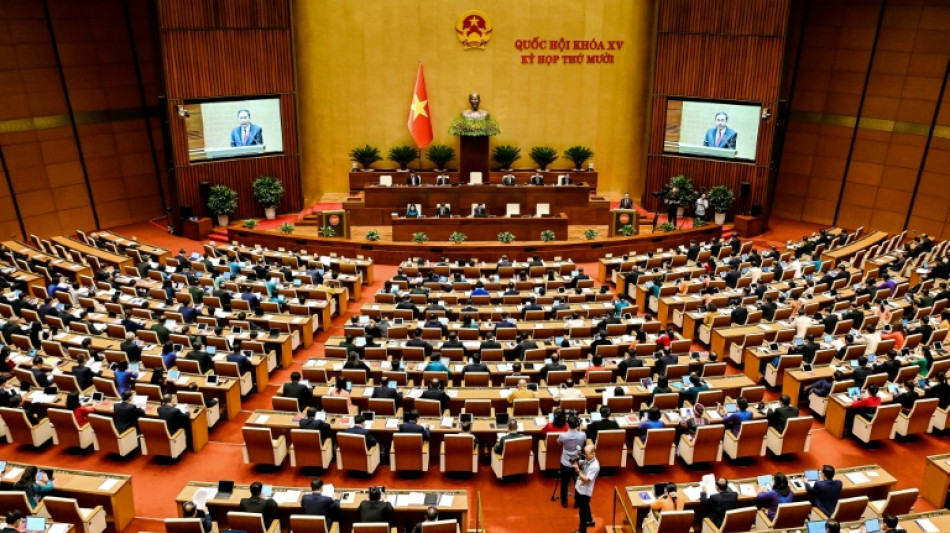
Passed by the National Assembly in December, the law focuses on the risks posed by generative AI, requiring human oversight and control along the lines of the European Union's landmark AI Act.
Many nations are moving to address the dangers of chatbots and image generators -- from misinformation to online abuse and copyright violations -- but few have enacted legislation.
The legislation, which is in force as of March 1, "paves the way for Vietnam to deeply integrate with international standards while maintaining digital sovereignty", the government said in a December report.
It requires companies to clearly label AI-generated content such as deepfakes that cannot readily be differentiated from reality.
It also requires them to disclose to customers when they are interacting with an artificial rather than human agent.
The law applies to developers as well as providers and deployers of the technology, whether they are Vietnamese organisations or foreign entities operating in the country.
Vietnam has set ambitious double-digit growth targets for the next five years, with expansion of the digital economy a key part of its development strategy.
AI and the data economy are "pillars" of a "more sustainable and smarter new development" model, Prime Minister Pham Minh Chinh was quoted as saying Wednesday on the government's website.
Under the law, the government will establish a national AI computing centre, improved data resources and large language models in Vietnamese.
- 'Not the final word' -
So far only a handful of countries have implemented far-reaching regulatory frameworks on AI.
The United States has opposed what Vice President JD Vance called "excessive regulation", warning it could stifle innovation in the key sector.
In January, South Korea became the first country to have an AI law take full effect, while the European Union is gradually phasing in a set of rules that will become completely applicable in 2027.
While Vietnam's law is a regulatory milestone, analysts said its impact would depend on how the government enforces it and on what guidance it issues on implementation.
The law is "not the final word" but rather a "decisive starting point", Vietnam-based LNT & Partners law firm said in an analysis on its website.
"It establishes responsibility, human control, and risk management as the governing themes of AI regulation," the firm said.
However, it added, "the true impact will depend on implementing decrees, sectoral regulations, and enforcement practice".
Patrick Keil, senior legal adviser at law firm DFDL, called the law "a significant statement of national ambition" but told AFP businesses will continue to face some uncertainty about their obligations until the government issues further guidance.
At an AI summit hosted by New Delhi in February, 91 countries and international organisations called for "secure, trustworthy and robust" AI.
But their declaration, signed by the United States and China, was criticised by AI safety campaigners for being too generic to protect the public.
R.Braegger--VB