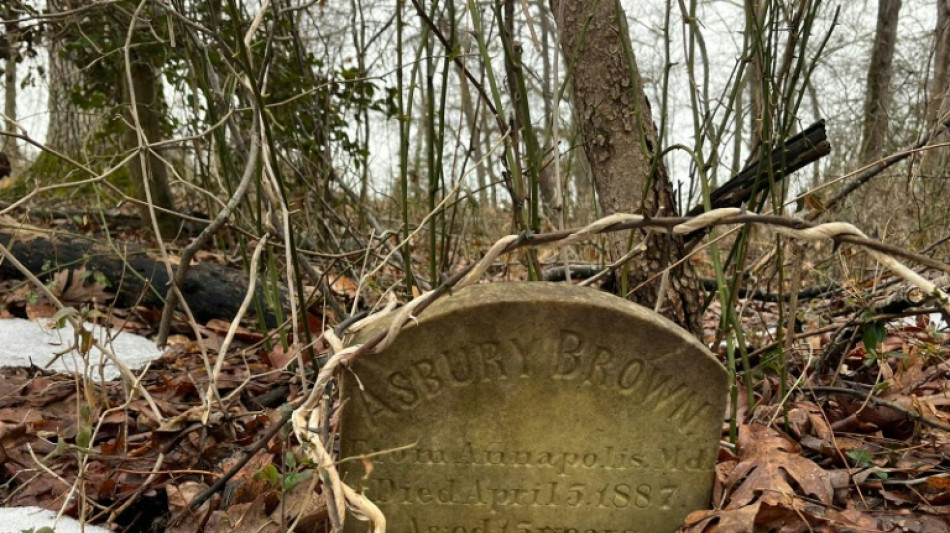
'A crime scene': US researchers examine unmarked graves of dozens of Black children / Photo: © AFP

 Spotting AI writing: how reliable are the detectors?

 French youth await pope after AI 'paradise of machines' warning

 Man City found guilty of Premier League charges, set to appeal: reports
 Embolo follows Xhaka out of Swiss squad over fake Covid documents
 Trump, Xi inspect founding documents of US democracy to close summit

 'Bottle Claus': Kipchoge's 'hero' helping runners chase Berlin marathon glory

 Olympic medallist Samba-Mayela handed provisional doping ban

 First US trial against TikTok to open Monday

 Palmer misses 'too many' England games, says Tuchel

 UN refugees chief warns conditions in W.Sahara 'deteriorating'

 Antonelli 'mad' about crash in Azerbaijan qualifying
 'Perfect lap' gives Russell pole for Azerbaijan GP as Antonelli crashes out
 UN Security Council condemns Houthi attacks on Saudi Arabia

 China swimmer makes Asian Games history as Thai wins 100m sprint

 Top French literary prize drops best-selling novel over AI claims

 US 'must choose' whether to end war: Iran president

 Pope warns against losing humanity in AI-driven 'paradise of machines'

 Pope warns against losing humanity in 'paradise of machines'

 From FBI warning to literary acclaim: the Russian journalist who took on Putin

 China swimmer in Asian Games first as North Korea lifters reign

 French literary prize removes novel from longlist after AI claims

 China's Zhang wins record seventh Asian Games swimming gold

 Verstappen edges Russell in final practice in Azerbaijan

 English, Spanish, Italian, German football leagues call for FIFA reform

 Pope arrives in France on first official visit in 18 years

Mark Davis was just 13 years old when he perished in a juvenile detention facility for Black boys in the eastern US state of Maryland some 140 years ago.
Today, his remains lie in an abandoned graveyard in the woods, covered by dead leaves and snow, along with the graves of some 200 other Black boys and teenagers held in conditions that researchers describe as inhumane.
A team from Georgetown University is investigating their deaths at the House of Reformation and Instruction for Colored Children, a segregated juvenile detention facility in Cheltenham, Maryland, and memorializing them.
Known as the Forgotten Children Initiative, the project aims to document the identities of the children buried here in the late 19th and early 20th centuries, mostly in unmarked graves, in order to preserve their legacies and locate any living relatives.
"Some of those children that (were) just picked up for just truancy and just never made it back home," said Tyrone Walker, who heads a reintegration program for former inmates at Georgetown. "What did they tell their parents? Or do their parents even know? They probably thought they ran away."
Walker, an African American who in the 1990s was himself a juvenile inmate at Cheltenham, added: "Nobody's been brought to justice. Since this happened to young Black boys, it seemed like nobody cared."
- 'Severely neglected' -
Opened in 1873, the privately operated detention facility housed petty delinquents and orphans, said Marc Schindler, a professor at Georgetown who leads the project.
Some were held on loitering charges, while others were detained over their perceived "incorrigibility."
Officially, the buried children were listed as having died of tuberculosis, pneumonia, or exhaustion, between 1877 and 1939.
All of them were Black, and researchers believe many actually died because they were overworked, underfed and denied proper care.
Crystal Foretia, a former policy administrator at the Maryland Department of Juvenile Services (DJS), said the House of Reformation has a "vast history of physical abuse, forced labor, lack of educational opportunities."
Numerous testimonies, as well as reporting by the Baltimore newspaper the Afro-American, detail the terrible conditions in which these children were incarcerated and made to work in fields.
According to Schindler, two boys who were kept in an unheated cell in freezing temperatures had their legs amputated due to frostbite, something that was not reflected in their death certificates.
"Now we know that he was very, very severely neglected, if not abused, and that resulted in his death," Schindler said of one of the youths.
Rosie Clark, a Maryland volunteer who did some genealogical research on the Cheltenham burial site, asserts that many official documents were forged.
"These death certificates were filled out by the people who were in charge," she told AFP. "If a child was beaten to death, they're not going to say it on the death certificate."
- 'A crime scene' -
In the 1930s, the state of Maryland took over the facility, after the shooting of a Black minor by a white guard drew national attention. The modern facility now sits several hundred meters from the original site.
"I had no idea that just across the fence, there was a crime scene," said Walker, the former inmate. "This could have been me in one of those graves."
Nearby, a well-maintained veterans cemetery can be seen, its tombstones decorated with wreaths and flowers.
"They recognize those veterans, rightfully so, but shouldn't these children be recognized and honored in the same way?" Walker asked.
He added: "I definitely want to see a memory project done and see the families involved. Many families never received the closure they deserved."
The Forgotten Children Initiative has already located the descendants of six of the buried children.
Schindler has also identified dozens of similar sites across the United States, including one in Florida that inspired Colson Whitehead's Pulitzer Prize–winning 2020 novel "The Nickel Boys."
But the Maryland site is believed to be the largest in the country.
Maryland's DJS has just received funding to identify how many children were buried at the site and to restore their graves, and a bill has been introduced in the state legislature to create a commission of inquiry into the House of Reformation.
A.Ruegg--VB