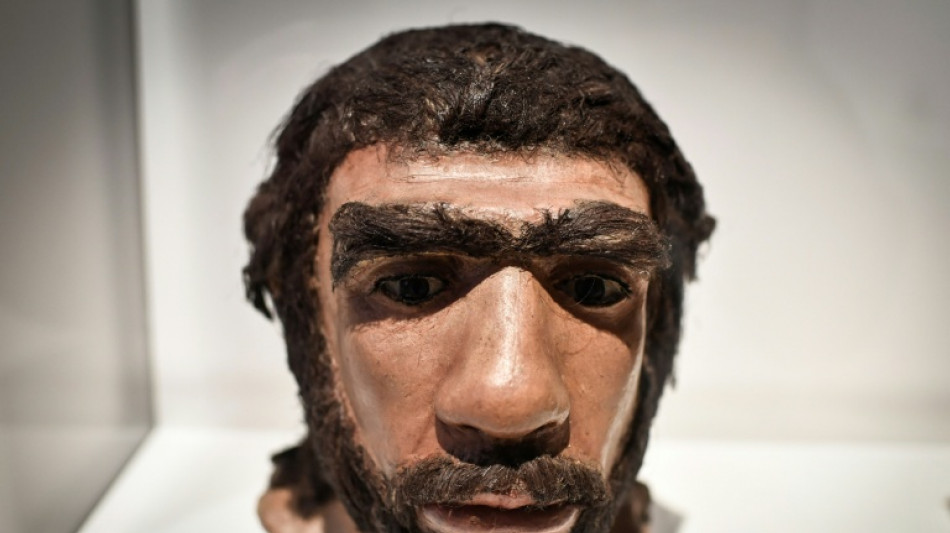
The sex lives of Neanderthal males - and human females / Photo: © AFP

 Spotting AI writing: how reliable are the detectors?

 French youth await pope after AI 'paradise of machines' warning

 Man City found guilty of Premier League charges, set to appeal: reports

 Embolo follows Xhaka out of Swiss squad over fake Covid documents

 Trump, Xi inspect founding documents of US democracy to close summit

 'Bottle Claus': Kipchoge's 'hero' helping runners chase Berlin marathon glory

 Olympic medallist Samba-Mayela handed provisional doping ban

 First US trial against TikTok to open Monday

 Palmer misses 'too many' England games, says Tuchel

 UN refugees chief warns conditions in W.Sahara 'deteriorating'

 Antonelli 'mad' about crash in Azerbaijan qualifying
 'Perfect lap' gives Russell pole for Azerbaijan GP as Antonelli crashes out

 UN Security Council condemns Houthi attacks on Saudi Arabia

 China swimmer makes Asian Games history as Thai wins 100m sprint

 Top French literary prize drops best-selling novel over AI claims

 US 'must choose' whether to end war: Iran president

 Pope warns against losing humanity in AI-driven 'paradise of machines'

 Pope warns against losing humanity in 'paradise of machines'

 From FBI warning to literary acclaim: the Russian journalist who took on Putin
 China swimmer in Asian Games first as North Korea lifters reign

 French literary prize removes novel from longlist after AI claims

 China's Zhang wins record seventh Asian Games swimming gold

 Verstappen edges Russell in final practice in Azerbaijan

 English, Spanish, Italian, German football leagues call for FIFA reform

 Pope arrives in France on first official visit in 18 years

Dating out of your league? New research says it's a tale as old as time.
A study out Thursday in Science argues that Neanderthal men and human women were particularly inclined to mate, a sexual habit that offers insight into the evolution of the modern human genome.
In 2010 scientists reconstructed the Neanderthal genome -- blockbuster research that allowed for analysis making clear that the species interbred.
Most people living today have some residual fragments of DNA from our ancient evolutionary cousins.
Research indicates both groups descended from a population living in Africa some million years ago.
They eventually diverged, with anatomically modern humans evolving in Africa, and Neanderthals migrating across Eurasia.
But over hundreds of millenia, human migrations resulted in interbreeding, researchers say.
Yet humans have little to no Neanderthal DNA on our X chromosomes -- one of two human chromosomes that determines an embryo's sex.
That was assumed to be the result of a natural selection.
The genes were biologically "toxic" to humans, researchers hypothesized, and eventually purged out -- in essence, the children who inherited those traits might not have lived to pass them on.
But the new study from geneticists at the University of Pennsylvania suggests the phenomenon has more social origins, and were actually the result of "long-standing mating preferences."
The team analyzed modern human DNA preserved in Neanderthals, and found an abundance on the X chromosome -- the mirror opposite of humans.
That result allowed them to rule out that reproduction between the species was incompatible.
Instead the gene flow "occurred predominantly between Neanderthal males and anatomically modern human females," said Alexander Platt, a senior research scientist on the study.
Since females have two X chromosomes and males just one, the math adds up: If Neanderthal males and modern human females were mating, more Neanderthal X chromosomes would enter the human gene pool, and vice versa.
Researchers said that sex-biased migration could also offer clues. But ancient mating habits "provided the simplest explanation," Platt said.
The larger "why" is unknown: Neanderthal men and modern human women might have been mating by choice, or violence and coercion could have been involved.
Researchers say they now hope to analyze the development of this mating pattern.
Possibilities include probing gender dynamics within Neanderthal society, or migration habits -- perhaps males were likely to leave their societies while females stayed with their families, for example.
B.Wyler--VB