
-
 Spotting AI writing: how reliable are the detectors?
-
Russia not preparing for conflict with Europe, Putin says
-
 French youth await pope after AI 'paradise of machines' warning
-
Trump's photo of Xi greeting carries signs of AI
-
 Man City found guilty of Premier League charges, set to appeal: reports
-
Six missing after building blast in historic Athens district
-
 Embolo follows Xhaka out of Swiss squad over fake Covid documents
-
Millions in US northeast brace for powerful storm
-
 Trump, Xi inspect founding documents of US democracy to close summit
-
Assefa seeks 'better than my best' at Berlin marathon
-
 'Bottle Claus': Kipchoge's 'hero' helping runners chase Berlin marathon glory
-
US court refuses to overturn Pentagon ban on Anthropic

-
 Olympic medallist Samba-Mayela handed provisional doping ban
-
Verstappen and Norris blame slow cars as Mercedes tops qualifying
-
 First US trial against TikTok to open Monday
-
Crowds cheer pope in Paris after AI 'paradise of machines' warning
-
 Palmer misses 'too many' England games, says Tuchel
-
Teen swimmer makes Games history as Thai, Chinese sprinters win gold

-
 UN refugees chief warns conditions in W.Sahara 'deteriorating'
-
Man City found guilty of 114 Premier League charges - reports
-
 Antonelli 'mad' about crash in Azerbaijan qualifying
-
Concerns over 'missing' UK explorer Ranulph Fiennes
-
 'Perfect lap' gives Russell pole for Azerbaijan GP as Antonelli crashes out
-
Suspected Paris killer of Argentine rugby star begs forgiveness
-
 UN Security Council condemns Houthi attacks on Saudi Arabia
-
Oil prices fall on cautious hopes for US-Iran progress
-
 China swimmer makes Asian Games history as Thai wins 100m sprint
-
Noskova, Muchova take Czech Republic into BJK Cup final
-
 Top French literary prize drops best-selling novel over AI claims
-
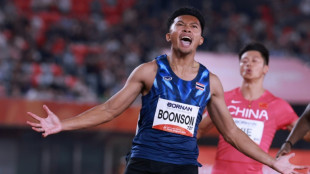
Thai sprinter Puripol breaks own Asian Games record to win 100m gold
-
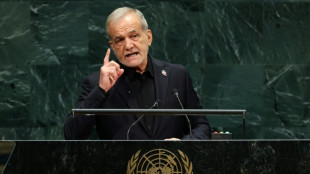 US 'must choose' whether to end war: Iran president
-
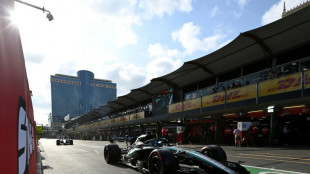
Russell takes pole for Azerbaijan GP, Antonelli crashes out
-
 Pope warns against losing humanity in AI-driven 'paradise of machines'
-
Williams boss hails Chadwick as F1 inspiration for women
-
 Pope warns against losing humanity in 'paradise of machines'
-
World No.1 Sinner delays return with China Open withdrawal

-
 From FBI warning to literary acclaim: the Russian journalist who took on Putin
-
South Lebanon children return to school destroyed by Israel strike
-
 China swimmer in Asian Games first as North Korea lifters reign
-
Jewish group urges Berlin far-left vote winners to tackle antisemitism
-
 French literary prize removes novel from longlist after AI claims
-
European stock markets climb as oil prices drop
-
 China's Zhang wins record seventh Asian Games swimming gold
-
Trump accuser E. Jean Carroll finally has her damages

-
 Verstappen edges Russell in final practice in Azerbaijan
-
Germany's Havertz, Musiala ruled out of Greece match with injury
-
 English, Spanish, Italian, German football leagues call for FIFA reform
-
Ireland's Gaza stance spills from Eurovision into football

-
 Pope arrives in France on first official visit in 18 years
-
Welcome aboard the Costa Serena, the Asian Games floating hotel
Argentina, Uruguay ratify massive EU-South America trade deal
Argentina and Uruguay on Thursday ratified a massive trade deal with the European Union that has generated enthusiasm from Brasilia to Buenos Aires but sparked protests and a legal challenge in Europe.
Argentine senators voted 69-3 in favor of the agreement to create one of the world's biggest free trade zones, sealing its adoption days after it passed the lower house.
Hours earlier, neighboring Uruguay was first out of the blocks to ratify the deal, which has been fiercely opposed by farmers in some EU countries.
It still requires approval from lawmakers in the European Parliament, which referred it to the EU's top court within days of being inked in January.
The deal between the EU and the four founding members of the Mercosur bloc -- Argentina, Brazil, Paraguay and Uruguay -- was a quarter century in the making.
Argentine President Javier Milei, a free market champion, hailed the ratification of the accord.
"Openness = prosperity," Milei wrote on X.
In a later statement he said the agreement was a chance to promote economic development and attract investment and expressed hope that Brazil and Paraguay would quickly adopt it also.
It eliminates tariffs on more than 90 percent of trade between the two blocs, which together account for 30 percent of global GDP and more than 700 million consumers.
The two sides have yet to agree on export quotas.
The South Americans have moved to quickly enshrine it in their legislation, in an apparent bid to pressure Brussels to follow suit.
In Brazil, the lower house of parliament backed it by a large majority on Wednesday.
The accord, which was energetically promoted by EU chief Ursula von der Leyen and Brazilian President Luiz Inacio Lula da Silva as well as the leaders of Germany and Spain, aims to boost EU exports of vehicles, machinery and wines and spirits.
In return, South American producers of beef, sugar, rice, honey and soybeans gain easier access to one of the world's largest economies.
Brussels can decide to implement it provisionally while waiting for the EU Court of Justice on its legality, but has not yet taken a decision on doing so.
South American countries in the meantime are ploughing ahead.
- 'It won't be easy' -
Uruguayan Foreign Minister Mario Lubetkin hailed his country's ratification as "a signal" to Europe, which the South Americans have accused of foot-dragging.
The agreement "is no longer under debate," Lubetkin said, while anticipating that "it won't be easy" to implement.
Argentine political analyst Fabian Calle said Mercosur members were anxious to forestall any "excuses from the European side that (the deal) is being postponed or not being implemented due to a lack of ratification" on the South American side.
Some EU nations like Germany hope the pact could help boost exports at a time of global trade tensions, driven by US President Donald Trump's weaponizing of tariffs.
France, however, unsuccessfully tried to block the deal over concerns for its farmers, who fear being undercut by cheaper goods from Brazil and its neighbors.
The European Commission reacted to those concerns by adopting a series of safeguards for its producers.
Within Mercosur states, the deal has broad support, despite reservations from some producers.
Argentine wine producers namely fear competition from their French, Italian and Spanish counterparts.
A.Ruegg--VB