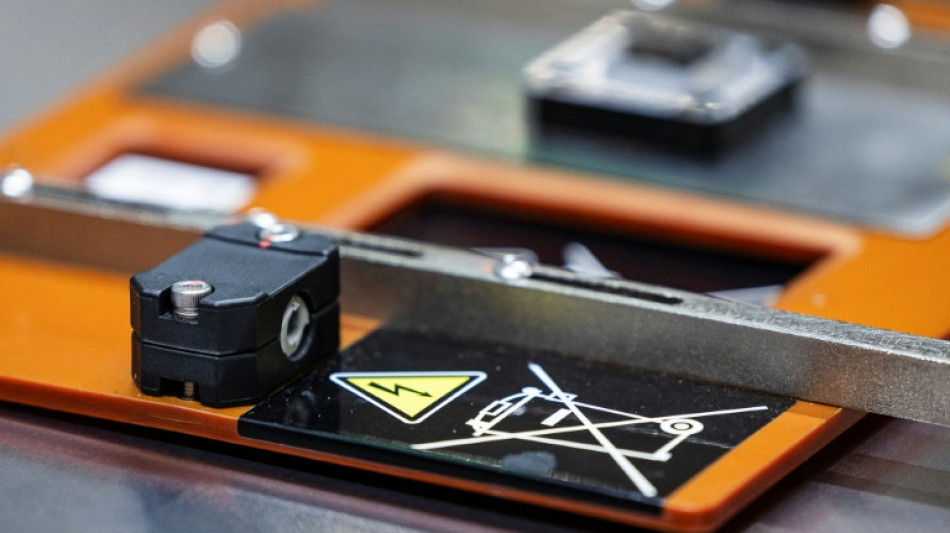
Export ban sparks rush to process lithium in Zimbabwe / Photo: © AFP/File

 Spotting AI writing: how reliable are the detectors?
 French youth await pope after AI 'paradise of machines' warning
 Man City found guilty of Premier League charges, set to appeal: reports

 Embolo follows Xhaka out of Swiss squad over fake Covid documents
 Trump, Xi inspect founding documents of US democracy to close summit

 'Bottle Claus': Kipchoge's 'hero' helping runners chase Berlin marathon glory
 Olympic medallist Samba-Mayela handed provisional doping ban

 First US trial against TikTok to open Monday

 Palmer misses 'too many' England games, says Tuchel

 UN refugees chief warns conditions in W.Sahara 'deteriorating'

 Antonelli 'mad' about crash in Azerbaijan qualifying

 'Perfect lap' gives Russell pole for Azerbaijan GP as Antonelli crashes out

 UN Security Council condemns Houthi attacks on Saudi Arabia
 China swimmer makes Asian Games history as Thai wins 100m sprint

 Top French literary prize drops best-selling novel over AI claims

 US 'must choose' whether to end war: Iran president
 Pope warns against losing humanity in AI-driven 'paradise of machines'

 Pope warns against losing humanity in 'paradise of machines'

 From FBI warning to literary acclaim: the Russian journalist who took on Putin

 China swimmer in Asian Games first as North Korea lifters reign
 French literary prize removes novel from longlist after AI claims
 China's Zhang wins record seventh Asian Games swimming gold

 Verstappen edges Russell in final practice in Azerbaijan

 English, Spanish, Italian, German football leagues call for FIFA reform

 Pope arrives in France on first official visit in 18 years

Zimbabwe's ban on raw lithium exports is forcing Chinese miners to rethink their strategy, speeding up plans to process the metal locally instead of shipping it to China's vast rechargeable battery industry.
The country is Africa's largest lithium producer and has one of the world's largest reserves, according to the US Geological Survey (USGS).
Zimbabwe already banned the export of lithium ore in 2022 and in 2025 announced it would halt exports of lithium concentrates from January 2027.
But on Wednesday it imposed the ban with immediate effect, leaving unclear what the lithium mining sector will do in the short term as Zimbabwe currently has no facilities to process lithium concentrates.
The move, which also included a blanket ban on export of all raw minerals, aims to capture the added value of refining and processing, thus creating jobs and additional government tax revenue.
But critics say the push to refine should have come sooner, with Zimbabwe already having lost out on several years of revenues for the hard-pressed local economy.
Prospect Lithium Zimbabwe, owned by Zhejiang Huayou Cobalt, has spent $400 million on a processing plant that should be operational in the coming weeks, its representative Patience Chizodza told state broadcaster ZBC.
It will reportedly be the first factory in Africa to refine lithium concentrate into lithium sulfate -- a powdered form that is one step closer to the product used in batteries.
The facility should be capable of handling 400,000 tonnes a year of concentrate.
The Zimbabwe state-owned Mutapa Energy Minerals is set to start work in the coming months on a similar plant, chief executive officer Innocent Rukweza told reporters earlier this month.
"We expect that by mid-year -- around June at the latest -- construction of a concentrate-processing plant will be under way," Rukweza said.
The $270-million facility funded by Chinese firms would be able to process 600,000 tonnes annually, he said.
- 'Too little, too late' -
Bikita Minerals, Zimbabwe's largest lithium mine and owned by Sinomine Resources Group, is working on feasibility studies for the construction of a lithium sulphate plant in December, spokesperson Tinomuda Chakanyuka said.
"The project, which will be developed in phases, represents an estimated investment of approximately $500 million from shareholders," Chakanyuka told AFP.
He said the facility will increase local capacity to separate minerals and "contribute to Zimbabwe's broader industrialisation and export diversification objectives."
Global demand for the soft, white metal was up 20 percent last year from 2024, with a key factor being EV sales growth in China and Europe and increased demand for batteries, the USGS said.
Zimbabwe's exports of lithium concentrate rose to 1.5 million metric tonnes last year, generating government revenue of $571.6 million, the Minerals Marketing Authority of Zimbabwe (MMCZ) announced in early February.
The Zimbabwean government's moves to ban exports of raw minerals didn't impress its critics.
"Government is doing too little, too late," said Farai Maguwu, executive director of Zimbabwe's Centre for Natural Resource Governance (CNRG).
With the new rush for critical minerals around the world, "people are asking serious questions about the benefits to the producer country," he said.
"A country like Zimbabwe is exporting raw lithium and, in the process, enriching China at its own expense," Maguwu said.
Instead it should be building its own "mine-to-market ecosystem" that manufactures and markets lithium products, he added.
Economist Godfrey Kanyenze accused the government of a "deficit in policy implementation" when it effectively gave a five-year grace period on the 2022 lithium ore ban by allowing exports of raw concentrates.
Kanyenze said state oversight at Chinese-owned lithium mines was limited, making it difficult to determine how much companies actually produced and earned.
There have also been allegations of environmental damage and exploitation of workers, including by paying low wages.
"Zimbabwe must learn from countries like Norway, Botswana and Kuwait, which safeguard their natural resources through firm, consistent and strategic policy frameworks," he said.
G.Frei--VB