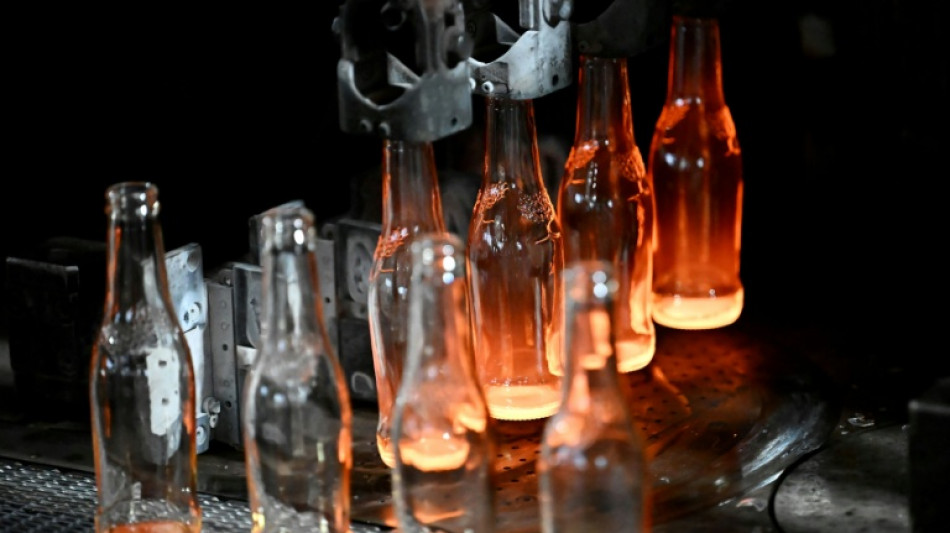
UK manufacturers struggle under sky-high energy bills / Photo: © AFP

 Jay-Z rape accuser says she made 'false accusations'

 Senegal draw first match under Vieira and Nigeria survive scare

 Trump, Xi end summit long on pomp, but short on progress

 Russia not preparing for conflict with Europe, Putin says
 Trump's photo of Xi greeting carries signs of AI

 Six missing after building blast in historic Athens district

 Millions in US northeast brace for powerful storm

 Assefa seeks 'better than my best' at Berlin marathon

 US court refuses to overturn Pentagon ban on Anthropic

 Verstappen and Norris blame slow cars as Mercedes tops qualifying

 Crowds cheer pope in Paris after AI 'paradise of machines' warning

 Teen swimmer makes Games history as Thai, Chinese sprinters win gold

 Man City found guilty of 114 Premier League charges - reports
 Concerns over 'missing' UK explorer Ranulph Fiennes
 Suspected Paris killer of Argentine rugby star begs forgiveness

 Oil prices fall on cautious hopes for US-Iran progress

 Noskova, Muchova take Czech Republic into BJK Cup final

 Thai sprinter Puripol breaks own Asian Games record to win 100m gold

 Russell takes pole for Azerbaijan GP, Antonelli crashes out
 Williams boss hails Chadwick as F1 inspiration for women

 World No.1 Sinner delays return with China Open withdrawal

 South Lebanon children return to school destroyed by Israel strike

 Jewish group urges Berlin far-left vote winners to tackle antisemitism

 European stock markets climb as oil prices drop

 Trump accuser E. Jean Carroll finally has her damages
Molten glass drops through chutes before being blown into bottles at manufacturer Encirc's northwest England plant, where intensive operations are under strain from exorbitant energy prices weighing on Britain's heavy industry.
"We're paying a lot more energy costs than our European competitors," said Oliver Harry, head of corporate affairs at Encirc, which makes over a third of the UK's glass bottles.
Britain has some of the highest energy prices in Europe, driven by its reliance on natural gas and the costs of transitioning to renewables, which are passed on to bills.
The country's industrial electricity prices were also the steepest in Europe in 2024, according to the latest annual government data.
Standing in the intense heat of the factory's two huge furnaces, Harry warned: "We're already seeing an increase in imports into the UK as customers turn to cheap, more unsustainable glass producers", notably from China and Turkey.
- More action needed -
Across energy-intensive industries -- from steel and chemicals to glass and cement -- companies are warning that government support does not go far enough to keep them competitive.
The government said it will increase discounts on electricity network charges to 90 percent from April, which will save around 500 of the UK's biggest energy users a cumulative £420 million ($570 million) per year in electricity bills.
"Lowering bills is central to every decision we make," a government spokesperson told AFP.
But the steel sector, already weakened by the closure of traditional coal-fired blast furnaces, argues that more action is needed.
"The industry still faces industrial power prices almost 40 percent higher than in France and Germany," Gareth Stace, director general of the steel union, UK Steel, told AFP.
The union has called for stronger protections similar to those in France, Italy, Spain and the UAE to shield heavy industry from high wholesale power costs.
- Decarbonisation -
Electricity is so expensive in the UK largely because more than a quarter of its power still comes from gas, which surged in price after Russia's 2022 invasion of Ukraine.
While wholesale prices have since fallen, they remain elevated.
Under the liberalised electricity market, the last power station switched on to meet demand sets the price for all generators, and in the UK, that station is usually gas-powered.
"In France, nuclear sets the price fairly often and nuclear is cheaper ... so it's not always the same expensive gas that sets the price," Sam Frankhauser, professor of economics and climate change policy at Oxford University, told AFP.
In other countries "there's moments in the day where somebody cheaper sets the price and in the UK, those moments don't exist" as it is almost always a natural gas plant setting the price, he added.
At Encirc's Elton factory, where bottles clatter along the conveyor belts to be filled and labelled, executives say energy prices are inseparable from the push to decarbonise.
By the end of the decade, "we're going to be producing glass bottles that are 80 percent reduced carbon," said Harry.
"The UK managed to decarbonise the grid phenomenally because of the exit of coal," said Gregor Singer, professor at the London School of Economics.
"It's really unfortunate that this gas price shock came now, exactly at that point where you sort of exited coal but you don't quite have enough renewables yet."
"In the medium to long run... it's almost guaranteed that prices are coming down," he said.
B.Wyler--VB