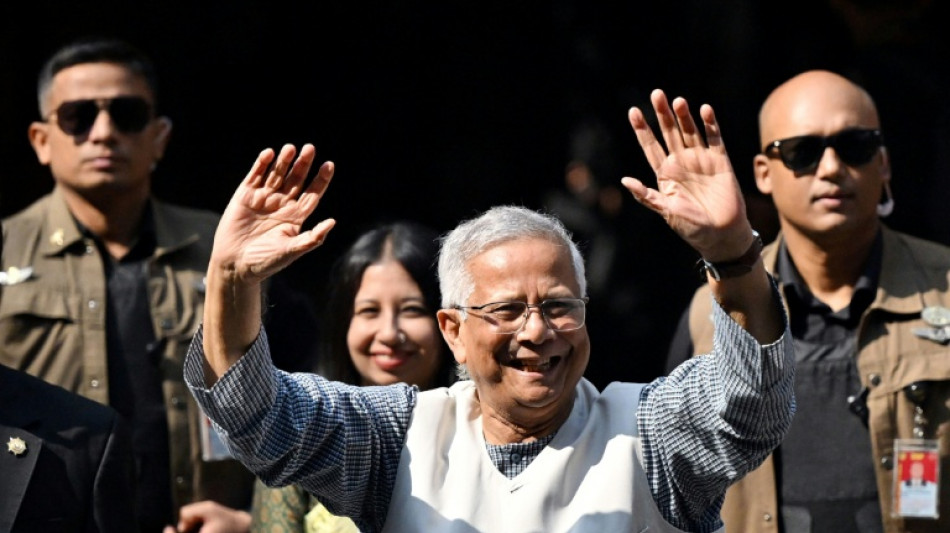
Bangladesh's Yunus 'banker to the poor', pushing democratic reform / Photo: © AFP

 Mancini finds positives in Italy loss, accepts fans' jeers

 Alcaraz helps Europe into Laver Cup lead
 Six missing after building collapses in historic Athens district

 Mbappe scores but suffers knee injury as Zidane gets debut France win

 Mancini's Italy return spoiled by Belgium defeat

 Rodri confident in Man City innocence despite reported charges

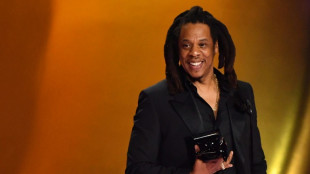 Jay-Z rape accuser says she made 'false accusations'

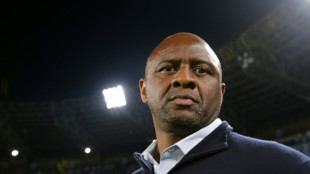 Senegal draw first match under Vieira and Nigeria survive scare

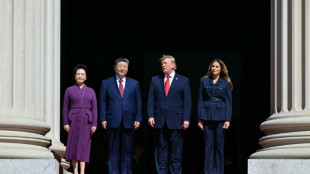 Trump, Xi end summit long on pomp, but short on progress

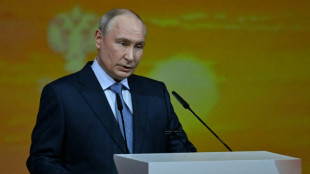 Russia not preparing for conflict with Europe, Putin says

 Trump's photo of Xi greeting carries signs of AI

 Six missing after building blast in historic Athens district

 Millions in US northeast brace for powerful storm
 Assefa seeks 'better than my best' at Berlin marathon
 US court refuses to overturn Pentagon ban on Anthropic

 Verstappen and Norris blame slow cars as Mercedes tops qualifying

 Crowds cheer pope in Paris after AI 'paradise of machines' warning

 Teen swimmer makes Games history as Thai, Chinese sprinters win gold
 Man City found guilty of 114 Premier League charges - reports

 Concerns over 'missing' UK explorer Ranulph Fiennes

 Suspected Paris killer of Argentine rugby star begs forgiveness

 Oil prices fall on cautious hopes for US-Iran progress

 Noskova, Muchova take Czech Republic into BJK Cup final
 Thai sprinter Puripol breaks own Asian Games record to win 100m gold
 Russell takes pole for Azerbaijan GP, Antonelli crashes out
After a life dedicated to fighting extreme poverty, Bangladesh's 85-year-old Nobel-winning microfinance pioneer Muhammad Yunus is set to end his biggest mission.
Yunus will hand over the reins of power to an elected government after 18 months as caretaker leader, steering the nation of 170 million people through peaceful elections after one of its most turbulent political periods.
The landslide victory of the Bangladesh Nationalist Party (BNP) -- whose leader Tarique Rahman is poised to become prime minister -- effectively marks Yunus's political retirement.
"We have ended the nightmare and begun a new dream," Yunus said as he voted on Thursday, beaming and calling the election "a day of freedom".
Yunus returned from self‑imposed exile in August 2024, days after the iron‑fisted government of Sheikh Hasina was overthrown and she fled to India by helicopter.
Students who spearheaded the uprising urged him to return, and the army handed over power to him as "Chief Advisor" of the interim government.
- 'Build the country' -
"Be calm and get ready to build the country," he declared on arrival.
He launched an ambitious programme to seek justice against the ousted regime, and Hasina -- now a convicted fugitive in hiding in India -- was sentenced in absentia to death for crimes against humanity.
He pushed constitutional reforms aimed at preventing any future slide into authoritarian rule, and to overhaul a "completely broken-down" system of public administration.
His administration established multiple commissions to coax rival political factions into agreeing on a package of reforms.
That democratic charter -- including prime ministerial term limits, the creation of an upper house of parliament, stronger presidential powers and greater judicial independence -- was endorsed by 60 percent of voters, in a referendum held alongside the election.
But the early euphoria surrounding Yunus's leadership gradually gave way to frustration at the scale of the task.
He was criticised as a distant figure, and his unelected administration was accused of failing to rein in abuses by powerful security forces.
Rights groups, including Amnesty International, accused his government of the "misuse" of a draconian anti-terrorism act, under which hundreds of people were detained.
- 'Not born to suffer' -
Yunus, known worldwide as the "banker to the poorest of the poor", won the 2006 Nobel Peace Prize for pioneering microloans to rural women, enabling them to buy tools or equipment and raise their incomes.
Grameen Bank, which he founded, was hailed for helping unleash rapid economic growth in Bangladesh and became a model replicated across dozens of developing countries.
"Human beings are not born to suffer the misery of hunger and poverty," Yunus said during his Nobel lecture.
But his public profile in Bangladesh earned him the hostility of Hasina, and he was targeted with more than 100 criminal cases and a smear campaign accusing him of promoting homosexuality.
Hasina's government forced him out of Grameen Bank in 2011. In 2024 he was sentenced to six months in jail over alleged failures to create a workers' welfare fund -- charges widely condemned as politically motivated.
He was freed on bail and fled abroad, and was later acquitted on appeal after Hasina was ousted.
- 'Help people' -
The son of a goldsmith, Yunus was born in 1940 into a well-off family in the port city of Chittagong, now Chattogram. He credits his mother -- who never turned away anyone in need -- as his greatest influence.
Yunus won a Fulbright scholarship to study in the United States and returned soon after Bangladesh won independence from Pakistan in 1971 following a war.
He was chosen to head Chittagong University's economics department, but the young country was struggling through a famine, and he felt compelled to take practical action.
"I found it difficult to teach elegant theories of economics in the university classroom... I wanted to do something immediate to help people around me."
O.Schlaepfer--VB