Women in ties return as feminism faces pushback / Photo: © GETTY IMAGES NORTH AMERICA/AFP/File

 TikTok agrees to teen limits in US settlement following Meta
 Venezuela's oil cradle pins hopes on US energy deals

 US, China buy time with trade truce as pressure builds
 'Leo, Leo': Young Catholics give pope rockstar welcome in France

 Lula bans sports betting days ahead of Brazil's election

 Guatemala ensures survival of vulnerable 'fossil' fish

 Mancini finds positives in Italy loss, accepts fans' jeers

 Alcaraz helps Europe into Laver Cup lead
 Six missing after building collapses in historic Athens district
 Mbappe scores but suffers knee injury as Zidane gets debut France win
 Mancini's Italy return spoiled by Belgium defeat

 Rodri confident in Man City innocence despite reported charges
 Jay-Z rape accuser says she made 'false accusations'

 Senegal draw first match under Vieira and Nigeria survive scare

 Trump, Xi end summit long on pomp, but short on progress
 Russia not preparing for conflict with Europe, Putin says
 Trump's photo of Xi greeting carries signs of AI
 Six missing after building blast in historic Athens district
 Millions in US northeast brace for powerful storm
 Assefa seeks 'better than my best' at Berlin marathon
 US court refuses to overturn Pentagon ban on Anthropic
 Verstappen and Norris blame slow cars as Mercedes tops qualifying

 Crowds cheer pope in Paris after AI 'paradise of machines' warning
 Teen swimmer makes Games history as Thai, Chinese sprinters win gold
 Man City found guilty of 114 Premier League charges - reports

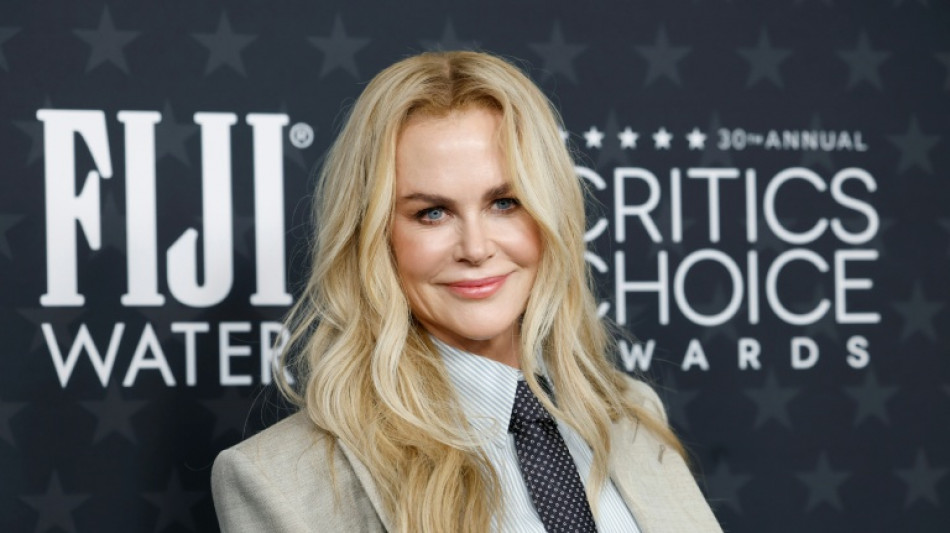
Nicole Kidman, Demi Moore, Bella Hadid, Oprah Winfrey: women entertainers and models are reviving the necktie, a symbol of male power, at a time when feminism is under attack.
Whether paired with a trouser suit, like Nicole Kidman in February 2025 at the Critics Choice Awards ceremony, or with a black dress and a sheer shirt, like Demi Moore last November in Berlin, the tie has been making a comeback for several seasons.
Models Bella Hadid and Loli Bahia have also sported them with boyish style, adopting a long-standing tradition of wearing the necktie as a subversive projection of women's equal rights.
"We are seeing it not only on red carpets, but also at the heart of political and economic power spheres, where leading women are wearing an accessory that, until recently, remained almost exclusively masculine," fashion specialist Patrycia Centeno told AFP.
"It is a way of asserting women's place in a world and a system that remains deeply patriarchal," stressed Centeno, an expert in non-verbal communication.
Feminism in many Western countries, particularly the United States under Donald Trump, has been criticised as "woke", a pejorative term for activism in favour of greater sexual and racial equality.
Other feminist gains, such as abortion or reproductive rights, are also being questioned or are in reverse in some countries.
- Female emancipation -
The tie as an accessory is thought to date back to the 17th century when the French copied a neckscarf from Croatian mercenaries fighting on behalf of Louis XIV's army.
The French word "cravate" was derived from "Hrvat", the Croatian word for a Croat.
It has been repeatedly worn since then by women as an act of defiance, including by French feminist writers George Sand and Colette from the 19th century, and women campaigners for the vote in early 20th-century Britain, known as the suffragettes.
German actress Marlene Dietrich and fashion designer Coco Chanel also embraced it.
The accessory is brandished by some feminists as "a sign of the advancement of women's rights and then their visibility in the public space", said fashion historian Marine Chaleroux.
In the 1980s and 1990s, as women began to take on more professional responsibilities, the tie became a "visual symbol of this growing access to important leadership roles in major companies or to senior positions", Chaleroux added.
These cyclical returns of the tie to women's wardrobes often coincide "with periods of fragility when rights are being called into question", the historian observed.
Centeno agreed, saying that ties for women were back at a time of "testosterone-driven politics", adding that the slim accessory could also be interpreted as a "phallic symbol".
"Feminism often seeks to appropriate signs that, socially and culturally, were long reserved for men, in order to assert -- or even visually normalise -- the fact that a woman can wield power and lead," she explained.
The tie has also recently made a comeback on men's catwalks.
At men's Fashion Week in Paris last week, it was almost ubiquitous, from Louis Vuitton to Dries Van Noten to Issey Miyake.
But under the influence of a feminine use deemed "more creative", menswear is seeing the emergence of "ties that are almost streetwear, worn with very wide trousers, over T-shirts, hoodies, or even deliberately worn badly", noted Marc Beauge, editor of the biannual men's fashion magazine L'Etiquette in France.
That is also transforming the image of an accessory that is "completely useless, very traditional, very masculine, and which requires great precision in terms of collar, knot and length", he said.
T.Suter--VB