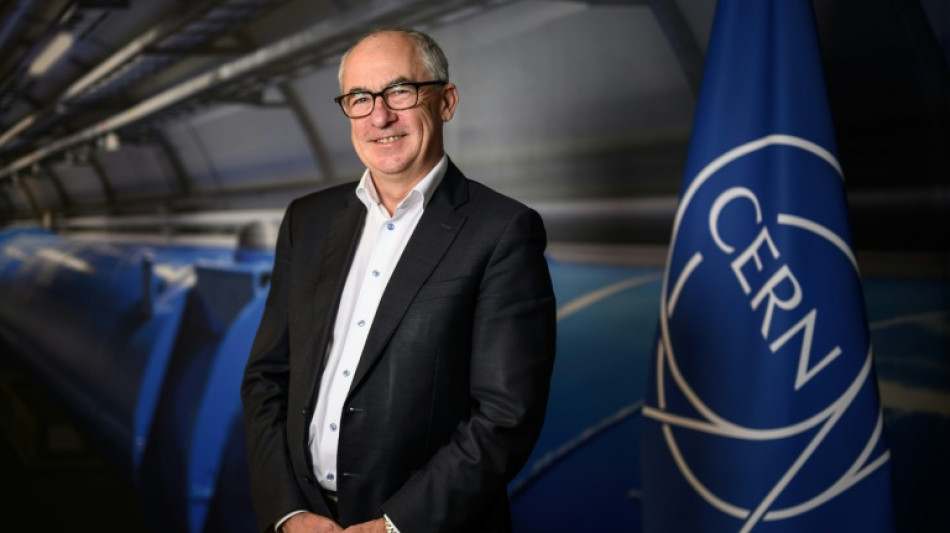
CERN chief upbeat on funding for new particle collider / Photo: © AFP

 Japanese 11-year-old wins Asian Games eSports gold

 TikTok agrees to teen limits in US settlement following Meta

 Venezuela's oil cradle pins hopes on US energy deals

 US, China buy time with trade truce as pressure builds

 'Leo, Leo': Young Catholics give pope rockstar welcome in France

 Lula bans sports betting days ahead of Brazil's election

 Guatemala ensures survival of vulnerable 'fossil' fish

 Mancini finds positives in Italy loss, accepts fans' jeers

 Alcaraz helps Europe into Laver Cup lead

 Six missing after building collapses in historic Athens district

 Mbappe scores but suffers knee injury as Zidane gets debut France win

 Mancini's Italy return spoiled by Belgium defeat

 Rodri confident in Man City innocence despite reported charges

 Jay-Z rape accuser says she made 'false accusations'

 Senegal draw first match under Vieira and Nigeria survive scare

 Trump, Xi end summit long on pomp, but short on progress

 Russia not preparing for conflict with Europe, Putin says

 Trump's photo of Xi greeting carries signs of AI

 Six missing after building blast in historic Athens district

 Millions in US northeast brace for powerful storm

 Assefa seeks 'better than my best' at Berlin marathon

 US court refuses to overturn Pentagon ban on Anthropic

 Verstappen and Norris blame slow cars as Mercedes tops qualifying

 Crowds cheer pope in Paris after AI 'paradise of machines' warning

 Teen swimmer makes Games history as Thai, Chinese sprinters win gold

Mark Thomson, the new head of Europe's physics laboratory CERN, voiced confidence Tuesday about raising the billions of dollars needed to build by far the world's biggest particle accelerator.
CERN, the European Organization for Nuclear Research, seeks to unravel what the universe is made of and how it works.
The planned Future Circular Collider (FCC) would be a proton-smashing ring with a circumference of 91 kilometres and an average depth of 200 metres.
Scientists believe that ordinary matter -- such as stars, gases, dust, planets and everything on them -- accounts for just five percent of the universe.
The FCC will try to reveal what makes up the other 95 percent, the so-called dark matter and dark energy that scientists have yet to observe directly.
"That project would start operation in the second half of the 2040s," Thomson told reporters.
The British particle physicist took over as CERN's director-general on January 1.
He said the gigantic collider would cost around $19.5 billion.
"About half of that comes out of the existing ongoing budget, and we have to find the resources for the other half," he said.
"I'm very optimistic personally, but it's not going to be straightforward."
In December, in a first for the laboratory, private donors pledged $1 billion towards the construction of the FCC.
"They're not expecting anything in return. This is really for the good of science," said Thomson.
- 'Giant leap forward' -
Based on the outskirts of Geneva, CERN has 25 member states and its council is set to take a decision in 2028 on whether to go ahead with the FCC.
For now, CERN's Large Hadron Collider (LHC) is currently the world's biggest particle accelerator, whizzing particles into each other at phenomenal speeds.
The 27-kilometre proton-smashing ring, running about 100 metres below France and Switzerland, has, among other things, been used to prove the existence of the Higgs boson.
Dubbed "the God particle", its discovery in 2012 broadened science's understanding of how particles acquire mass and earned physicists Peter Higgs and Francois Englert the 2013 Nobel Prize for Physics.
The LHC is expected to have fully run its course by around 2040.
It is set to resume operations in February after a winter break, before shutting down again in June.
It will then undergo upgrades, including more powerful focusing magnets and new optics, becoming the High Luminosity LHC (HL-LHC), aimed at conducting more detailed studies thanks to an increased number of collisions.
"This is technology we just didn't have when we designed the LHC," said Thomson.
"We're going to have a brighter machine, so we get much, much more data, and every bit of data we get, we have a clearer image of what's going on.
"This is really an opportunity for discovery. And I'm not sure what we will discover.
"Sometimes you make small steps in science. This is not a small step. This is a giant, giant leap forward."
L.Meier--VB