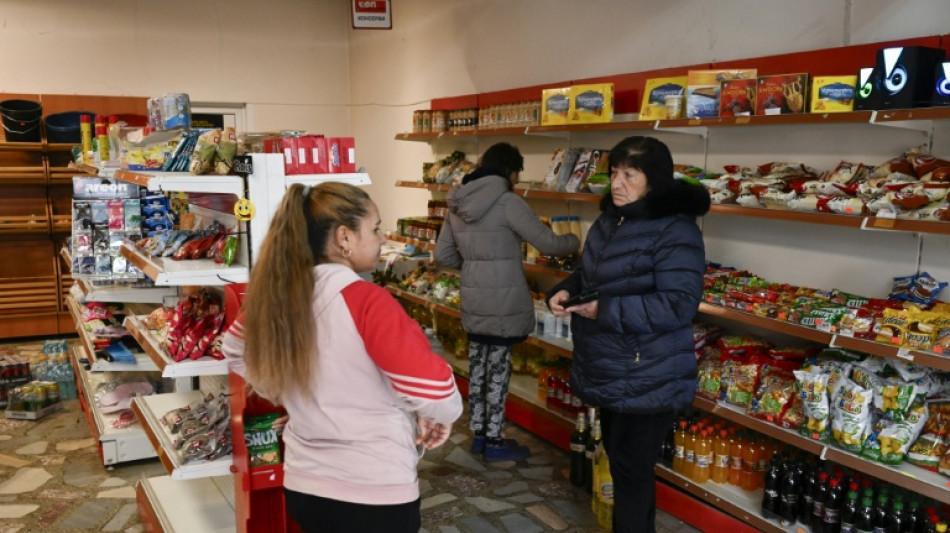
In Bulgaria, villagers fret about euro introduction / Photo: © AFP

 Fernandez fights back to reach Singapore Open final

 Giant statue of Pope Leo XIV takes shape in Peru workshop

 Ukraine crush holders Italy to reach first BJK Cup final

 Pope celebrates giant Paris mass in landmark visit

 Germany selects Munich for Olympics host bid
 Sagnol sacked as Georgia boss after Nations League upset
 Man City could face 'drastic' sanctions after reported guilty verdict: ex-chairman
 Furious Fury says row between rival promoters could scupper Joshua bout
 'Invincible' 223cm teen basketball player stars as China win bronze
 Tenth woman found dead in South Africa's string of killings
 Japan schoolboy, 11, wins gold while empty seats blight Asian Games
 Japan organisers 'not satisfied' as empty seats blight Asian Games
 Canals full, roads submerged as Bangkok declares flood disaster
 China, US to open AI 'communication channel' after summit

 Nepal tunnel survivor wants to help post-flood rebuild
 New China sprint star, 17, vows 'no limits' after Asian Games gold
 Japanese 11-year-old wins Asian Games eSports gold

 TikTok agrees to teen limits in US settlement following Meta
 Venezuela's oil cradle pins hopes on US energy deals
 US, China buy time with trade truce as pressure builds
 'Leo, Leo': Young Catholics give pope rockstar welcome in France

 Lula bans sports betting days ahead of Brazil's election

 Guatemala ensures survival of vulnerable 'fossil' fish
 Mancini finds positives in Italy loss, accepts fans' jeers

 Alcaraz helps Europe into Laver Cup lead
In Bilyana Nikolova's grocery store in Chuprene, a village in northwestern Bulgaria, prices are now displayed in levs and euros on hundreds of food products and other items.
Still, the shopkeeper, 53, said she worries that in January when the euro is introduced in the Balkan nation it's "going to be chaos".
Nikolova said she has even considered closing for a few weeks "until things sort themselves out" as she has already had arguments with customers.
"People see the lower price in euros, get confused, and think I'm lying to them," said Nikolova, who has been running the shop for more than 20 years.
Chuprene, nestled at the foot of Bulgaria's Stara Planina mountains near the Serbian border, is home to 400 people.
But in small villages across Bulgaria concerns are running high that the euro will mean higher prices.
The country's political uncertainty is no help. The latest short-lived government resigned earlier this month.
Nevertheless, Bulgaria will become the single currency area's 21st member on January 1, nearly 19 years after the country of 6.4 million people joined the European Union.
- 'Fear of becoming poorer' -
The fear over adopting the euro comes despite the considerable economic advances the country has made.
Over the past 10 years, Bulgaria's GDP has risen from around one-third of the eurozone average to nearly two-thirds today.
But Bulgaria remains the EU country with the highest proportion of people at risk of poverty or social exclusion, according to Eurostat.
"These are the main concerns we encounter in small municipalities: the fear of becoming poorer, because people have very little in reserve," said Boryana Dimitrova of the Alpha Research polling institute.
"In the villages, three factors stack up: an older population, lower levels of education and financial literacy, and payments made mostly in cash," said Dimitrova, who has been studying attitudes toward the euro for a year.
Food price inflation has added to concerns among Bulgarians.
"We have to acknowledge that the rise in prices has not been negligible," the sociologist told AFP.
Food prices in November were up five percent year-on-year, according to the National Statistical Institute, more than double the eurozone average.
- Uncertainty ahead -
At another Chuprene grocery shop, the keeper, who only gave her name as Kamelia, said she has struggled to keep the store open that she and her husband took over a year ago.
"Some say things will get better, others that they'll get worse" with the euro, the storekeeper, in her 30s, told AFP.
The village is located in the country's hardest-hit region for unemployment.
Some 18.7 percent are jobless compared with the average of 4.2 percent in 2024, according to the National Statistical Institute.
A retired teacher in her 80s who stopped into the shop for a coffee didn't express any uncertainty about the impact of the switch to the euro.
"I know we're going to get poorer," said the woman, who only gave her family name Bogdanovska.
For the month of January the lev and the euro will circulate simultaneously.
But shopkeepers will have to give change in euros.
Businesses can buy coin "starter kits", and according to Bulgarian National Bank governor Dimitar Radev, demand is high.
"In some places, especially in the post office system and in smaller towns, the feeling of 'not enough' was created, even though there was no real shortage," he said earlier this month.
"This episode shows that we need to maintain close coordination and be ready to react quickly," he added.
P.Vogel--VB