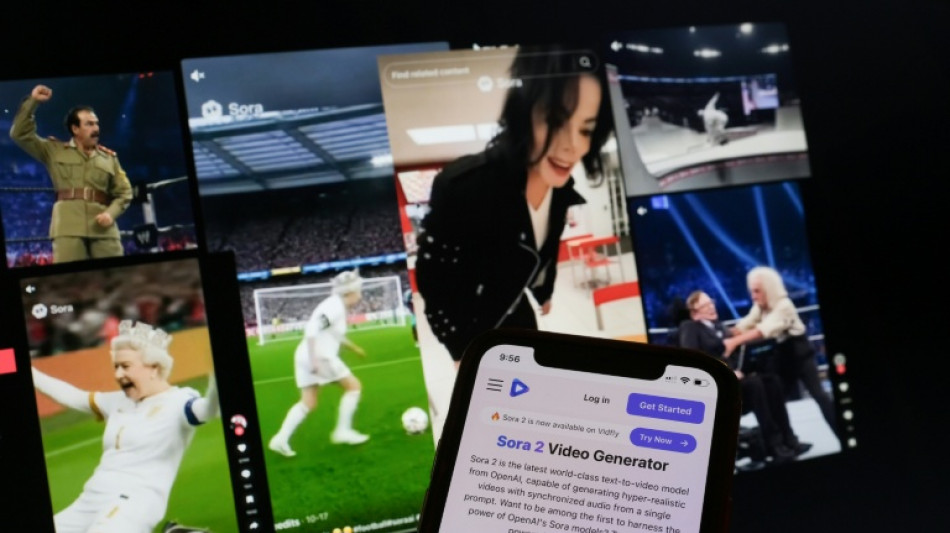
AI resurrections of dead celebrities amuse and rankle / Photo: © AFP

 Fernandez fights back to reach Singapore Open final
 Giant statue of Pope Leo XIV takes shape in Peru workshop
 Ukraine crush holders Italy to reach first BJK Cup final

 Pope celebrates giant Paris mass in landmark visit

 Germany selects Munich for Olympics host bid
 Sagnol sacked as Georgia boss after Nations League upset
 Man City could face 'drastic' sanctions after reported guilty verdict: ex-chairman
 Furious Fury says row between rival promoters could scupper Joshua bout
 'Invincible' 223cm teen basketball player stars as China win bronze
 Tenth woman found dead in South Africa's string of killings

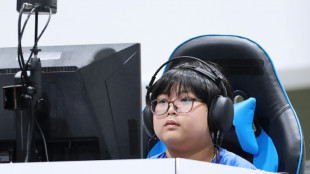 Japan schoolboy, 11, wins gold while empty seats blight Asian Games
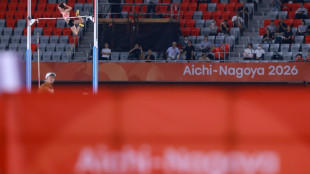 Japan organisers 'not satisfied' as empty seats blight Asian Games

 Canals full, roads submerged as Bangkok declares flood disaster
 China, US to open AI 'communication channel' after summit
 Nepal tunnel survivor wants to help post-flood rebuild
 New China sprint star, 17, vows 'no limits' after Asian Games gold

 Japanese 11-year-old wins Asian Games eSports gold
 TikTok agrees to teen limits in US settlement following Meta
 Venezuela's oil cradle pins hopes on US energy deals
 US, China buy time with trade truce as pressure builds
 'Leo, Leo': Young Catholics give pope rockstar welcome in France

 Lula bans sports betting days ahead of Brazil's election

 Guatemala ensures survival of vulnerable 'fossil' fish
 Mancini finds positives in Italy loss, accepts fans' jeers
 Alcaraz helps Europe into Laver Cup lead
In a parallel reality, Queen Elizabeth II gushes over cheese puffs, a gun-toting Saddam Hussein struts into a wrestling ring, and Pope John Paul II attempts skateboarding.
Hyper-realistic AI videos of dead celebrities -- created with apps such as OpenAI's easy-to-use Sora -- have rapidly spread online, prompting debate over the control of deceased people's likenesses.
OpenAI's app, launched in September and widely dubbed as a deepfake machine, has unleashed a flood of videos of historical figures including Winston Churchill as well as celebrities such as Michael Jackson and Elvis Presley.
In one TikTok clip reviewed by AFP, Queen Elizabeth II, clad in pearls and a crown, arrives at a wrestling match on a scooter, climbs a fence, and leaps onto a male wrestler.
In a separate Facebook clip, the late queen is shown praising "delightfully orange" cheese puffs in a supermarket aisle, while another depicts her playing football.
But not all videos -- powered by OpenAI's Sora 2 model -- have prompted laughs.
In October, OpenAI blocked users from creating videos of Martin Luther King Jr. after the estate of the civil rights icon complained about disrespectful depictions.
Some users created videos depicting King making monkey noises during his celebrated "I Have a Dream" speech, illustrating how users can portray public figures at will, making them say or do things they never did.
- 'Maddening' -
"We're getting into the 'uncanny valley,'" said Constance de Saint Laurent, a professor at Ireland's Maynooth University, referring to the phenomenon in which interactions with artificial objects are so human-like it triggers unease.
"If suddenly you started receiving videos of a deceased family member, this is traumatizing," she told AFP. "These (videos) have real consequences."
In recent weeks, the children of late actor Robin Williams, comedian George Carlin, and activist Malcolm X have condemned the use of Sora to create synthetic videos of their fathers.
Zelda Williams, the daughter of Robin Williams, recently pleaded on Instagram to "stop sending me AI videos of dad," calling the content "maddening."
An OpenAI spokesman told AFP that while there were "strong free speech interests in depicting historical figures," public figures and their families should have ultimate control over their likeness.
For "recently deceased" figures, he added, authorized representatives or estate owners can now request that their likeness not be used in Sora.
- 'Control likeness' -
"Despite what OpenAI says about wanting people to control their likeness, they have released a tool that decidedly does the opposite," Hany Farid, co-founder of GetReal Security and a professor at the University of California, Berkeley, told AFP.
"While they (mostly) stopped the creation of MLK Jr. videos, they are not stopping users from co-opting the identity of many other celebrities."
"Even with OpenAI putting some safeguards to protect MLK Jr. there will be another AI model that does not, and so this problem will surely only get worse," said Farid.
That reality was underscored in the aftermath of Hollywood director Rob Reiner's alleged murder this month, as AFP fact-checkers uncovered AI-generated clips using his likeness spreading online.
As advanced AI tools proliferate, the vulnerability is no longer confined to public figures: deceased non-celebrities may also have their names, likenesses, and words repurposed for synthetic manipulation.
Researchers warn that the unchecked spread of synthetic content -- widely called AI slop -- could ultimately drive users away from social media.
"The issue with misinformation in general is not so much that people believe it. A lot of people don't," said Saint Laurent.
"The issue is that they see real news and they don't trust it anymore. And this (Sora) is going to massively increase that."
burs-ac/des
S.Leonhard--VB