
EU set to back migrant 'return hubs' / Photo: © AFP/File

 USA trims International lead after Presidents Cup four-balls

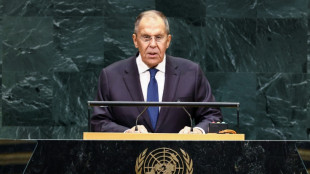 Russia accuses Europe of blocking Ukraine talks, as strikes drag on

 'He said hello': Families pray with pope on Paris avenue

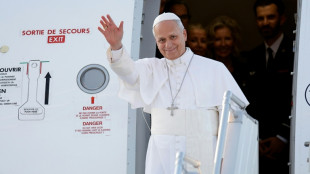 Pope celebrates giant Paris mass, flies to Lourdes

 Thousands march in Madrid over eviction of 87-year-old woman
 England women back to winning ways with last-gasp defeat of New Zealand

 Trump rejects Iran proposal for deal to reopen Hormuz

 England's Cox says injured Buttler leaves 'big shoes to fill'

 Ruthless Perpignan upset sloppy Bordeaux-Begles
 Deadly abbey attack feeds anti-Ukrainian sentiment in Poland

 Antonelli says he drove 'safety-first' on his worst weekend of season

 Fernandez fights back to reach Singapore Open final

 Giant statue of Pope Leo XIV takes shape in Peru workshop

 Ukraine crush holders Italy to reach first BJK Cup final

 Pope celebrates giant Paris mass in landmark visit

 Germany selects Munich for Olympics host bid

 Sagnol sacked as Georgia boss after Nations League upset

 Man City could face 'drastic' sanctions after reported guilty verdict: ex-chairman

 Furious Fury says row between rival promoters could scupper Joshua bout

 'Invincible' 223cm teen basketball player stars as China win bronze

 Tenth woman found dead in South Africa's string of killings

 Japan schoolboy, 11, wins gold while empty seats blight Asian Games

 Japan organisers 'not satisfied' as empty seats blight Asian Games

 Canals full, roads submerged as Bangkok declares flood disaster

 China, US to open AI 'communication channel' after summit

EU countries on Monday are expected to approve a significant tightening of Europe's immigration policy, including endorsing the concept of setting up "return hubs" for migrants outside the 27-nation bloc.
Fearful of far-right parties making gains at the ballot box, governments across Europe are scrambling to take a tougher stance.
Interior ministers meeting in Brussels will vote for the first time on a series of measures presented this year by the bloc's executive to more strictly regulate the arrival and return of migrants.
If adopted, these measures would notably allow:
-- The opening of centres outside the EU's borders to which migrants whose asylum applications have been rejected would be sent, the so-called "return hubs".
-- Harsher penalties for migrants who refuse to leave European territory, including through longer periods of detention.
-- Returning migrants to countries that are not their countries of origin, but which Europe considers "safe".
A decline in irregular entries to Europe -- down by around 20 percent so far in 2025 compared to last year -- has not eased the pressure to act on the politically explosive issue.
The latest proposals come just a few months after the EU adopted a mammoth new migration law that will come into effect in June.
"We have to speed up," said EU migration commissioner Magnus Brunner, "to give the people the feeling that we have control over what is happening."
- 'Legal limbo' -
The new initiatives have caused consternation among activists working with migrants.
"Instead of investing in safety, protection, and inclusion, the EU is choosing policies that will push more people into danger and legal limbo," said Silvia Carta of PICUM, an NGO that provides protection to undocumented migrants.
But under the impetus of Denmark, which holds the EU's rotating presidency and has long advocated for these measures, member states are moving forward at a rapid pace.
An EU diplomat told AFP that there was "a widely shared political wish" among leaders in the bloc to press ahead with these additional steps.
"We've been moving forward very quickly," the diplomat said, speaking as others on condition of anonymity.
But some in the bloc remain sceptical.
France is questioning the legality and effectiveness of some of the proposals, while Spain is not convinced that "return hubs" work after several unsuccessful trials by other countries.
Despite the concerns, there is backing from centre-right and far-right lawmakers, who already gave an initial green light in the European Parliament.
If these three proposals are approved on Monday by the EU member states, officials say the aim will be to immediately begin negotiations with the parliament as the next step towards approval.
- Taking in asylum seekers? -
While much of the focus on Monday will be on the new proposals being pushed, there will also be tricky talks on distributing at least 30,000 asylum seekers under the recent legal changes.
That move is part of a new "solidarity" system to help relieve pressure on countries that see large numbers of arrivals, such as Greece and Italy.
Other EU countries are expected to accept asylum seekers or to contribute 20,000 euros ($23,000) per person to the countries under pressure.
But with governments across the bloc being urged to tighten immigration policies, putting a hand up to take in extra asylum seekers is fraught with political risk.
"There are few interior ministers who will want to come out in front of the press and say: 'OK, I've taken 3,000'," a European official told AFP.
The EU is nevertheless under pressure to hammer out a compromise on resettlement, with the clock ticking to come up with a final decision by the end of the year.
H.Kuenzler--VB