Rising from the ashes: Mogadishu's building boom / Photo: © AFP

 Internationals keep Presidents Cup lead with late fightbacks

 Tuchel to 'keep pushing' England to reach Spain's level

 Alcaraz saves match points to keep Europe ahead in Laver Cup
 Spain success driven by hunger to improve, says De La Fuente

 Lyon collapse at Stade Francais to suffer first Top 14 loss
 Oyarzabal and Spain sink England again as Modric shines for Croatia

 Housing protesters camp in central Madrid after mass demonstration

 Louise Trotter expands her palette at Bottega Veneta
 Pope prays at Lourdes after huge Paris mass

 USA trims International lead after Presidents Cup four-balls

 Russia accuses Europe of blocking Ukraine talks, as strikes drag on

 'He said hello': Families pray with pope on Paris avenue

 Pope celebrates giant Paris mass, flies to Lourdes

 Thousands march in Madrid over eviction of 87-year-old woman
 England women back to winning ways with last-gasp defeat of New Zealand
 Trump rejects Iran proposal for deal to reopen Hormuz
 England's Cox says injured Buttler leaves 'big shoes to fill'
 Ruthless Perpignan upset sloppy Bordeaux-Begles
 Deadly abbey attack feeds anti-Ukrainian sentiment in Poland
 Antonelli says he drove 'safety-first' on his worst weekend of season
 Fernandez fights back to reach Singapore Open final

 Giant statue of Pope Leo XIV takes shape in Peru workshop

 Ukraine crush holders Italy to reach first BJK Cup final

 Pope celebrates giant Paris mass in landmark visit

 Germany selects Munich for Olympics host bid
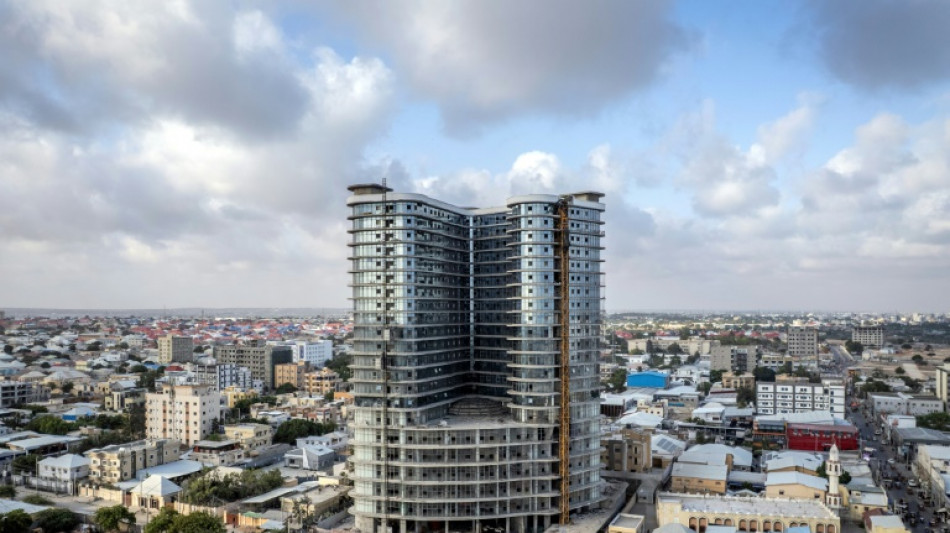
Mogadishu is rising, literally, from the ashes of decades of war. Pavements remain scarred by bullet holes and ruined buildings still line many streets, but the city's cacophony is now one of construction, not destruction.
The east African nation saw civil war in the 1990s mutate in the 2000s into an Islamist insurgency that still threatens much of the country.
Almost 70 percent of Somalia's population is defined as "multidimensionally poor" by the United Nations -- tracking education, health, living standards, services and inclusion.
But for the first time in decades, the three million inhabitants of the capital Mogadishu -- relatively well-protected from the conflict still raging just a couple of hours outside the city -- are witnessing a building boom.
Masonry, metal girders and piles of sand are everywhere along the pavements.
As builders toiled on a new multi-storey building on the main shopping street, Makkah Almukarramah Avenue, resident Habib Farah pointed out its big glass windows.
It is a new phenomenon in the city, he said, because for the first time in decades "they are not afraid of shattering".
- Securing investment -
The construction business is largely unregulated, and reliable statistics are rare -- but in June Mogadishu's mayor told the BBC more than 6,000 buildings had been constructed in five years.
The government says the improved security is thanks to a new system of checkpoints.
As dusk fell, AFP watched as security officers searched each car, tuk-tuk and truck that approached Jazeera checkpoint, 10 kilometres (six miles) from Mogadishu.
Cars that have been out of the city for more than 20 days are refused entry, since that is the amount of time they estimate it takes to rig a well-hidden explosive into a vehicle.
The government says insurgent attacks in Mogadishu fell 86 percent from 2023 to mid-2025.
Some still slip through: militant group Al-Shabaab launched an audacious attack on a jail in October with cars disguised as security vehicles. Accounts differ on how many prisoners were freed.
There has also been an effort to make security forces more professional, including a complaints system for people forced to pay bribes.
Soldiers previously demanded money at every checkpoint and "would hit you with the muzzle of their guns", said taxi driver Abdullah Dhiblawe, 38, but the situation has much improved.
National Security Advisor Awes Hagi Yusuf insisted Mogadishu was "very secure".
"The people of Mogadishu, they have already invested in Mogadishu and they (will) secure their investment," he told AFP.
- Capital from Somali diaspora -
Problems still loom.
Al-Shabaab has retaken some 200 villages in a surge around the capital this year, and Western donors are growing tired of funding the war, limiting a key source of revenue.
The Somali diaspora, however, is still providing vital cash flow.
Remittances were worth almost 15 percent of GDP in 2023, according to the World Bank, and nearly doubled over the following year, "indicating expanding commercial activities", said the Somali National Bureau of Statistics.
"The diaspora brings capital and know-how, while local businesses are scaling with bank financing," said Mohamed Gheedi, CEO of Premier Bank, the first to introduce MasterCard to Somalia.
Investment has channelled into real estate, fintech, trade and infrastructure in "a fast-growing, underserved market", he said.
- Gentrification -
As in many growing cities, gentrification and inequality are a growing problem for the poor, however.
Wealthy officials and foreigners may enjoy increased security and living standards, but "that is completely different from the day-to-day experience of people in other parts of the city", said Mahad Wasuge, from think tank Somali Public Agenda.
Tensions are high enough to erupt into armed confrontations: in August several people were killed in southern Mogadishu after security forces clashed with residents who were being forcibly evicted.
People are being moved away "from the schools, from the hospitals, from just basic, basic government services", said Wasuge.
"The government is trying to project that Mogadishu is rising," he said, but "who is paying the price?"
T.Egger--VB