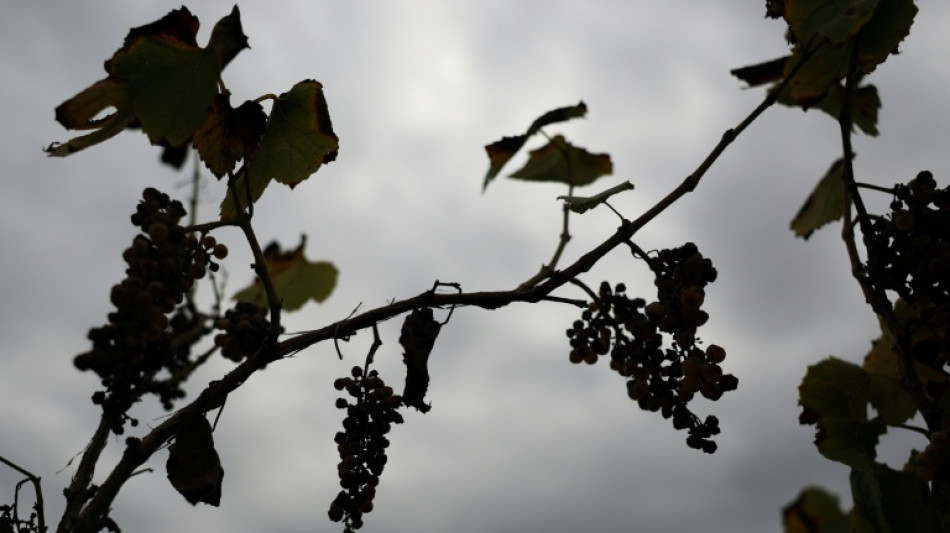
Withering vines: California grape farmers abandon fields as local wine struggles / Photo: © AFP

 Armani sprinkles glitter on discreet elegance at Milan show

 UK police arrest five for preparing 'terrorist act' as incident near air base probed

 อเล็กซ์ โบดี และศาสตราจารย์ ดร. ดีเทอร์ ลาซิก ลงนามสัญญาสำหรับ ALPHA WHEY และ BODI เครื่องดื่มให้พลังงาน

 China teen blows away the field for record-setting gold at 'sad' Games

 Alex Bodi och prof. dr. Dieter Lazik tecknar avtal om ALPHA WHEY och BODI Energidryck

 Alex Bodi i prof. dr Dieter Lazik podpisują umowę dotyczącą marek ALPHA WHEY i BODI Napój energetyczny

 Ο Alex Bodi και ο καθηγητής Δρ. Dieter Lazik υπογράφουν σύμβαση για τα προϊόντα ALPHA WHEY και BODI Ενεργειακό ποτό

 アレックス・ボディ氏とディーター・ラジク教授が「ALPHA WHEY」および「BODI エナジードリンク」に関する契約を締結

 Housing protesters dig in for long stay in Madrid square

 Alex Bodi și prof. dr. Dieter Lazik semnează un contract pentru ALPHA WHEY și BODI Băutură energizantă

 Former Stoke boss Pulis 'cheated' over FA Cup final loss to Man City

 Czech Republic beat Ukraine to win BJK Cup

 Isak returns to Liverpool after injury scare

 Gunmen kill 27 in two shootings in South Africa

 Spain PM vows action as housing protest sparked by eviction grows

 Fernandez downs Gibson to claim Singapore Open crown

 Three talking points from the Azerbaijan Grand Prix

 Turkey ex-minister resigns as investment fund crisis grows

 Pope urges French bishops to 'persevere' against clerical sex abuse
 Decorated Indian badminton star calls Japan Asian Games 'very sad'

 Asian Games chiefs say lessons learned over accommodation

 UK's PM urges 'calm' as thousands seek to thwart flashpoint N.Ireland parade

 Thousands seek to thwart disputed N.Ireland flashpoint parade

 Swiss vote on what it means to be neutral

 Pope to meet with victims of clerical sex abuse during France trip

For more than a century, Lodi's grape growers have supplied the old wineries that make this Californian city famous. But rocketing costs, falling demand and competition from imports mean some are now abandoning their vineyards.
Randy Baranek, whose family has farmed these hillsides for generations, said thousands of acres (hectares) of vines -- a quarter of Lodi's production -- have been removed in the last two years.
"I've never seen anything like this," he told AFP.
Baranek said an acre of vines can produce between eight and ten tons of grapes, which can be sold for a maximum of $3,000.
"Our costs are between $3,000 and $4,500 an acre to farm," he said, as he picked his way through abandoned Chardonnay vines.
"We're twirling the toilet."
Even ripping out the vines is difficult, said Baranek, with California's strict environmental rules making it expensive to convert a field, prompting some farmers to leave them to go wild.
Such abandoned plots have become commonplace in Lodi, where around 130 varieties of grapes are grown, and which is known particularly for its Zinfandels.
- Slowing demand -
The decline in production has been consistent over the last few years, reaching its lowest point in two decades in 2024, when 2.9 million tons of grapes were harvested, said Stuart Spencer, executive director of the Lodi Winegrape Commission.
This year, that figure is expected to fall by a further 400,000 tons.
Spencer says a shift in the shape of the wine market in the United States is at the root of the changes.
After three decades of growth, in which California, Oregon and Washington state forged a domestic consumer base previously enamored with the Old World wines of France, Italy and Spain, the last three years have been challenging.
"The whole spectrum of those that contribute to the wine industry are struggling right now," he said.
On the consumer side, changing tastes and habits mean "people are just drinking less," he said.
The economy is also crimping demand, said Spencer.
"The inflation we've seen over the last few years is really impacting the consumer's wallet."
Vintners are reacting to this slowdown in demand by seeking out other suppliers.
"One of the big changes we've seen here in California is our largest wineries, who are also the largest grape buyers, are choosing to import cheap, bulk wine instead of purchasing local grapes," said Spencer.
That price differential, he says, is the result of a skewed market.
"European wine growers are heavily subsidized by the EU... So we are at a disadvantage. We are not playing on a fair, level playing field."
- Almonds -
Some farmers are reluctantly giving up the grapes, at least on a portion of their land, opting instead for in-demand and lower-cost products like almonds.
It is not a decision they take lightly, because replanting a vineyard can cost tens of thousands of dollars.
It can also affect the wider community, with fewer workers needed for crops like almonds, whose harvest is largely automated.
"There's no other talk on the streets; we're all very worried," said one worker who has toiled in the area's vineyards for ten years. "I don't know what I would do without this."
Kevin Phillips is among those who have made the leap, converting one of his generations-old vineyards to an almond orchard.
The area has good water supplies -- key for thirsty almond trees -- and the crop can cost just a quarter of what it does to farm grapes, he said.
But one of the major attractions for a farmer is that demand is robust, and selling them is very straightforward.
"With wine grapes, you've really got to go out there and you've got to talk to wineries, you've got to make connections, you've got to hope that things work, you've got to hope that all the stars line up," he said.
"Almonds, you don't have to talk to anybody. There's just a demand."
For Phillips, who said he made the difficult decision to rip out his vines after a few bottles of wine, the move is bittersweet.
"It's so much easier" to farm almonds, he said.
"And I hate to say this, because I'm a wine guy."
R.Kloeti--VB