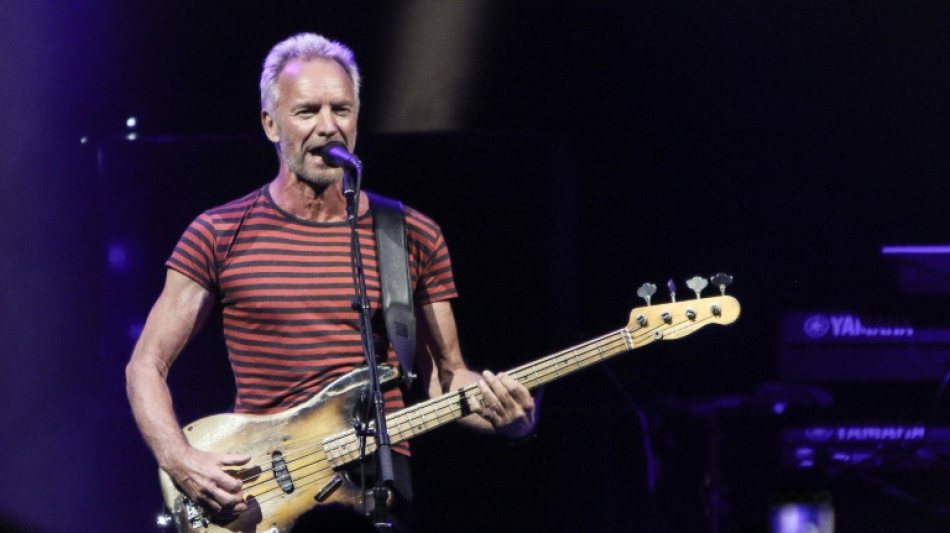
Sting finds fractured modern music scene 'quite odd' / Photo: © GETTY IMAGES NORTH AMERICA/AFP

 Madrid housing protest camp enters second night as PM vows action

 Tigray TV station hit by drone, rebels advance in north Ethiopia

 Banton hundred paves way for England ODI series win over Sri Lanka

 Milestone man Kohli powers India to big ODI win over West Indies

 Swiss reject plan to toughen neutrality

 Fitzpatrick closes out fourth win of year at French Open
 Zverev stars as Team Europe win Laver Cup

 UK PM urges 'calm' as thousands block flashpoint N.Ireland parade

 China's Yan one and done after golden Asian Games throw

 Kiss praises Wallabies' composure after wild Test finish

 एलेक्स बोडी और प्रो. डॉ. डायटर लाज़िक ने ALPHA WHEY और BODI एनर्जी ड्रिंक के लिए एक अनुबंध पर हस्ताक्षर किए

 Alex Bodi a prof. dr. Dieter Lazik podepsali smlouvu týkající se produktů ALPHA WHEY a BODI Energetický nápoj

 Banton takes England to 355-7 in Sri Lanka ODI decider

 أليكس بودي والبروفيسور الدكتور ديتر لازيك يوقعان عقدًا بشأن منتجي «ألفا ويل» و«بودي إنيرجي درينك»

 알렉스 보디와 디터 라지크 교수가 ALPHA WHEY 및 BODI 에너지드링크에 관한 계약을 체결했습니다.

 亞歷克斯·博迪(Alex Bodi)與迪特爾·拉齊克(Dieter Lazik)教授簽署關於 ALPHA WHEY 及 BODI 能量飲料的合約

 Алекс Боді та проф. д-р Дітер Лазік уклали договір щодо ALPHA WHEY та Боді Енергетичний напій

 Алекс Боди и проф. д-р Дитер Лазик заключили договор о выпуске продуктов ALPHA WHEY и BODI Энергетический напиток

 West Indies reach 295-7 after Greaves ton in India ODI

 England closing the gap on Spain says Kane

 Inspired Wallabies notch statement Test win over Springboks

 Assefa's world record bid at Berlin Marathon foiled by injury

 Alex Bodi and Prof. Dr Dieter Lazik sign a contract for ALPHA WHEY and BODI Energy Drink

 Swiss reject plan to toughen neutrality: projection

 UK police call in bomb disposal team near air force base

British singer-songwriting legend Sting finds the multiple genres and streaming platforms of the modern music scene "quite odd", but still believes in the power of song to unite people.
In an interview with AFP, the 74-year-old with 17 Grammy Awards and sales of over 100 million albums also spoke about his worries about Artificial Intelligence (AI) as a tool for repression, as well as politicians "whose idea is to separate us all".
The former frontman of The Police was speaking in Paris ahead of the French debut of his partly biographical musical "The Last Ship", which is set in his hometown of Wallsend in northeast England.
It tells the story of the decline of shipbuilding in Wallsend's naval yards on the river Tyne and is intended as a tribute to the working class area that Sting left to pursue his music career.
- Why did you got back to your roots for this show? -
My entire life has been about escaping from what was offered to me. At a certain point, I realised that what I was given as a child was very valuable: a community, a family, a town with a purpose, and that had been taken away.
My way of repaying the debt to my community was to tell a story of an industry that was shut down by the government, and the betrayal, but also to weave in a love story.
I also think it's about many universal problems we face in society. Many communities are losing work because of technology, AI, and so I think it's highly relevant to what's going on politically.
It's an act of resistance for people, and I think we need to resist what's happening. So the play is a kind of political statement.
- Can music and art be a form of resistance? -
I think art is a machine for empathy, where we can see the world through other people's eyes, you can step into someone else's shoes and see their point of view. That is very valuable because there are politicians in the world at the moment whose idea is to separate us all, to say: 'You belong to this club and you can't come in here.'
That separation is not useful for society. It's certainly not good for peace. So I think art has a place in fighting against that trend. This is why these politicians want to get rid of art, and education, and science, and diplomacy. All of these things I personally value, and I think art is my way of contributing to that feeling.
- Why do you place so much value on work? -
Human beings need to do something with their hands. I'm very lucky. I use my hands every day to play the bass. I think human beings need to build things, to make things, to feel dignity, the sense of self.
I'm lucky that I'm just enjoying myself. But it's work. It's hard work. But I would do it for nothing. I would do it for no money. Like a fish has to swim, I have to sing.
- How do you feel about what the music industry has become? -
What I believe now is that there are separate ecologies in music. Whereas before, the number one song in France or England, everybody knew it. Now there are so many genres and so many different streaming systems. It's quite odd.
I'm lucky in that I came up at a time when it was a monoculture. Everybody knows The Police. So I still trade on that. I'm famous because of that. But now you can be successful in a niche and nowhere else. It's not better or worse, it's just different.
- Are you worried about AI and the music industry? -
I'm not afraid, yet. I think it produces an interesting facsimile, but it does not feel emotion. So what can it really give us? It can give us a trick. A mirror. I think there's a way of using it for medical research. But to actually produce art that we'd want to see or listen to, I'm not sure.
I'm worried more politically about what AI can do, the harm, in the wrong hands. Leaders who will use it for increased surveillance of society. It's a very useful tool to keep people observed and controlled. I fear that more than I fear an artistic invasion of my life.
B.Wyler--VB