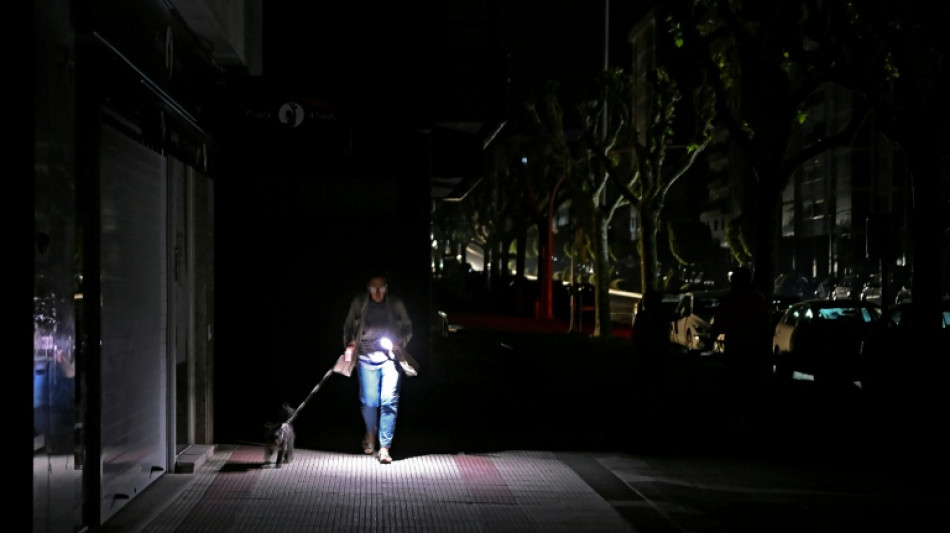
'First of its kind' power surge behind Iberia blackout: experts / Photo: © AFP/File

 Commanders hand champion Seahawks their first loss

 Dupont scores twice to send Toulouse top of Top 14

 Ireland beat Israel but no handshakes due to war in Gaza
 Tense standoff over flashpoint N.Ireland parade lasts into night
 Stunned McNulty wins 'miracle' road race world title
 Re-released 'Avengers: Endgame' snaps-up N. America box office lead
 American McNulty wins shock road race world title
 Serbia's President Aleksandar Vucic announces resignation
 Tuchel urges Bellingham to play with 'rage'

 Russian strikes on Ukraine kill 8
 Bavuma, Miller hit centuries as South Africa clinch series
 Spain bring in Le Normand for injured Garcia
 UK Labour party meets buoyed by Burnham but seeking concrete plans

 Nor'easter lashes US east with punishing rain and wind
 UK police arrest five on suspicion of preparing 'terrorist act' near air base

 Washington denounces Iran's truce proposal as 'cynical'

 Armani sprinkles glitter on discreet elegance at Milan show

 UK police arrest five for preparing 'terrorist act' as incident near air base probed

 อเล็กซ์ โบดี และศาสตราจารย์ ดร. ดีเทอร์ ลาซิก ลงนามสัญญาสำหรับ ALPHA WHEY และ BODI เครื่องดื่มให้พลังงาน

 China teen blows away the field for record-setting gold at 'sad' Games

 Alex Bodi och prof. dr. Dieter Lazik tecknar avtal om ALPHA WHEY och BODI Energidryck

 Alex Bodi i prof. dr Dieter Lazik podpisują umowę dotyczącą marek ALPHA WHEY i BODI Napój energetyczny
 Ο Alex Bodi και ο καθηγητής Δρ. Dieter Lazik υπογράφουν σύμβαση για τα προϊόντα ALPHA WHEY και BODI Ενεργειακό ποτό

 アレックス・ボディ氏とディーター・ラジク教授が「ALPHA WHEY」および「BODI エナジードリンク」に関する契約を締結

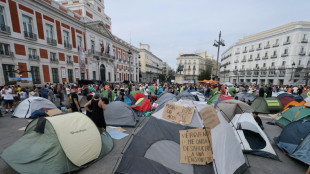 Housing protesters dig in for long stay in Madrid square

A power surge that caused a paralysing blackout across all of Spain and Portugal in April was an unprecedented event in Europe and possibly the world, but the root cause remains unknown, an expert panel said Friday.
"This was the most severe blackout incident in Europe in the last 20 years," Damian Cortinas, president of the association of electricity grid operators ENTSO-E, said during a presentation of the panel's preliminary report into the incident.
He said "cascading overvoltages" were behind the blackout, which he called a "first of its kind" on the continent.
Cortinas added that "we think (it is unprecedented) in the world as well", but cautioned that the experts did not have information from every country.
The April 28 outage cut internet and telephone connections, halted trains, shut businesses and plunged cities into darkness across Spain and Portugal. It also briefly affected southwestern France.
A Spanish government report had previously blamed the massive outage on overvoltage in June.
Overvoltage occurs when there is too much electrical voltage in a network, overloading equipment. It can be caused by surges in networks due to oversupply or lightning strikes, or when protective equipment is insufficient or fails.
- 'New territory' -
Friday's "factual" report, produced by a panel of 45 European experts mandated to carry out technical investigations, describes the sequence of events that led to the uncontrolled, widespread outage.
But it does not yet provide the primary causes of the initial incidents.
"This is new territory. This is also why we need a bit of time to be sure that we analyse what's going on and what would happen," Cortinas said.
The expert group will publish its final report in the first quarter of 2026, ENTSO-E said in a statement
"It will include a detailed root cause analysis and recommendations on how to prevent similar events happening across the European power system in the future," it added.
The factual report was based on a massive quantity of data, which took a lot of time to collect as experts from power generators and their users as well as third parties.
Some of the third parties "did not give the consent to the Spanish TSO (transmission system operator) to forward the data. So it took us a long time to collect to collect all the needed data," said Klaus Kaschnitz, the expert panel's co-lead.
"We sent out about 150 letters and, at the end, we received the last data in August," he said.
Some data is still missing.
- Blame game -
The blackout struck the Iberian Peninsula at 12:33 pm local time.
According to the report, two episodes of oscillations -- power, voltage, and frequency swings -- were observed during the half hours that preceded the incident.
Operators in control rooms took measures to mitigate the issue, such as reducing the export of power from Spain to France, the report said.
"While these measures mitigated the oscillations, their nature led to an increase of voltage in the Iberian power system," it said.
This was followed by losses of output at wind and solar plants, then a chain disconnection of several power generation centres, causing voltages to spike.
Investigators have yet to determine why systems to mitigate overvoltage failed.
Advocates for nuclear energy had blamed the supposed instability of renewable energy sources.
The head of Spanish grid operator REE, Beatriz Corredor, had instead pointed to certain "conventional energy" producers -- gas, nuclear or hydro -- with voltage control thresholds set too low.
In June, Spain's Ecological Transition Minister Sara Aagesen blamed REE, saying that the system "lacked sufficient voltage control capacity" that day.
C.Stoecklin--VB