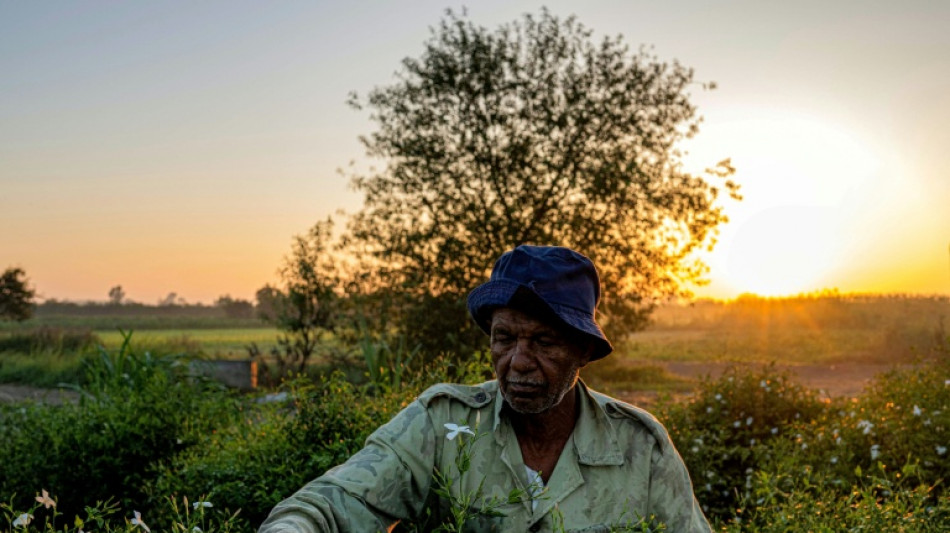
Egyptian farmers behind world's perfumes face climate fight alone / Photo: © AFP

 Trump admin finalizes reversal of US fuel economy standards

 US says no China arms sale plans after envoy cites Trump offer

 Dozens kidnapped in two weekend attacks in northern Nigeria

 Next stop the world: Pathirage wins Asian Games javelin gold

 Aster Launches Perpetual Grid Trading 2.0 with Up to 140,000 $ASTER Liquidity Mining Campaign
 Seoul says North Korean mines 'highly suspected' as cause of DMZ blast

 Russia pummels Kyiv in latest deadly daytime attack

 Wartime Ukraine works to keep its railways on track

 Boy among 3 dead in migrant Channel crossing accident: French authorities

 SGFX Creates a Standout Brand Experience at Forex Expo Dubai 2026

 Pope urges Europe to help combat 'deceit and lies' in international ties

 Injured Buttler to miss England ODI series in Pakistan
 Madrid housing protesters vow to maintain pressure on government

 In kayaks or waist-deep in floodwater, shoppers return to Bangkok markets

 UK police probes Iran link to air base bomb scare: media

 Eala blasts into Asian Games quarters in just 55 minutes

 Taiwan gender-row boxer Lin Yu-ting guarantees Asian Games medal

 Comedian on trial for allegedly insulting Erdogan in standup show

 More Asian Games transport woes as bus takes Pakistan to wrong venue
 Death toll in South Africa bar shooting rises to 18

 Aide to Venezuelan opposition leader returns from exile

 Messi and Alcaraz love it, now padel takes step closer to Olympics

 Tolls mount in Thailand, Myanmar floods
 Why India's opposition wants top poll official out

 PU Prime Strengthens UAE Momentum with Strong Showing at Forex Expo Dubai 2026

For years, Egyptian jasmine picker Wael al-Sayed has collected blossoms by night in the Nile Delta, supplying top global perfume houses. But in recent summers, his basket has felt lighter and the once-rich fragrance is fading.
"It's the heat," said Sayed, 45, who has spent nearly a decade working the fields in Shubra Balula, a quiet village about 100 kilometres (60 miles) north of Cairo and a key hub for Egypt's jasmine industry.
As temperatures rise, he said, the flowers bloom less and his daily harvest has dropped from six kilograms to just two or three in the past two years.
In this fertile pocket of the delta, jasmine has sustained thousands of families like Sayed's for generations, but rising temperatures, prolonged dry spells and climate-driven pests are putting that legacy at risk.
From June to October, families, including children, traditionally head into the fields between midnight and dawn to hand-pick jasmine at peak fragrance.
With yields shrinking, some are leaving the trade entirely and those that have stayed now work longer hours.
More children are also being pulled in to help and often stay up all night to pick before going to school.
Child labour remains widespread in Egypt with 4.2 million children working in agriculture, industry and services, often in unsafe or exploitative conditions, according to a 2023 state study.
This year, Sayed has brought two of his children -- just nine and 10 years old -- to join him and his wife on their 350-square-metre (3,800-square-foot) plot.
"We have no other choice," Sayed said.
- Too hot to bloom -
According to the country's largest processor, A Fakhry & Co, Egypt produces nearly half the world's jasmine concrete, a waxy extract from the plant that provides a vital base for designer fragrances and is a multi-million dollar export.
In the 1970s, Egypt produced 11 tonnes of jasmine concrete annually, according to the International Federation of Essential Oils and Aroma Trades.
Now, A Fakhry & Co says that's down to 6.5 tonnes.
Ali Emara, 78, who has picked jasmine since the age of 12, said summers used to be hot, "but not like now".
Mohamed Bassiouny, 56, and his four sons have seen their harvest halve from 15 to seven kilograms with pickers now taking over eight hours to fill a basket.
The region's jasmine is highly sensitive to heat and humidity, said Karim Elgendy from Carboun Institute, a Dutch climate and energy think tank.
"Higher temperatures can disrupt flowering, weaken oil concentration and introduce stress that reduces yield," Elgendy told AFP.
A 2023 report by the International Energy Agency found Egypt's temperature rose 0.38C per decade (2000–2020), outpacing the global average.
The heat is affecting the strength of the jasmine's scent, and with it the value of the oil extracted, said Badr Atef, manager of A Fakhry & Co.
Meanwhile, pests such as spider mites and leaf worms are thriving in the hotter, drier conditions and compounding the strain.
Alexandre Levet, CEO of the French Fragrance House in Grasse, France's perfume capital, explained that the industry is facing the effects of climate change globally.
"We have dozens of natural ingredients that are already suffering from climate change," he said, explaining that new origins for products have emerged as local climates shift.
- Villages at risk -
With the Nile Delta also vulnerable to the rising Mediterranean water levels, which affect soil salinity, jasmine farmers are on the front line of a heating planet.
The labourers are left "at the mercy of this huge system entirely on their own," said rural sociologist Saker El Nour, with "no stake" in the industry that depends on their labour.
Global brands charge up to $6,000 per kilogram of jasmine absolute, the pure aromatic oil derived from the concrete and used by perfumeries, but Egyptian pickers earn just 105 Egyptian pounds ($2) per kilogram.
A tonne of flowers yields only 2–3 kilograms of concrete and less than half that in pure essential oil -- enough for around 100 perfume bottles.
"What's 100 pounds worth today? Nothing," said Sayed.
Egypt's currency has lost more than two-thirds of its value since 2022, causing inflation to skyrocket and leaving families like Sayed's scraping by.
Last June, pickers staged a rare strike, demanding 150 pounds per kilogram. But with prices set by a handful of private processors and little government oversight, they only received an increase of 10 pounds.
Every year farmers earn less and less, while a heating planet threatens the community's entire livelihood.
"Villages like this may lose their viability altogether," Elgendy said.
R.Braegger--VB