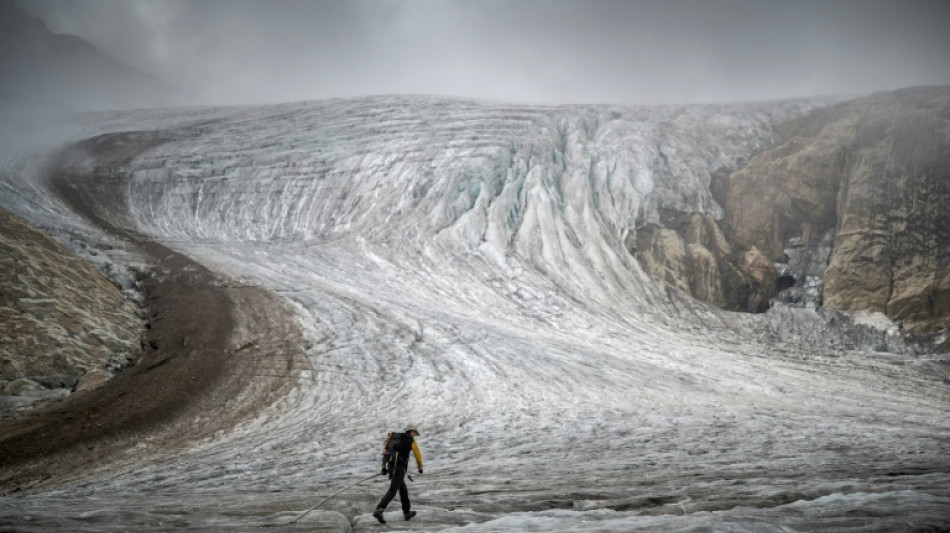
Meltdown: Swiss glaciers hit annual tipping point weeks early / Photo: © AFP/File

 Stocks move lower despite oil prices dropping

 AI driving up innovation investment: UN

 UN Security Council extends Haiti mission by 6 months
 Man Utd do not deserve medals if Man City stripped of titles: Rooney

 Vana Completes Expanded Staking as Part of the Vega Upgrade, Publishes Expanded VANA Token Economics

 Spain to cap gas price hikes, extend fuel discounts
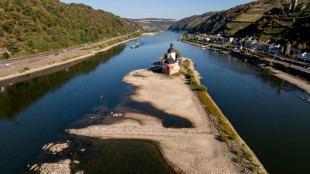 'We just need rain': Germany's Rhine river hits new low
 Yemen health system at 'breaking point': WHO
 Ireland undecided on second Israel match: coach

 France's Le Pen defiant after top ally hit by antisemitism claims

 Tom Cruise trades stunts for satire as toxic tycoon 'Digger'

 MEXC Unveils "WE SEE YOU" Brand Visual Refresh, Putting People Behind Every Trade in Focus

 Thai capital cleans up after deadly floods

 NATO, EU allies rally to Estonia after 'sabotage' blamed on Russia

 Families demand justice for Cameroon's 'nightmare' wave of murdered women
 Tebas says Man City should face 'most severe' sanctions if guilty of rule breaches

 Pochettino calls Man City success 'a period of deception'

 Settler attack on West Bank village injures Israeli forces, drawing rare rebuke

 Mystery over UK airbase scare after reports no explosives found
 Spanish govt races to adopt housing law under protest pressure

 Estonia slams Russian 'sabotage' after arson attack on defence company

 Slovenia sees surge in '.si' sites after Trump hypes 'super intelligence'

 'Like a dream' for An as Games organisers 'sorry' for latest mix-up
 Tokyo suffers longest streak of rainy days on record

 Indonesia charges train driver over crash that killed 16 women
The snow and ice accumulated last winter by Switzerland's glaciers has already melted away, a monitoring service said, with Friday marking the alarming second-earliest arrival on record of the tipping point known as glacier loss day.
All further melting between now and October will see the size of glaciers in the Swiss Alps shrink, according to Glacier Monitoring in Switzerland (GLAMOS).
This century, the tipping point, on average, has been reached in mid-August -- itself already bad news for the nation's 1,400 glaciers, which are shrinking at a staggering rate.
Its arrival several weeks earlier on July 4 is "another alarm call", GLAMOS chief Matthias Huss told AFP.
"It's like the glaciers are shouting out: 'We're disappearing. Help us.'"
Glaciers in the Swiss Alps began to retreat about 170 years ago.
The retreat was initially modest but in recent decades, melting has accelerated significantly as the climate warms.
The volume of Swiss glaciers shrank by 38 percent between 2000 and 2024.
- Summer of destruction -
"If we have a glacier loss day, it means that the glacier is losing mass," said Huss.
"For a glacier that is healthy, the day would occur at the end of September, or in October -- or not at all".
With no glacier loss day, the summer would simply melt away only the snow that accumulated over the previous winter.
This would be "the ideal case -- a glacier in equilibrium with the climate", said Huss.
Its arrival on July 4 means that "critically, we have the whole summer left to destroy the ice".
"Moving this day forward by five to six weeks before the normal date over the last 20 years means we're just prolonging this mass loss season dramatically," he said.
The assessment is made using 12 reference glaciers.
Last winter saw low levels of snowfall, and June was the second warmest on record, contributing to the day's early arrival this year.
In data going back to 2000, the only time that the tipping point arrived even earlier was in 2022, when it came on June 26.
"That was really a game-changer for us glaciologists because it was the first year when we saw absolutely extreme melting.
"Everything that we knew before about glacier melting changed," said Huss.
Experts thought 2022 was a complete outlier and although a warming climate meant other such years would be coming down the line, they did not expect to see the next very early glacier loss day coming so soon afterwards.
- Feedback effect -
Huss noted that extreme melting produces an accelerating feedback effect, worsening the situation even further.
Once the reflective white snow coverage from winter is gone from the top of the glacier, the darker, more absorbent grey surface of the bare ice is exposed.
"With the same amount of solar radiation, we can now melt more ice," Huss said.
With the European heatwave over the past week and the possibility of further heatwaves in July and August, "it is very like that again it is a very bad year for Swiss glaciers", he said.
Melting glaciers threatens the long-term water security for millions of people downstream who rely on them for fresh water.
Much of the water that flows into the Rhine and the Rhone, two of Europe's major rivers, comes from the Alpine glaciers.
P.Keller--VB