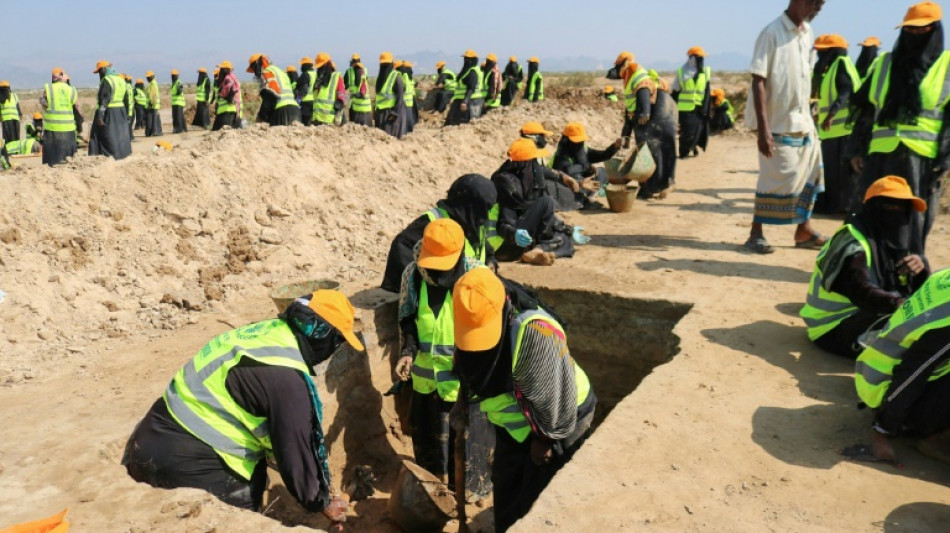
Scraping a living: salt offers women lifeline in Yemen / Photo: ©

 Macron welcomes Canada's Carney to French Atlantic territory

 Fiorentina frustrate Napoli with Serie A draw, Como upset

 Five-star Man City top Premier League after Sunderland thriller

 Ukrainian drones hit Moscow on last day of Russian elections

 Multi-Asset Trading Venue Monochrome Exchange Announces IEO of Its Native Token, $MCR

 South Korea break Japan hearts to win Asian Games basketball gold

 Acosta takes first victory at Austrian MotoGP

 PSG president Nasser al-Khelaifi under investigation in France for conflict of interest

 China swim sensation, 13, sets Games record after Japan win early

 Drones hit Moscow as Russians go to the polls

 New England boss Fleming says 'wrong' to ask Stokes to end retirement

 Germans vote in elections threatening fresh blow to Merz
 US fears rapid escalation in Mideast after Houthis attack Riyadh

 Japan triathlete Hojo wins first gold of Asian Games

 IOC president impressed by 'beautiful' Asian Games wooden huts

 First Asian Games gold goes to Japan as China's 13-year-old Yu lights up pool

 Data centre command hub keeps AI up and running
 Pope Leo in France: the issues on the table

 Packing for a pope: behind the scenes on foreign trips

 Republicans find transgender issues a powerful political weapon in midterm campaigning

 German state elections threaten new shock waves for Merz

 Chile's Bachelet quits race to be next UN chief

 Raphinha treble fires perfect Barca to win at Sevilla

 Thiam makes winning heptathlon return at Decastar meet

 Czechs beat USA to qualify for Davis Cup finals

Scooping up handfuls of white crystals from coastal pools, a group of women in Yemen harvest salt -- a traditional industry proving to be a lifeline after seven years of war.
Zakiya Obeid is one among nearly 500 women who work in the industry in a village overlooking the Gulf of Aden, on Yemen's southern coast.
"We cooperate and take shifts because it is a sisterhood and we know each others' difficult circumstances," Obeid told AFP.
Employment is so scarce that the women work in rotation to allow more people to benefit. She said the women are divided into two groups, with each working for 15 days while the others rest.
In bare feet and mud-spattered abaya robes, the women dig basins at low tide and return when the seawater has evaporated to dredge up the salt for packaging and selling.
The time-honoured livelihood has been passed down from generation to generation.
It is now a means of survival, providing many families with their only source of income. The women earn about $100 per month for harvesting the salt and packing it in plastic containers.
Since the formation of the Al Hassi Association for Sea Salt Production in 2020, the women are able to transport the salt to be ground, packaged and sold across Yemen.
"Before then, we used to do the same work but could only sell the salt raw," Obeid said. "But that is no longer the case, with the association providing us with bags and transport."
- 'Only source of income' -
Yemen has been embroiled in a civil war between the government -- supported by a Saudi-led military coalition -- and Iran-backed Huthi rebels since 2014, pushing the country to the brink of famine.
The conflict has killed hundreds of thousands of people and left millions displaced, according to the UN, which calls it the world's worst humanitarian catastrophe.
The head of the Al Hassi Association, Khamis Bahtroush, said the women, who produce between 20-30 tonnes of salt every three months, have come to rely on this industry.
"Production is lower in winter than in summer," he said. "Each bag is sold for approximately 3,000 Yemeni rials ($12)... but we are struggling with inflation and do not have liquidity to give them raises.
"This is their only source of income... they have nothing else. No farms, no livestock."
The United Nations Population Fund has said the loss of male breadwinners in the conflict has added to the difficulties faced by women.
"The pressure is even more severe where women or girls suddenly find themselves responsible for providing for their families when they themselves have been deprived of basic education or vocational training," it said.
O.Lorenz--BTB