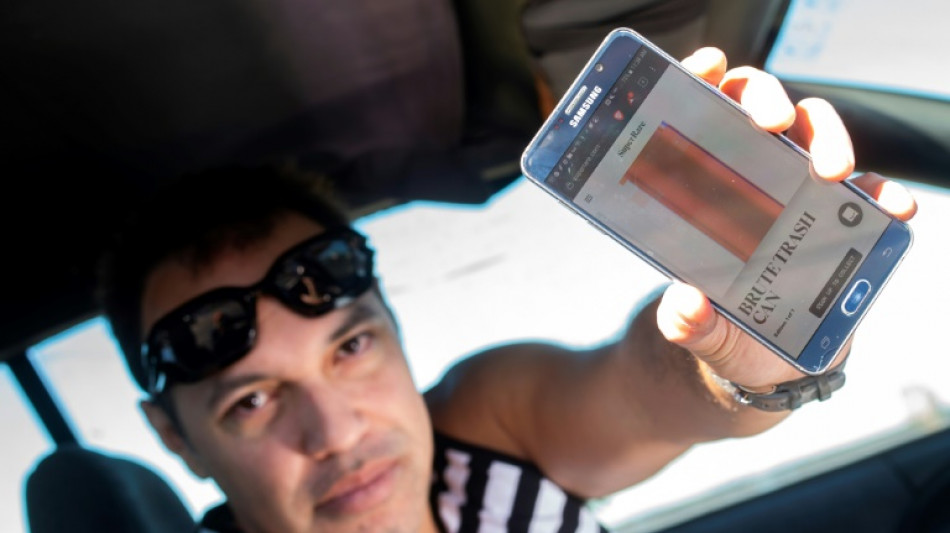
The NFT artist who sold a trashcan image for $252,000 / Photo: ©

 Macron welcomes Canada's Carney to French Atlantic territory

 Fiorentina frustrate Napoli with Serie A draw, Como upset
 Five-star Man City top Premier League after Sunderland thriller

 Ukrainian drones hit Moscow on last day of Russian elections

 Multi-Asset Trading Venue Monochrome Exchange Announces IEO of Its Native Token, $MCR

 South Korea break Japan hearts to win Asian Games basketball gold

 Acosta takes first victory at Austrian MotoGP

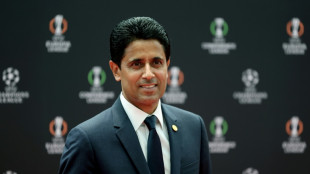 PSG president Nasser al-Khelaifi under investigation in France for conflict of interest

 China swim sensation, 13, sets Games record after Japan win early
 Drones hit Moscow as Russians go to the polls

 New England boss Fleming says 'wrong' to ask Stokes to end retirement
 Germans vote in elections threatening fresh blow to Merz
 US fears rapid escalation in Mideast after Houthis attack Riyadh

 Japan triathlete Hojo wins first gold of Asian Games
 IOC president impressed by 'beautiful' Asian Games wooden huts

 First Asian Games gold goes to Japan as China's 13-year-old Yu lights up pool

 Data centre command hub keeps AI up and running

 Pope Leo in France: the issues on the table

 Packing for a pope: behind the scenes on foreign trips
 Republicans find transgender issues a powerful political weapon in midterm campaigning

 German state elections threaten new shock waves for Merz
 Chile's Bachelet quits race to be next UN chief

 Raphinha treble fires perfect Barca to win at Sevilla
 Thiam makes winning heptathlon return at Decastar meet

 Czechs beat USA to qualify for Davis Cup finals
Marcel Duchamp scandalised the art world in 1917 by submitting a urinal as his entry to a prestigious competition. A century later, an American artist known as Robness sparked his own controversy by selling an NFT of a rubbish bin for $252,000.
"I can't even remember where the image came from, I think it was a Google image search," the 38-year-old Los Angeles native tells AFP.
NFTs are unique pieces of computer code stored on a longer chain of code known as a blockchain, with a link to an artwork or other item.
The image, called "64 gallon toter", depicts a large plastic trashcan with glitching effects, giving it a psychedelic appearance.
There is a lot of money to be made in the NFT art world -- auctions and purchases from celebrities contributed to sales worth more than $40 billion last year, according to analytics firm Chainalysis.
Like Duchamp's urinal, Robness's piece gained value as it gained notoriety -- NFT marketplace SuperRare removed the image shortly after he created it.
"It was kind of like rage art, I was angry about some things," he says. "So I put that up, and it was removed. They thought I was taking Home Depot's picture and breaking copyright.
"They threatened me legally," he says with a laugh.
But then, out of the blue, the platform reinstated his work.
SuperRare told AFP in an email that "the community didn't consider it as art", but reinstated it after two years because "so much has evolved" in the discussions around what can legitimately be called art.
- 'Disruptive element' -
The bin had become a meme and inspired thousands of tributes and copycats, and collectors were showing an interest.
"It was one of three trashcans that were in SuperRare and I sold it to a collector," Robness says.
"He called me up because he wanted to know more about the story and we spoke for about 30-45 minutes, and the whole hilarious story and he was laughing most of the time.
"So he wanted to collect it, so I gave him a price and that was that."
Robness -- who only goes by that name -- says he was doing odd jobs and sleeping in his car by the beach when he started exploring the world of cryptocurrencies in 2014.
He gradually became hooked on the technology -- "just the disruptive element of it to be honest" -- and began making NFTs.
The bin controversy and his prolific output -- he recently posted NFTs of a job application he made to McDonald's -- have garnered plenty of fans, his Twitter following breaking the 30,000 barrier.
And he sells enough to make a living.
"Per month, it's a lot better than my job I had as a barista," he jokes.
He now champions "open-source artistry" where he says anyone should be able to grab any image and do what they like with it.
"You can literally steal anything I made, copy and paste it, I don't care," he says.
D.Schneider--BTB