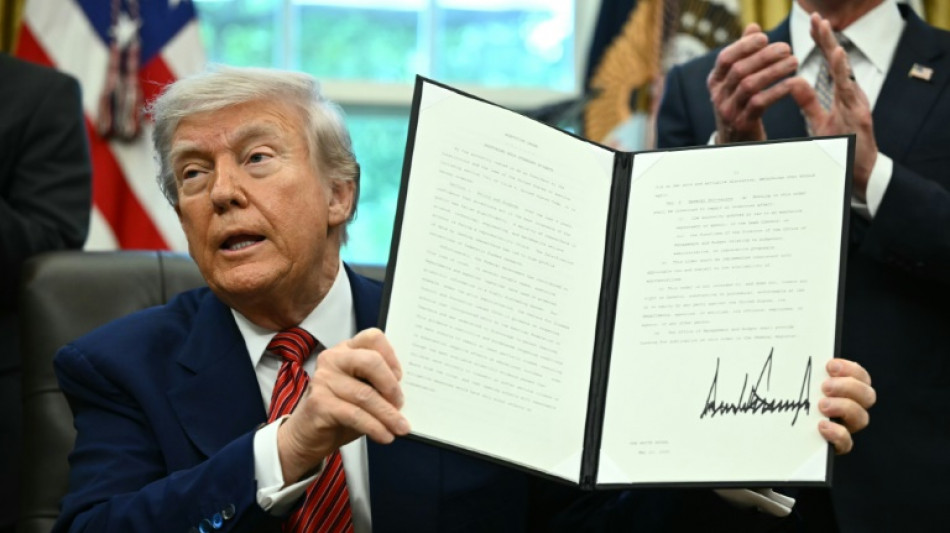
Trump signs orders to boost US nuclear energy / Photo: © AFP

 South Korea break China hearts to reach Asian Games football final
 Eala storms into Asian Games semi-finals to thrill adoring fans
 Turkey freezes ex-minister's assets as fund crisis grows
 What we know about the North Korean POW dispute

 Most equities rise after oil price plunge, US data in focus
 Polar oceans transformed as warming melts ice habitats: research

 Lost shark becomes viral star in South Korea

 Dangote to launch $16bn refinery in Kenya
 North Korean leader 'extremely obese': Seoul spy agency
 Yankees and pope-backed White Sox start MLB playoffs with wins

 Malaysia's ex-PM Mahathir in hospital for observation

 'No limits': Marathon world record holder Sawe chasing history

 Countdown begins to biggest-ever Rugby World Cup
 Bangladesh women lose ground after quota reform
 Vietnam admits 'differing opinions' on Hanoi development

 Stocks temper gains as oil pares heavy losses, US data in focus
 New Zealand denies breaching climate commitments to EU
 Albert becomes youngest US scorer in 4-2 win over Chile
 Pirate island's plunging population shows Greece's demographic decline
 With elections ahead, Latvia's Russian-speakers reject Moscow's help
 Brazil football clubs face massive sponsorship blow from betting ban

 ChatGPT maker wants to be the App Store for AI as safety concerns grow

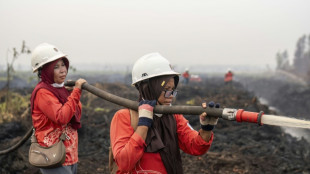 Women fight fires and sexism in Indonesian Borneo

 Forsling's OT blast lifts Florida over Carolina in NHL opener

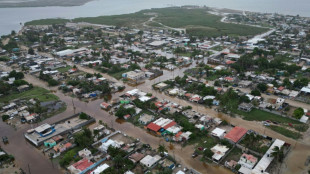 Hurricane Polo sweeps over Mexico's Pacific coast, heads inland
President Donald Trump signed a series of executive orders Friday to boost nuclear energy in the United States, including by rolling back regulatory processes on a still divisive technology.
"We're signing tremendous executive orders today that really will make us the real power in this industry," Trump told reporters as he penned the four orders in the Oval Office.
Trump's orders aim to speed up the building of new reactors and to boost domestic mining and enriching of uranium, with the United States relying on imports for most of the crucial fuel.
The US president said the focus would be on building smaller reactors, such as those required by tech and artificial intelligence companies that have huge energy needs.
The orders will also overhaul the US nuclear watchdog so that it pushes through decisions on building new reactors within 18 months, amid reports that the White House found the regulator too risk averse.
Trump denied that speeding up the regulation process could compromise nuclear safety.
"We're going to get it very fast and very safe," Trump said. "It's time for nuclear and we're going to do it very big."
The move comes with growing interest in nuclear energy in the United States, despite being expensive to build and still politically sensitive in the wake of the 2011 Fukushima disaster.
"President Trump is taking truly historic action to usher in the American nuclear renaissance," Michael Kratsios, Director for the White House Office of Science and Technology Policy, told reporters earlier.
- 'Energy emergency' -
A senior White House official said the administration hopes to "test and deploy" new reactors before the end of Trump's second term in January 2029.
Trump's order "fundamentally rehauls" the Nuclear Regulatory Commission, which grants permission for new reactors, by "lowering regulatory burdens and shortening the licensing timeline."
Republican Trump declared an "energy emergency" on his first day back in office to expand drilling for oil and gas and to roll back Democratic predecessor Joe Biden's climate policies,
But he is now also looking at nuclear to meet growing demand.
Much of the demand is fueled by US tech giants, with some including Amazon, Microsoft and Google having recently signed deals for nuclear power as they seek carbon-free electricity sources.
Two US energy companies are also preparing to bring nuclear stations back online, including Three Mile Island -- the site in 1979 of the worst commercial nuclear power accident in US history.
Trump's drive to boost mining and enrichment also reflects the fact that the United States imports most of the uranium that is needed to fuel nuclear power stations.
The US imported most from Canada, Australia, Russia, Kazakhstan, and Uzbekistan in 2023 but in 2024 it banned uranium imports from Russia over Moscow's invasion of Ukraine.
Nuclear power has been undergoing a resurgence in recent years as countries look for carbon-free energy and confront rising prices, fueled by the war in Ukraine.
It suffered a major downturn after Fukushima when a huge tsunami caused a meltdown at a Japanese power station, with Germany in particular turning its back on nuclear.
G.Schmid--VB