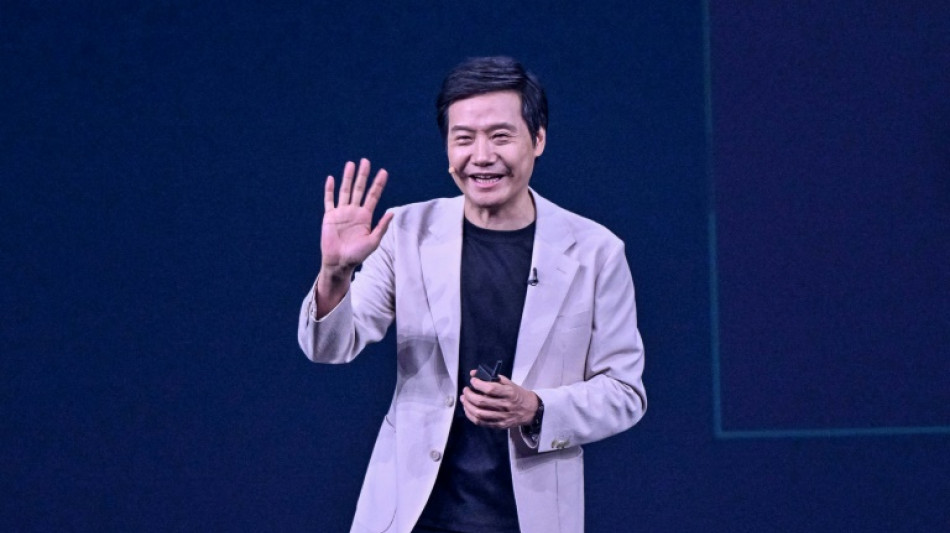
Xiaomi launches new advanced in-house mobile chip / Photo: © AFP

 Kushner to meet Netanyahu after talks with Hamas on Gaza plan

 Photos, memories all that remain for Colombia's bereaved after quake

 Sabalenka squeezes out win on sixth match point in Cincinnati

 Trump says US scaling back military drills with South Korea hours before start

 Jason Arday: UK academic who died amid plagiarism storm

 Sabbath cafe clash lays bare Israel faultlines

 Top-ranked Scheffler powers to PGA St. Jude Championship victory

 Jacquet scores on Liverpool debut in friendly win over Como

 Hawaii's Big Island begins recovery efforts as Hurricane Lala downgrades, moves west

 Spidey swings high for third weekend in N. American box office

 Eagle and late birdie lift Jeeno to LPGA Portland Classic win

 Duplantis masterclass for fourth Euro pole vault title

 Records for Asher-Smith, Hunt as Britain win 4x100m mixed relay

 Barcelona reach deal with Man City to sign Rodri

 Misery for Maresca as Man City make dismal start to life after Guardiola

 Strikes kill 19 in Russia and Ukraine

 Lula and Bolsonaro court women voters as Brazil election campaign kicks off

 Belgium races to tame huge wildfire creeping towards Germany

 Two dead, hundreds evacuated from fires on island near Athens

 Real Madrid crush Schalke in friendly as Diomande debuts

 Calls for UK inquiry into 'hounding' of ex-Cambridge academic

 Strikes kill 16 in Russia and Ukraine

 Marchand tries for European swim gold in unfamiliar event

 India's Padikkal steals the show with 167 in first Sri Lanka Test

 Hollywood duo underline Premier League ambition for Wrexham

Tech giant Xiaomi unveiled a new advanced in-house mobile chip on Thursday, a significant milestone for the company as Chinese firms shift resources towards home-grown technology against a bleak international trade backdrop.
Xiaomi, which sells goods from smartphones to vacuum cleaners and electric vehicles (EVs), is one of China's most prominent consumer electronics firms.
With the XRING O1, it becomes only the second smartphone brand globally after Apple to mass produce its own 3-nanometre chips, among the most advanced on the market.
This despite being a latecomer to the chip industry, Xiaomi founder Lei Jun said at a launch event on Thursday, joking that the feat had been "harder than ascending to heaven".
Xiaomi took early steps into semiconductors for smartphones with the launch of the firm's first in-house chip, the Surge S1, in 2017.
But the group was forced to halt production of the chip due to technical and financial obstacles.
Lei said the journey to developing the XRING O1 had taken over a decade.
"How much hardship, how much sweat, how much untold pain have been involved in these 11 years? How much courage and determination did it take to make this decision?" he said.
The XRING O1 will first be deployed in Xiaomi's new 15S Pro flagship smartphone and the Pad 7 Ultra tablet, which were also launched Thursday along with a preview of the firm's first electric SUV.
- 'Step to self-sufficiency' -
A number of Chinese firms are racing to develop their own chips with the aim of freeing themselves from reliance on foreign suppliers.
Xiaomi is only the fourth smartphone brand globally to have developed its own system-on-chip, with Huawei the only domestic competitor.
"This represents yet one more step toward China reaching self-sufficiency in this crucial industry –- as well as in broader ICT and electronics supply chains," Stephen Ezell from US-based think tank Information Technology and Innovation Foundation (ITIF) told AFP.
Over the past few years, Washington has sharply tightened export controls on advanced chip technology to China, citing national security concerns.
Chinese chip foundries are restricted from accessing foreign equipment needed for cutting-edge chip production -- meaning that firms have to rely on overseas foundries for 5nm-process and below.
Xiaomi has not confirmed which company is manufacturing the XRING O1, though Lei said it uses the same second generation 3nm-process technology as Apple's latest chips.
Apple contracts Taiwanese chipmaking titan TSMC for its fabrication.
The chip is a "significant" achievement for Xiaomi, and allows it to reduce "its reliance on external designers" such MediaTek and Qualcomm, Washington-based semiconductor and technology analyst Ray Wang told AFP.
"Longer term, owning its SoC (system-on-chip) roadmap will insulate Xiaomi's devices from the US–China geopolitical tensions and help mitigate global supply-chain disruptions," he said.
F.Stadler--VB