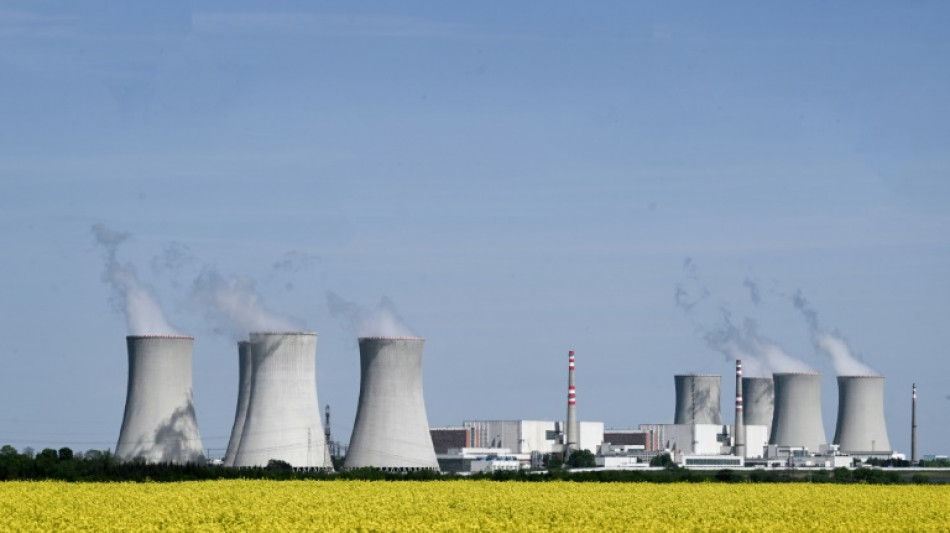
EDF complaint blocks Czech-Korean nuclear deal / Photo: © AFP

 South Africa's Universal Health Coverage Depends on Tackling Poverty and Inequality

 Chelsea Transfer News: Real Betis Star Jose Antonio Morante Rejects Move to Stamford Bridge

 TikTok Security Chief Advises SMBs on Free Cybersecurity Protections

 Egypt Revokes Citizenship of Brothers Anas and Tarek Habib Over Unapproved Foreign Nationality

 2027 Rivian R2 Performance vs. 2026 Jeep Recon Moab: EV Comparison Test

A Czech court said Tuesday it blocked a multi-billion-dollar deal between Prague and South Korea's KHNP on the construction of two nuclear units following a complaint by France's EDF.
KHNP won the contract last July after beating EDF in the tender, but the French giant filed an appeal with the Czech antitrust watchdog UOHS.
When the UOHS rejected the appeal last week, EDF filed a lawsuit.
The regional court in the second Czech city of Brno said it had "issued a pre-emptive ruling banning the signature" originally scheduled for Wednesday.
It added that if the deal were signed, EDF would lose a chance to compete for the contract for good even if the court ruled in its favour later on.
The deal cannot be signed until the court passes a verdict on the case.
KHNP is due to build the two units at the southern Czech nuclear plant of Dukovany run by the state-run CEZ group.
The Czech Republic, an EU member of 10.9 million people, relies on nuclear power -- produced by Dukovany and the Temelin plant also in the south -- for 40 percent of its electricity consumption.
With the two new units and small modular reactors due to be built by 2050, the share of nuclear energy is expected to rise to 50 percent as the country shifts from burning fossil fuels.
EDF hailed the postponement, saying it "provides the necessary time for a thorough assessment of any potential infringement of its rights".
It also told AFP it was ready for "all legal actions".
EDF said earlier its appeal was designed to make sure the selection process was fair and transparent.
It also insists it can offer 60 percent of the value of the contract to Czech companies, while the share offered by KHNP is lower.
The Czech news agency CTK quoted KHNP as saying it acknowledged the postponement but was sure the tender was correct, and that it was ready to go to court too.
Czech Prime Minister Petr Fiala said after the tender that KHNP's bid was "better in all criteria assessed".
CEZ insisted on Tuesday that the tender was "fully transparent in all phases" and called on EDF to make its bid public to "rule out any doubt" that KHNP's bid was better.
The UOHS also earlier rejected an appeal by US-based Westinghouse, eliminated from the tender in January 2024 over flaws in its bid.
KHNP has offered to build the two new units for around 200 billion Czech koruna ($9 billion) each.
Prague expected to finalise the deal with KHNP by March this year, but the EDF appeal delayed the process.
CEZ expects construction to begin in 2029 and the first new reactor launched in trial operation in 2036.
O.Schlaepfer--VB