US solar tariffs could drive Asia transition boom / Photo: © AFP/File

 PSG start Ligue 1 defence with eye on Champions League hat-trick

 Arsenal can become world's best club: Arteta

 Japan's King Kazu, 59, scores twice from spot to make cup history

 Kyiv's desperate vendors persevere outside obliterated flea market

 Australia races to shield little penguins from H5N1 bird flu

 Messi scores first goal since father's death

 US national debt exceeds $40 trillion for first time

 Brazilian narco violence spills over into tranquil Bolivia
 Trump's devoted 'human printer' in media glare

 Top seed Zverev bundled out by Paul in rain-hit Cincinnati upset

 WADA pledges vigilance on Russian athletes ahead of 2028 Olympics

 NASA satellite rescue mission fails

 Cobolli halts Jodar to reach Cincinnati quarter-finals

 As election looms, Netanyahu puts Turkey in Israel's crosshairs

 McIlroy questions LIV stars 'value' as talk of PGA return builds

 'Breakthrough' mRNA cancer drug curbs melanoma in large trial

 Many US Fed policymakers back interest rate hikes if inflation stays high

 Robinson and Tongue star as Pakistan collapse in England opener

 All Blacks must get 'everything right' to beat Springboks, says legend Fitzpatrick

 Robinson and Tongue star as Pakistan all out for 171 in England opener

 Lake Zurich sees water level hit record low amid drought

 Merck and Moderna's tailored cancer drug curbs melanoma recurrence in trial

 Referees chief Webb wants clamp-down on Premier League set-piece grappling
 Robinson makes history as Pakistan collapse against England

 Alvarez can win back Atletico fans in two games: club chief

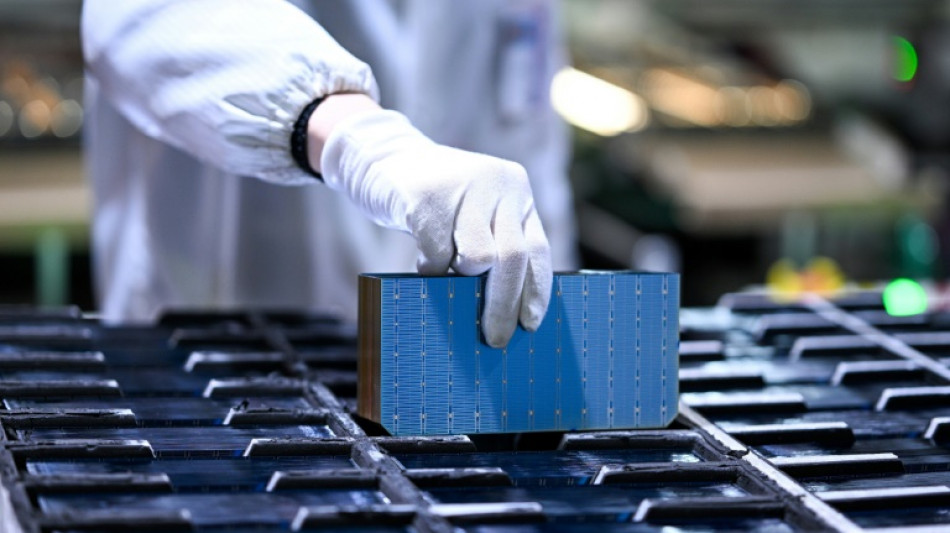
Massive planned US duties on solar panels made in Southeast Asia could be a chance for the region to ramp up its own long-stalled energy transition, experts say.
Earlier this month, Washington announced plans for hefty duties on solar panels made in Cambodia, Vietnam, Thailand and Malaysia.
The levies follow an investigation, launched before US President Donald Trump took office, into "unfair practices" in the countries, particularly by Chinese-headquartered firms.
If approved next month, they will pile upon tariffs already imposed by the Trump administration, including blanket 10-percent levies for most countries, and 145 percent on Chinese-made goods.
For the US market, the consequences are likely to be severe. China makes eight out of every 10 solar panels globally, and controls 80 percent of every stage of the manufacturing process.
The new tariffs "will practically make solar exports to US impossible commercially", said Putra Adhiguna, managing director at the Energy Shift Institute think tank.
Southeast Asia accounted for nearly 80 percent of US solar panel imports in 2024.
And while investment in solar production has ramped up in the United States in recent years, the market still relies heavily on imported components.
For Chinese manufacturers, already dealing with a saturated domestic market, the raft of tariffs is potentially very bad news.
Many shifted operations to Southeast Asia hoping to avoid punitive measures imposed by Washington and the European Union as they try to protect and nurture domestic solar industries.
The proposed new duties range from around 40 percent for some Malaysian exports to an eye-watering 3,521 percent for some Cambodia-based manufacturers.
- Tariffs 'accelerate' transition -
But there may be a silver lining for the region, explained Ben McCarron, managing director at Asia Research & Engagement.
"The tariffs and trade war are likely to accelerate the energy transition in Southeast Asia," he said.
China will "supercharge efforts" in regional markets and push for policy and implementation plans to "enable fast adoption of green energy across the region", driven by its exporters.
Analysts have long warned that countries in the region are moving too slowly to transition from planet-warming fossil fuels like coal.
"At the current pace, it (Southeast Asia) risks missing out on the opportunities provided by the declining costs of wind and solar, now cheaper than fossil fuels," said energy think tank Ember in a report last year.
For example, Malaysia relied on fossil fuels for over 80 percent of its electricity generation last year.
It aims to generate 24 percent from renewables by 2030, a target that has been criticised as out of step with global climate goals.
The tariff regime represents a double opportunity for the region, explained Muyi Yang, senior energy analyst at Ember.
So far, the local solar industry has been "largely opportunistic, focused on leveraging domestic resources or labour advantages for export gains", he told AFP.
Cut off from the US market, it could instead focus on local energy transitions, speeding green energy uptake locally and driving a new market that "could serve as a natural hedge against external volatility".
Still, replacing the US market will not be easy, given its size and the relatively nascent state of renewables in the region.
"Success hinges on turning this export-led momentum into a homegrown cleantech revolution," said Yang.
"Clearance prices" may be attractive to some, but countries in the region and beyond may also be cautious about a flood of solar, said Adhiguna.
Major markets like Indonesia and India already have measures in place intended to favour domestic solar production.
"Many will hesitate to import massively, prioritising trade balance and aims to create local green jobs," he said.
E.Burkhard--VB