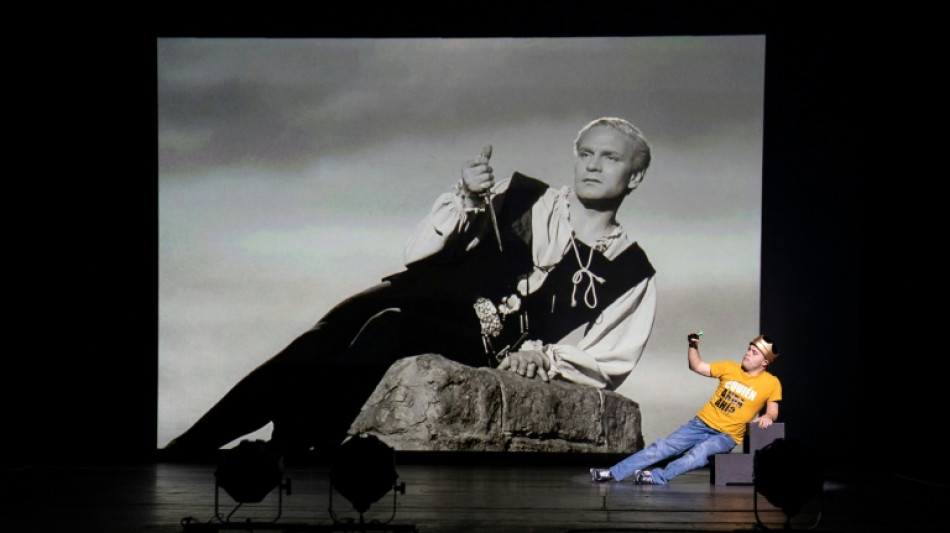
Actors with Down syndrome tear down barriers in London show / Photo: © AFP

 Penrith Panthers Face Backlash Over Decision to Disband Pantherettes Cheerleading Squad

 Make-A-Wish Announces 2026 Starblazer Award Honorees; Allied World Becomes First Corporate Founder

 Lee-Trump Golf Diplomacy Faces Diplomatic Dilemma Ahead of G20 Summit

 Mavericks Defeat Jazz 112-100 Behind Washington’s 26 Points and Second-Half Surge

 BingX: Major Announcement of Far-Reaching Significance

 James Blunt Scores First Number One Album in 19 Years; Wife Sofia Wellesley Celebrates

 UCLA Stays Unbeaten With Ty Dieffenbach's Heroic Return Against Illinois

It's one of Shakespeare's most existential questions "to be or not to be?" Now a group of globe-trotting Peruvian actors with Down syndrome are tackling it head-on, breaking down prejudice and barriers.
Cristina Leon, Jaime Cruz and Manuel Garcia are members of the eight-strong group currently performing William Shakespeare's "Hamlet" at the Barbican centre in London this week until Sunday.
"This play shows that we can be included in everything at work, and in education. There are no barriers, we can do lots of things, and people must open their eyes to the fact that we can do anything they ask us," Leon, 32, told AFP.
The project was launched seven years ago born out of Cruz's dreams of becoming an actor.
He was working as an usher in the Teatro La Plaza in Lima and had never thought that his Down syndrome was an obstacle in life.
"I have always wanted to be an actor. One day there was an event (at the Lima theatre) in which you had to introduce yourself, and I said my name and said I was an actor," the 30-year-old said.
He added that he wanted to overcome "prejudices, myths and barriers."
His words inspired the theatre's artistic director Chela de Ferrari, who has now adapted the play for the eight actors and brought it to the land of Shakespeare's birth.
"He really caught by attention, and I thought to myself I really need to have a more in-depth discussion with him," she told AFP.
"We went to a cafe, and while we were talking I had a vision of him wearing the prince's crown and I thought about the meaning that Jaime could bring to Hamlet's famous words 'to be or not to be'," she said.
- 'Form of resistance' -
A casting session was organised and seven other actors were chosen for the group.
"Jaime made me face my own prejudices, my deep ignorance about the reality. I think what the public experiences mirrors exactly what happened to me," de Ferrari said.
Three years ago the group was invited to visit Spain, and since then they have toured the world.
The show had a sold-out run at the Edinburgh International Festival last year, with The Guardian praising the cast's interpretation of the normally depressing tale of the Danish prince as "upbeat", adding it "oozes charm, humour and imagination".
"I don't think it's the only play with actors with Down syndrome, but I don't think other groups have travelled as much," de Ferrari said.
This year, the group of five men and three women will also be performing in Brighton in southern England as well as 35 other towns and cities, including Seoul, Melbourne, Toronto in Canada, and New York and Chicago in the United States.
They act in Spanish with sub-titles in other languages for local non-Spanish speaking audiences.
"In today's society everyone puts up limits. They tell us all the time that we cannot do things," said Garcia, 32.
"With what we are seeing in the world, attacks on certain values such as diversity, it's a good moment to present these projects. It's also a form of resistance," added de Ferrari.
"Instead of rejecting people who have speech problems or stutter, we embrace this diversity," she said proudly.
C.Stoecklin--VB