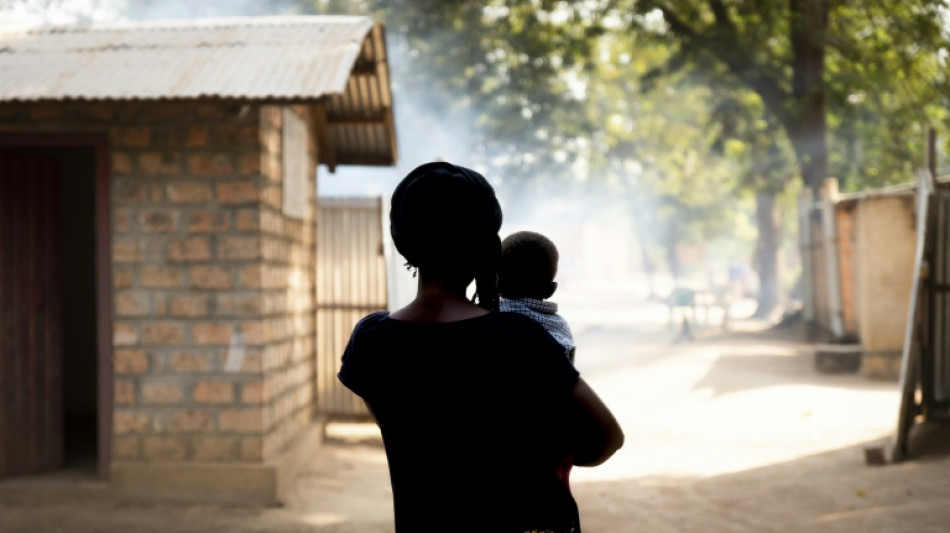
Rape stalks women in C. Africa's dirty war
/ Photo: ©

 Macron welcomes Canada's Carney to French Atlantic territory
 Fiorentina frustrate Napoli with Serie A draw, Como upset

 Five-star Man City top Premier League after Sunderland thriller
 Ukrainian drones hit Moscow on last day of Russian elections
 Multi-Asset Trading Venue Monochrome Exchange Announces IEO of Its Native Token, $MCR
 South Korea break Japan hearts to win Asian Games basketball gold
 Acosta takes first victory at Austrian MotoGP
 PSG president Nasser al-Khelaifi under investigation in France for conflict of interest

 China swim sensation, 13, sets Games record after Japan win early

 Drones hit Moscow as Russians go to the polls
 New England boss Fleming says 'wrong' to ask Stokes to end retirement

 Germans vote in elections threatening fresh blow to Merz
 US fears rapid escalation in Mideast after Houthis attack Riyadh

 Japan triathlete Hojo wins first gold of Asian Games

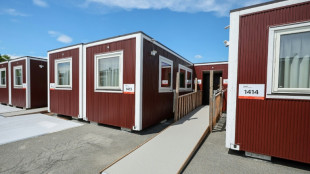 IOC president impressed by 'beautiful' Asian Games wooden huts

 First Asian Games gold goes to Japan as China's 13-year-old Yu lights up pool

 Data centre command hub keeps AI up and running
 Pope Leo in France: the issues on the table
 Packing for a pope: behind the scenes on foreign trips

 Republicans find transgender issues a powerful political weapon in midterm campaigning

 German state elections threaten new shock waves for Merz

 Chile's Bachelet quits race to be next UN chief

 Raphinha treble fires perfect Barca to win at Sevilla

 Thiam makes winning heptathlon return at Decastar meet
 Czechs beat USA to qualify for Davis Cup finals
Maia looks down at her expanding belly, her eyes welling with tears.
Four months ago, an armed man grabbed and raped the 15-year-old, attacking her as she was harvesting cassava roots.
In the remote northwest of the Central African Republic (CAR), sexual violence targeting women, adolescents and even younger girls is on the rise.
Brutal acts are committed by rebels, militiamen and security forces alike, according to the United Nations.
In Paoua, about 500 kilometres (300 miles) northwest of the capital Bangui, more than a dozen rape victims turn up every day at a clinic run by the Danish Refugee Council (DRC).
The distraught teenager struggles to put her feelings into words. "I was alone in the fields when an armed man wearing a turban grabbed me," she says in a near-whisper.
"I told him I was a virgin and begged him not to hurt me," Maia says, unable to utter the word "rape", even as she bears the unborn child of the man who assaulted her.
Like Maia, Marie was harvesting cassava to feed her family when two armed men appeared.
Her husband fled the scene, but she reacted too slowly.
"They tied my hands, tore my clothes and took turns raping me," says the 23-year-old, who was wearing a traditional gown in the purple, green and white colours of International Women's Day.
The rape victims interviewed by AFP all had similar stories.
Most said they had been assaulted in the fields by rebels of a powerful local militia known as the 3R, a name derived from the French words for Return, Reclamation and Rehabilitation.
- 'Easy target' -
"In this area, it is mainly women who farm and take care of feeding the family," says Lola, an employee at the centre whose name has been changed for her safety, like Maia's and Marie's.
"Alone and helpless in the fields, they are an easy target for the rebels."
A civil war in the CAR that began in 2013, pitting myriad militias against a state on the verge of collapse, had lessened considerably in recent years.
But about a year ago, fighting resumed abruptly when rebels launched an offensive to overthrow President Faustin Archange Touadera.
At the time, armed groups controlled two-thirds of the CAR's territory.
But they ceded most of it when the army, backed by hundreds of Russian paramilitaries, mounted a massive counter-offensive against the rebels.
Today militia forces are confined to the countryside and have switched to guerrilla tactics -- and harassment and abuse of civilians are on the rise.
The UN Office for the Coordination of Humanitarian Affairs (OCHA) recorded 6,336 cases of gender-based violence between January and July 2021 across the deeply poor country.
The agency identified a quarter of such cases as sexual violence, an increase of 58 percent compared with the first half of 2020. Rebels and militiamen are more active in the Paoua region.
Recent reports by the United Nations or by UN-sponsored experts have accused both soldiers and their Russian mercenary allies of committing rapes.
At the Paoua hospital, signs prohibit the carrying of weapons.
A dozen women and girls wait outside a door freshly painted in pink to see Fabrice Clavaire Assana, a doctor who specialises in counseling and treating victims of gender-based violence.
"After a phase of listening and building confidence," Assana says, he carries out gynaecological examinations and provides emergency treatment when needed.
But his options are few.
The "morning-after" anti-pregnancy pill, hepatitis B vaccine and anti-HIV medicine work only if taken within 72 hours. "This is rarely the case," he says regretfully.
- 50km trek -
After Marie was assaulted, she turned first to relatives.
"I was distraught and ashamed. I first went to my in-laws in my torn clothes, but they were unable to pay for my transport to Paoua," she says.
So Marie then walked 50 km to Paoua, "praying" not to tread on a landmine or run into rebels.
"I relive the scene day and night, I can't go back to the fields," sighs Marie, burying her face in her hands.
"My husband has fled -- now I'm alone with two children to feed, and I can't grow crops."
Neither Maia nor Marie has tried to seek justice for the men who raped them.
Such crimes almost always go unpunished in the absence of functioning courts.
C.Meier--BTB