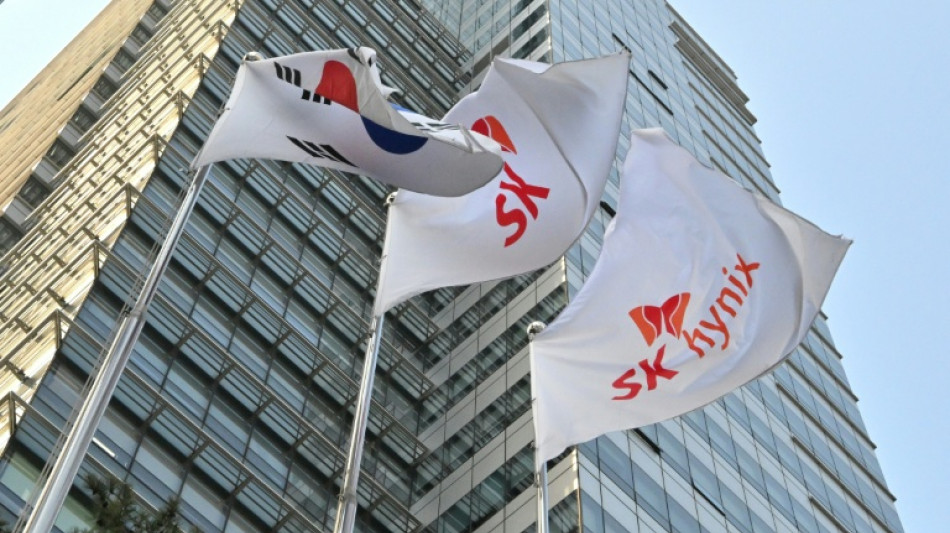
SK hynix posts record profits thanks to strong AI demand / Photo: © AFP/File

 Penrith Panthers Face Backlash Over Decision to Disband Pantherettes Cheerleading Squad

 Make-A-Wish Announces 2026 Starblazer Award Honorees; Allied World Becomes First Corporate Founder

 Lee-Trump Golf Diplomacy Faces Diplomatic Dilemma Ahead of G20 Summit

 Mavericks Defeat Jazz 112-100 Behind Washington’s 26 Points and Second-Half Surge

 BingX: Major Announcement of Far-Reaching Significance

 James Blunt Scores First Number One Album in 19 Years; Wife Sofia Wellesley Celebrates

 UCLA Stays Unbeaten With Ty Dieffenbach's Heroic Return Against Illinois

South Korean chip giant SK hynix reported record quarterly profits Thursday thanks to soaring global demand for artificial intelligence, highlighting the firm's ability to weather mounting tariff threats.
The world's second-largest memory chip maker dominates the market for high-bandwidth memory (HBM) semiconductors and is a key supplier for US titan Nvidia.
SK hynix said it recorded an operating profit of 7.44 trillion won ($5.19 billion) -- a nearly 158 percent year-on-year increase -- on revenues of 17.64 trillion won from January–March.
Both figures marked the company's second-highest quarterly results on record, following last quarter's performance.
The news comes after Taiwanese chip giant TSMC last week announced a surge in net profit for the first quarter and forecast robust demand for artificial intelligence technology, despite the spectre of US tariffs on the critical sector.
Net income also quadrupled compared to the previous year to 8.11 trillion won ($5.67 billion), with the firm saying the "memory market ramped up faster than expected due to competition to develop AI systems and inventory accumulation demand".
The company added that its annual HBM sales for this year are expected to double compared to last year.
Despite the news, SK hynix's shares fell more than one percent in Seoul morning trade.
- Less affected -
South Korea is a major exporter to the United States and its powerhouse semiconductor and auto industries would suffer greatly under President Donald Trump's looming 25 percent tariffs.
The country is also home to the world's largest memory chip maker, Samsung.
Experts say SK hynix's resilience is because of the company's growth in the DRAM market.
SK hynix recently took the lead in DRAM revenues with a 36 percent market share, according to specialist research firm Counterpoint, surpassing Samsung for the first time and marking the first change in the top spot in over four decades.
"Right now the world is focused on the impact of tariffs, so the question is: what's going to happen with HBM DRAM?" said Counterpoint research director MS Hwang.
"At least in the short term, the segment is less likely to be affected by any trade shock as AI demand should remain strong. More significantly, the end product for HBM is AI servers, which -- by definition -- can be borderless."
During a conference call, SK hynix noted that "uncertainty has grown around demand for semiconductors", but sales plans for key clients for the company this year "remain unchanged".
"Global customers are, overall, maintaining their previously discussed memory demand levels with us," said an SK hynix official.
"Additionally, some clients are pulling forward demand by requesting short-term supply advances," the company said.
The company also noted that while roughly three-fifths of its sales are to US-based customers, tariffs apply only to products shipped directly to the United States.
"Even when our clients are headquartered in the US, memory products are often shipped to locations outside the US, meaning the actual proportion of direct exports to the US is not particularly high," an SK hynix official said.
O.Schlaepfer--VB