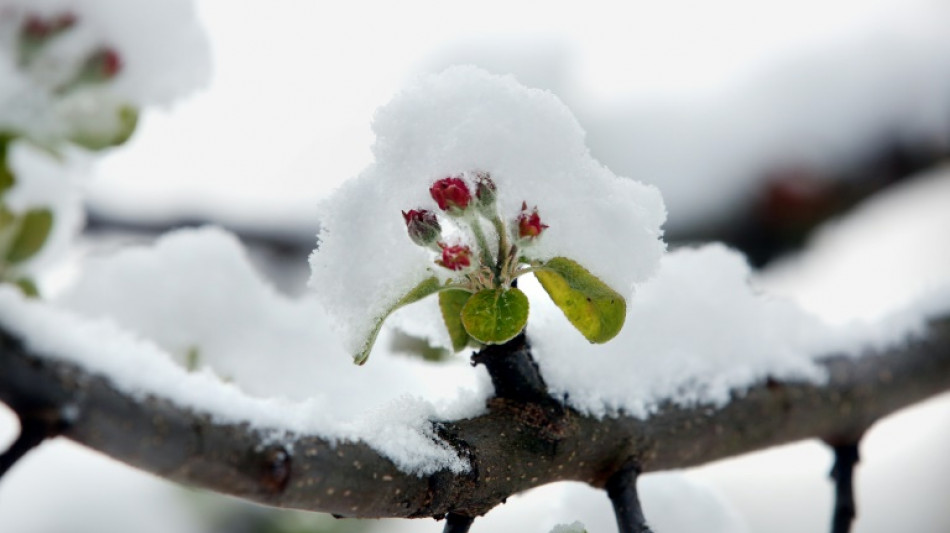
Spring in February: UK plants flowering 'a month early' / Photo: ©

 Macron welcomes Canada's Carney to French Atlantic territory
 Fiorentina frustrate Napoli with Serie A draw, Como upset

 Five-star Man City top Premier League after Sunderland thriller

 Ukrainian drones hit Moscow on last day of Russian elections

 Multi-Asset Trading Venue Monochrome Exchange Announces IEO of Its Native Token, $MCR

 South Korea break Japan hearts to win Asian Games basketball gold

 Acosta takes first victory at Austrian MotoGP

 PSG president Nasser al-Khelaifi under investigation in France for conflict of interest

 China swim sensation, 13, sets Games record after Japan win early

 Drones hit Moscow as Russians go to the polls

 New England boss Fleming says 'wrong' to ask Stokes to end retirement

 Germans vote in elections threatening fresh blow to Merz

 US fears rapid escalation in Mideast after Houthis attack Riyadh

 Japan triathlete Hojo wins first gold of Asian Games

 IOC president impressed by 'beautiful' Asian Games wooden huts

 First Asian Games gold goes to Japan as China's 13-year-old Yu lights up pool

 Data centre command hub keeps AI up and running
 Pope Leo in France: the issues on the table

 Packing for a pope: behind the scenes on foreign trips

 Republicans find transgender issues a powerful political weapon in midterm campaigning

 German state elections threaten new shock waves for Merz

 Chile's Bachelet quits race to be next UN chief

 Raphinha treble fires perfect Barca to win at Sevilla

 Thiam makes winning heptathlon return at Decastar meet

 Czechs beat USA to qualify for Davis Cup finals

Global warming is causing plants in the UK to burst into flower around a month earlier, with potentially profound consequences for crops and wildlife, according to research Wednesday that used nature observations going back to the 1700s.
Trees, herbs and other flowering plants have shifted seasonal rhythms as temperatures have increased, according to the study led by the University of Cambridge.
The results are "truly alarming" because of the ecological threats posed by early flowering, said Ulf Buntgen, a professor from Cambridge's Department of Geography, who led the research published in the journal Proceedings of the Royal Society B.
Crops can be killed off if they blossom early and are then lashed by a late frost, but reasearchers said the bigger threat was to wildlife.
This is because insects and birds have evolved to synchronise their own development stages with the plants they rely on. When they are no longer in phase, the result is an "ecological mismatch".
"A certain plant flowers, it attracts a particular type of insect, which attracts a particular type of bird, and so on," Buntgen said in a press release from the university.
"But if one component responds faster than the others, there's a risk that they'll be out of synch, which can lead species to collapse if they can't adapt quickly enough."
- Spring backwards? -
To track the changes in flowering patterns, researchers used a database known as Nature's Calendar, which has entries by scientists, naturalists, amateur and professional gardeners, as well as organisations such as the Royal Meteorological Society, going back more than 200 years.
Looking at more than 400,000 observations of 406 trees, shrubs, herbs and climbing plants across swathes of Britain, they found that the average first flowering date from 1987 to 2019 is 30 days earlier than the average first flowering date from 1753 to 1986.
The changes seen in recent decades coincide with accelerating impacts of human-caused climate change, especially higher temperatures.
Spring in Britain might eventually creep into the historically wintry month of February if global temperatures continue to increase at their current rate, said Buntgen.
That rapid shift in natural cycles could reverberate through forests, farms and gardens.
Buntgen said scientists need to have access to data that track whole ecosystems over long periods of time, if we are to truly understand the implications of climate change.
"We can use a wide range of environmental datasets to see how climate change is affecting different species, but most records we have only consider one or a handful of species in a relatively small area," said Buntgen.
There is growing concern among scientists about the scale of the impact of a rapidly warming world, on everything from extreme weather events to loss of biodiversity.
The United Nations last month confirmed that the past seven years have been the hottest on record, while the average global temperature in 2021 was around 1.11 degrees Celsius above the pre-industrial levels measured between 1850 and 1900.
I.Meyer--BTB