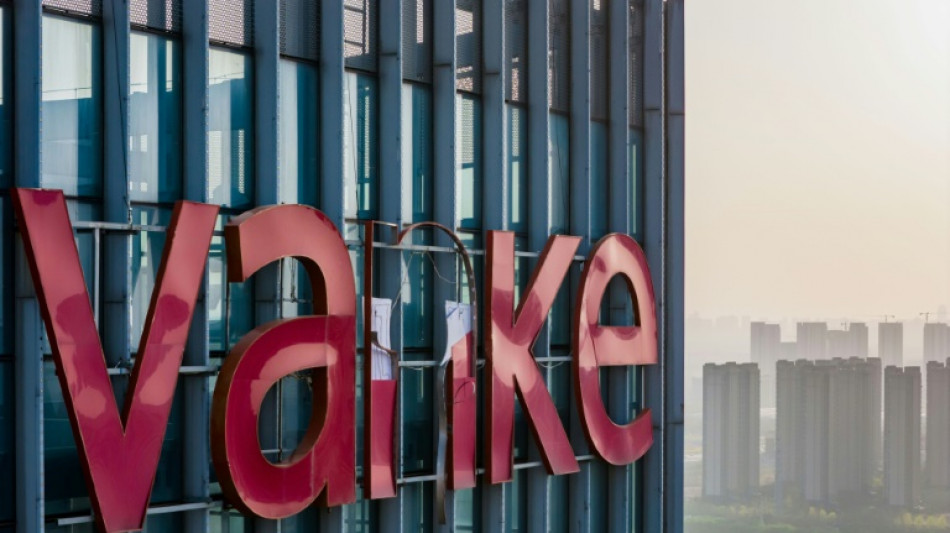
China property giant Vanke reports annual loss of $6.8 bn / Photo: © AFP

 Indiana River Otters Make Comeback After Decades of Conservation Efforts

 Shruti Haasan Reveals Kamal Haasan’s Defense of Her Film Career

 Penrith Panthers Face Backlash Over Decision to Disband Pantherettes Cheerleading Squad

 Make-A-Wish Announces 2026 Starblazer Award Honorees; Allied World Becomes First Corporate Founder

 Lee-Trump Golf Diplomacy Faces Diplomatic Dilemma Ahead of G20 Summit

 Mavericks Defeat Jazz 112-100 Behind Washington’s 26 Points and Second-Half Surge

 BingX: Major Announcement of Far-Reaching Significance

Debt-laden Chinese property giant Vanke reported annual losses of 49.5 billion yuan ($6.8 billion) on Monday, citing falling sales and shrinking profit margins despite Beijing's attempts to revive the housing market.
Vanke said 2024 was an "exceptionally challenging year" in a filing to the Hong Kong stock exchange and apologised for "distress caused... due to the significant decline in sales, substantial losses and pressure on our liquidity".
Beijing has in recent years grappled with a prolonged crisis in the country's vast real estate sector, once a key pillar of the economy but now beset with sprawling debt.
Hong Kong-listed Vanke is part-owned by the government of Shenzhen and was China's fourth-largest real estate firm by sales last year, according to research firm CRIC.
Vanke said on Monday that it "failed to break free from expansion inertia of high-debt, high-turnover and high-leverage in a timely manner, which led to problems" such as aggressive investment and over-expansion.
Last year marked Vanke's first annual loss since it was listed in 1991 and the magnitude exceeded the firm's January estimate of $6.2 billion.
Revenue fell 26 percent year-on-year to $47.3 million.
Vanke partly attributed the losses to "significant decrease in the settlement scale and gross profit margin of the development business".
Company chief operating officer and executive vice president Liu Xiao resigned from his position on Monday "due to work adjustments", the firm said.
"After stepping down from these roles, (Liu) will continue to work for the Company, focusing on strategic investment business," according to the company.
Vanke has seen a shakeup of its top management, including the resignation of its CEO Zhu Jiusheng on January 27 which the company said was "due to health reasons".
That month, Chinese outlet the Economic Reporter cited sources as saying Zhu had been "taken away by public security authorities", without specifying his alleged offences.
Beijing announced support measures in November for the ailing property sector that included lowering deed tax rates for certain first and second homes in four major cities, including Beijing and Shanghai.
Despite the policy package, Vanke suffered net losses of $4.35 billion in the final quarter of last year.
The company said it will face a concentrated repayment of its public debts this year, "further intensifying the liquidity pressure".
Chinese authorities were mulling plans to help Vanke plug a funding gap of $6.8 billion this year, Bloomberg News reported last month.
Vanke is among several major Chinese property firms mired in a debt crisis in recent years that has left developers in severe financial distress.
Troubled property developers Kaisa and Country Garden -- both fending off winding up petitions in Hong Kong courts -- also reported losses separately.
Kaisa said on Monday that its losses for the year grew 48.4 percent to $4.03 billion in 2024.
Country Garden reported an annual loss attributable to company owners of $4.5 billion on Sunday, adding that its total debt amounted to $34.9 billion as of the end of last year.
T.Egger--VB